
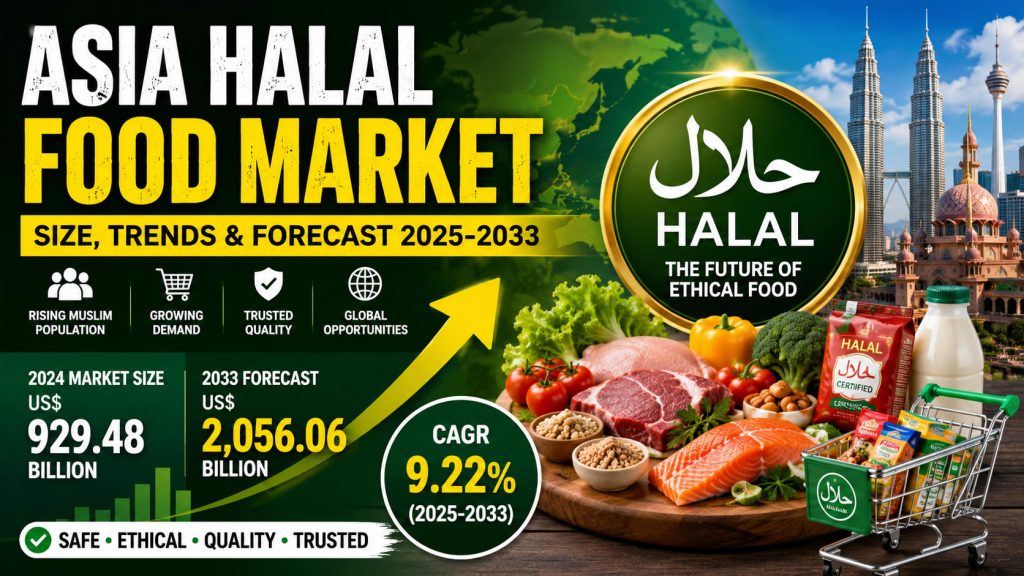
The Asia halal food market is entering a transformative growth phase, driven by demographic expansion, rising consumer awareness, and evolving global food preferences. According to Renub Research, the Asia halal food market is projected to grow from US$ 929.48 billion in 2024 to an impressive US$ 2,056.06 billion by 2033, expanding at a CAGR of 9.22% during 2025–2033.
The halal food sector, once viewed primarily as a niche religious market, has evolved into a global symbol of food safety, ethical sourcing, and premium quality. Across Asia, halal-certified products are now attracting not only Muslim consumers but also health-conscious non-Muslim buyers who associate halal certification with hygiene, transparency, and responsible food production.
Asia remains the heart of the global halal economy due to its enormous Muslim population and expanding middle class. Countries such as Indonesia, Malaysia, Pakistan, India, Bangladesh, and China are playing increasingly important roles in both halal food production and consumption. These nations are rapidly modernizing their supply chains, strengthening certification systems, and expanding exports to meet rising regional and international demand.
Why the Asia Halal Food Market Is Growing Rapidly
One of the strongest growth drivers behind the halal food industry is Asia’s large and expanding Muslim population. Indonesia alone is home to approximately 231 million Muslims, representing more than 13% of the global Muslim population. As Muslim communities continue to grow across Asia, demand for halal-certified meat, dairy products, packaged foods, snacks, and beverages is increasing significantly.
Mainstream retailers and supermarkets are responding aggressively to this demand. Dedicated halal food aisles are now common in many Asian hypermarkets, while restaurants and quick-service chains are introducing halal-certified menu options to attract a broader consumer base.
Urbanization is also reshaping buying behavior. Younger consumers living in cities increasingly rely on convenience foods, online grocery platforms, and ready-to-eat products. This has created new opportunities for halal-certified frozen foods, packaged meals, beverages, and health-focused nutrition products.
Digital transformation is another major catalyst for industry expansion. E-commerce platforms are making halal products more accessible than ever before. Consumers can now purchase certified halal foods directly through online marketplaces, mobile applications, and direct-to-consumer platforms. This digital accessibility is helping brands reach rural and underserved populations while strengthening consumer trust through transparent product labeling and certification details.
Halal Food Is Becoming Popular Beyond Muslim Consumers
An important trend shaping the future of the market is the growing interest among non-Muslim consumers. Increasingly, halal food is being recognized for its high standards of cleanliness, quality assurance, and ethical processing methods.
Many consumers now perceive halal-certified products as healthier and safer alternatives. Strict ingredient sourcing rules and humane animal treatment practices have contributed to this positive perception. In highly urbanized markets, especially among younger generations, food certifications and traceability have become major purchasing considerations.
This shift is encouraging halal food manufacturers to diversify their product offerings beyond traditional meat products. Companies are now investing in halal-certified confectionery, dairy products, nutraceuticals, snacks, cereals, grains, and convenience foods designed for modern lifestyles.
The broadening appeal of halal products is helping companies penetrate mainstream retail channels rather than relying solely on ethnic or religious specialty stores.
Regional Governments Are Supporting Halal Industry Development
Several Asian governments are actively supporting the halal food sector as part of broader economic development strategies. Malaysia and Indonesia, in particular, are positioning themselves as global halal hubs through investments in certification infrastructure, logistics, and international trade partnerships.
Regional cooperation and trade agreements are also playing an important role in market growth. Cross-border halal trade is becoming more efficient due to efforts aimed at harmonizing certification standards and simplifying export procedures.
The Association of Southeast Asian Nations (ASEAN) has become a major facilitator of halal trade across the region. Reduced trade barriers and growing collaboration among member nations are helping halal manufacturers expand internationally while lowering operational costs.
These initiatives are enabling Asia to strengthen its leadership position within the global halal supply chain.
India Emerging as a Key Halal Food Market
India’s halal food market is witnessing steady growth despite operational and regulatory complexities. A significant Muslim population, combined with rising awareness of halal-certified products, is supporting demand for halal meat, snacks, processed foods, and personal care items.
Urban retail outlets and online grocery platforms are increasingly offering halal-certified products to cater to changing consumer preferences. Additionally, many non-Muslim consumers in India are embracing halal products due to perceptions regarding food safety and cleanliness.
However, the market still faces challenges such as the absence of a centralized halal certification system and inconsistent awareness across rural regions. Political debates surrounding halal practices also occasionally impact industry sentiment.
Even with these obstacles, India remains one of the most promising long-term halal food markets because of its large population, rising disposable income, and expanding organized retail sector.
China’s Halal Food Industry Gains Momentum
China’s halal food market is also expanding rapidly, supported by domestic demand and export opportunities. Regions such as Ningxia, Xinjiang, and Gansu have become important halal production centers due to their sizable Muslim populations.
China’s Belt and Road Initiative has strengthened trade relationships with Muslim-majority countries, creating new export possibilities for Chinese halal products. Manufacturers are increasingly targeting international markets with halal-certified food offerings.
Despite this progress, China still faces challenges related to fragmented certification systems and consumer trust issues linked to past food safety concerns. A lack of national standardization continues to create inefficiencies within the industry.
Nevertheless, growing investments in halal infrastructure and increasing awareness among non-Muslim consumers are expected to support continued market expansion.
Pakistan Holds Significant Untapped Potential
Pakistan possesses enormous agricultural resources and one of the world’s largest Muslim populations, positioning the country as a potentially major player in the global halal food market.
The establishment of the Pakistan Halal Authority (PHA) in 2016 was intended to standardize certification systems and strengthen international trade opportunities. However, operational inefficiencies and limited infrastructure have slowed progress.
Pakistan still contributes only a modest share of global halal exports despite its production capabilities. Limited cold chain facilities, inconsistent quality control, and underdeveloped export logistics remain major barriers.
Experts believe that with stronger regulatory support, investment in food processing technology, and improved trade partnerships, Pakistan could emerge as a powerful halal export economy in the coming years.
Key Challenges Facing the Industry
Although the Asia halal food market is growing rapidly, several obstacles continue to hinder full-scale expansion.
High Certification Costs
Halal certification can be expensive, particularly for small and medium-sized enterprises (SMEs). Businesses often face high administrative costs related to inspections, audits, staff training, and ongoing compliance requirements.
For smaller companies with limited resources, these costs create barriers to market entry. As a result, large corporations frequently dominate the certified halal segment while many local producers remain excluded from formal distribution channels.
Supply Chain Transparency Concerns
Ensuring halal integrity throughout the supply chain remains another critical challenge. Modern food production involves multiple suppliers, imported ingredients, and international logistics networks, making traceability increasingly complex.
Cross-contamination risks and inconsistent ingredient verification can damage consumer trust. Without strong monitoring systems, maintaining end-to-end halal compliance becomes difficult.
To address these concerns, many companies are investing in blockchain tracking systems, digital traceability tools, and advanced quality monitoring technologies.
Distribution Channels Continue to Evolve
The way halal products reach consumers is also changing rapidly. Hypermarkets and supermarkets continue to dominate sales volumes, but online platforms are growing at a much faster pace.
E-commerce offers convenience, broader product selection, and direct access to certification information. Younger consumers, especially in urban areas, are increasingly relying on online grocery shopping for halal-certified foods.
Convenience stores and specialty retailers also remain important distribution channels, particularly in densely populated metropolitan regions.
This evolving retail environment is encouraging brands to invest heavily in digital marketing, direct-to-consumer strategies, and personalized shopping experiences.
Major Companies Operating in the Asia Halal Food Market
Several multinational and regional companies are competing aggressively within Asia’s expanding halal food sector. Key industry participants include:
Nestlé S.A.
JBS S.A.
BRF S.A.
Kawan Food Berhad
Cargill Inc.
Carrefour S.A.
Crescent Foods Inc.
VegaVites
American Halal Company Inc.
Al Islami Foods
These companies are investing heavily in product innovation, supply chain modernization, and international expansion strategies to capture growing consumer demand.
10 Recent Developments in the Asia Halal Food Industry
Nestlé expanded its halal-certified product portfolio across Southeast Asia.
BRF increased halal poultry exports to Asian markets.
Malaysia strengthened halal export partnerships with Middle Eastern countries.
Indonesia accelerated digital halal certification initiatives for SMEs.
Carrefour introduced dedicated halal product sections in selected Asian outlets.
Cargill invested in halal-compliant supply chain improvements.
Pakistan expanded halal meat export programs targeting Gulf nations.
Online grocery platforms across Asia added specialized halal food categories.
Chinese halal manufacturers increased participation in global halal trade expos.
Kawan Food Berhad expanded frozen halal convenience food offerings for urban consumers.
Future Outlook
The future of the Asia halal food market appears exceptionally strong. Rising consumer awareness, expanding Muslim populations, urbanization, digital retail growth, and increasing acceptance among non-Muslim consumers are all creating powerful long-term opportunities.
At the same time, governments and private companies are working to improve certification systems, supply chain transparency, and export competitiveness. Technological innovation is expected to further strengthen consumer trust while making halal verification more efficient and scalable.
As halal food evolves into a broader symbol of quality, safety, and ethical production, Asia is likely to remain the dominant force driving global market growth throughout the next decade.
Final Thoughts
The Asia halal food market is no longer limited to religious consumption patterns alone. It has become a fast-growing global industry shaped by changing consumer expectations, food safety awareness, and evolving retail ecosystems.
With the market forecast to exceed US$ 2 trillion by 2033, businesses that prioritize transparency, certification integrity, innovation, and digital accessibility are expected to emerge as long-term leaders.
For investors, manufacturers, retailers, and policymakers alike, the halal food sector represents one of the most promising opportunities within the global food industry today.