
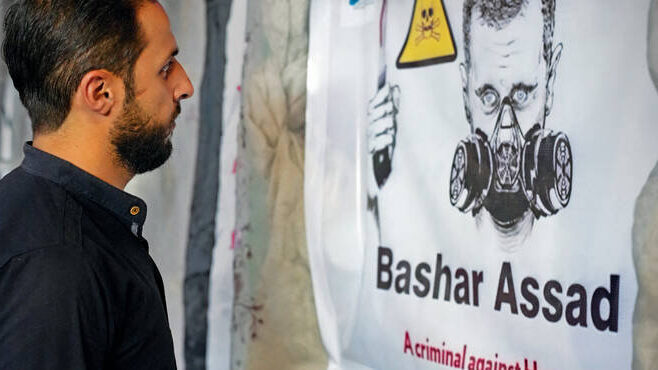
- OPCW inspectors say dozens of undeclared munitions from Assad’s clandestine program have been recovered
- Experts urge rapid destruction of chemical weapons and warn that more may remain buried or vulnerable to theft
LONDON: A cache of previously undeclared chemical weapons from the Assad era has been uncovered by the Organization for the Prohibition of Chemical Weapons’ technical secretariat and Syria’s interim authorities, exposing a potential security threat should other remaining stockpiles fall into the wrong hands.
The disclosure came in the OPCW’s May 26 monthly update on Syria, which outlined both the scale of the discovery and its potential consequences.
Inspectors found dozens of chemical munitions not previously declared to the organization, including aerial bombs matching those used in attacks on Hama’s Ltamenah in March 2017 and Khan Shaykhun in Aleppo in April 2017.
They also identified rockets of the same type used in the August 2013 attack on the Ghouta agricultural belt around Damascus.

Syrian authorities have arrested 18 suspects for alleged involvement in Assad’s chemical weapons program, including senior military, political and technical officials, Reuters reported, citing Mohamad Katoub, Syria’s permanent representative to the OPCW in The Hague.
“Despite the secrecy, the danger, and the immense security challenges … today we delivered for the Syrian people and for the world,” Katoub said. “It is the first time such munitions could be recovered before they were used in crimes against the Syrian people.”
OPCW Director-General Fernando Arias described the deployment’s outcome as “significant,” underscoring longstanding doubts about the completeness of Syria’s disclosures.
“It confirms the secretariat’s repeated assessment since 2014 that the former Syrian regime withheld information and unsuccessfully attempted to mislead the secretariat and the international community on the extent of its chemical weapons program,” Arias said in a May 27 statement.
Izumi Nakamitsu, the UN high representative for disarmament affairs, called the discovery “momentous,” not only for Syria but for international security and the global disarmament regime.
Addressing the UN Security Council on June 4, Nakamitsu stressed that the newly discovered weapons must now be formally declared and destroyed under OPCW verification, adding that further inspections of additional sites are needed.
Damascus has framed the discovery as evidence of a break with the past. The interim government’s representative to the UN, Ibrahim Olabi, hailed the discovery as a “decisive turning point” and a “major leap forward in delivering accountability.”
He also noted that his government had facilitated 32 OPCW inspection visits and handed over more than 60,000 pages of documents.
“Syria suffered from chemical weapons for more than 12 years,” he told the Security Council on June 4. “Today, it is committed to rid itself of its legacy.”
The newly uncovered cache is inseparable from the memory of Ghouta, the attack that came to define Assad’s chemical record.
In the early hours of Aug. 21, 2013, rockets filled with the nerve agent sarin struck opposition-held suburbs in Eastern and Western Ghouta, killing hundreds of civilians in what rights groups describe as the 21st century’s largest chemical weapons attack.
Human Rights Watch, as well as other investigators, later concluded that the delivery systems, trajectories and scale of the attack pointed to the involvement of Syrian government forces.
Assad’s government denied responsibility and blamed opposition groups but presented no supporting evidence, according to the New York-based monitor.
Some analysts say the latest revelations reflect a broader political shift since the fall of Assad’s government — one in which cooperation is driving progress.
Nanar Hawach, senior Syria analyst at the International Crisis Group, said “a decade of red lines, sanctions and strikes never forced these weapons into the open — a change of government did.
“What surfaced then is a successor in Damascus that treats cooperation on chemical weapons as currency for sanctions relief and reintegration,” Hawach told Arab News.
“The accountability the international community long demanded is advancing because it now serves Syrian interests, and not because outside enforcement finally worked.”
That political calculation sits atop a long, fraught history.
Syria acceded to the Chemical Weapons Convention in October 2013. While Damascus submitted an initial declaration, the OPCW found that it failed to fully disclose its program and “attempted — unsuccessfully — to mislead the international community about the overall scope and scale” of its chemical weapons activities.
Over the course of the civil war, which erupted in March 2011, the OPCW documented and independently confirmed the use of chemical weapons in Syria by former government forces and nonstate actors, including the militant group Daesh.
The Dec. 8, 2024, fall of the Assad regime, in a swift rebel offensive led by now-interim President Ahmad Al-Sharaa, opened new avenues for investigators on the ground.
The change enabled the OPCW technical secretariat to broaden efforts to uncover the full extent of Syria’s program and dismantle it in line with the convention.
That shift was soon reinforced by high-level engagement with the new authorities.
In February 2025, OPCW chief Arias visited Syria and met with its new leadership, who affirmed recognition of all OPCW mandates and reiterated Syria’s commitment to its obligations under the convention.
In early March 2025, Syria’s foreign minister, Asaad Al-Shaibani, visited the OPCW and addressed its executive council, again renewing the pledge.
“Syria is dedicated to this task through a strong commitment and will need the support of the international community, with the OPCW, to achieve it,” he said at the time.
Even as officials emphasize cooperation, the latest discovery has underscored the risks that remain.
Hawach highlighted the urgency of safely securing and destroying the newly uncovered stockpiles.
“These weapons stay dangerous as long as they are neither fully found nor destroyed,” he said.
That danger, he added, extends beyond the materials already recovered.
It includes “the material already recovered but still in storage, and the far larger amount buried at sites no one has reached, which could slip into the hands of a group like (Daesh), which has used such weapons before,” he said.
“How small the risk stays depends on the size of the efforts and speed of the search.”
Other experts warn that the problem is not only technical but also financial and criminal.
Randa Slim, who leads the Middle East program at the Washington-based Stimson Center think tank, said the uncovering of previously undeclared sites suggests that former Assad regime officials with links to the program may still have access to relevant materials or information.
“There is definitely an economic benefit to them to sell these materials to non-state actors — like Hezbollah or (Daesh),” she told Defense News on June 4.
The combination of military transition and incomplete information about the locations of chemical weapons materials, she said, could create a “proliferation risk” given the militant groups still operating in the region.
Indeed, Daesh used chemical weapons on several occasions during 14 years of civil war in Syria.
According to the Syrian Network for Human Rights, the group carried out five chemical weapons attacks in Syria between April 9, 2013, and Aug. 20, 2023, all in Aleppo Governorate, injuring at least 132 people.
An early-2024 OPCW Investigation and Identification Team report found that on Sept. 1, 2015, Daesh used sulfur mustard in the town of Marea in Aleppo.
Today, a Daesh resurgence remains plausible.
In early February, the UN Analytical Support and Sanctions Monitoring Team warned that Daesh “established networks across all Syrian governorates, embedding sleeper cells in urban centers, including Damascus.”
The group has reportedly exploited the security vacuum left by the US pullout and the handover of northeastern Syria to the new authorities.
Days after the US announced its withdrawal from Syria, Daesh spokesperson Abu Huzaifa Al-Ansari released an audio message urging members to target the new authorities in Damascus, Kurdistan24 reported on Feb. 22.
Observers say the US pullout removed a key pillar of on-the-ground intelligence, air support and coordination for local partners.
Meanwhile, the Kurdish-led Syrian Democratic Forces (SDF), Washington’s main ally against Daesh from 2013 until the group’s territorial defeat in 2019, are now in the process of integrating with the central government, raising fears that any breakdown could open space for Daesh to regroup.
Those fears deepened after a “mass escape” from Al-Hol camp in northeast Syria, which holds the wives and children of Daesh militants, was confirmed by Syrian authorities on Feb. 25, following the withdrawal of SDF guards in January.
The SDF cited “international indifference” to Daesh and “the failure of the international community to assume its responsibilities in addressing this serious matter.”
US intelligence agencies, according to The Wall Street Journal, reported that 15,000 to 20,000 people — including Daesh affiliates — are now at large in Syria after the escape.
For many Syrians, those numbers raise the stakes for containing the newly uncovered stockpiles.
If any remnants of Assad’s chemical weapons program fall into the wrong hands, the painful memories of attacks during the 14-year civil war could yet be repeated.
