

Revenue,
2025
USD 32.60 Bn

Forecast Year,
2035
USD 176.87 Bn


What is the Open Banking Systems Market Size in 2026?
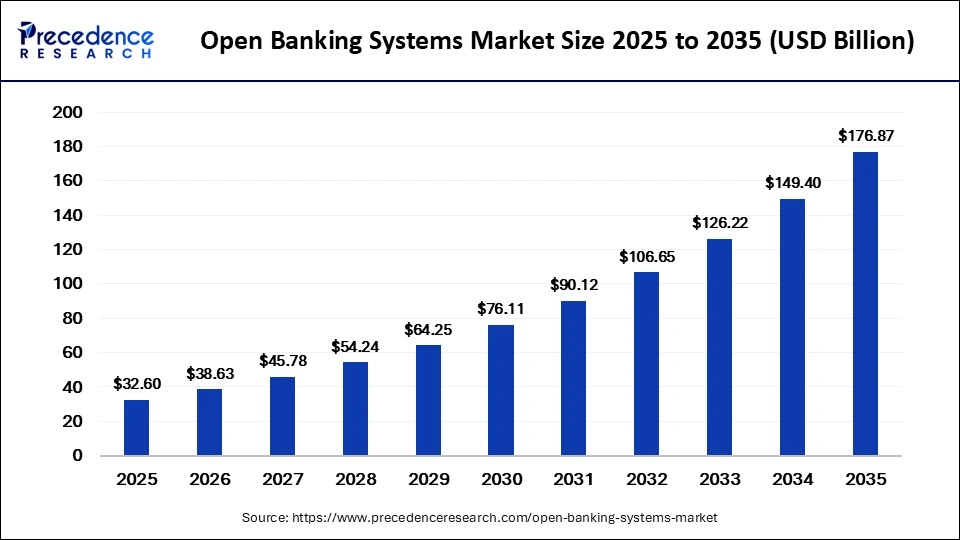
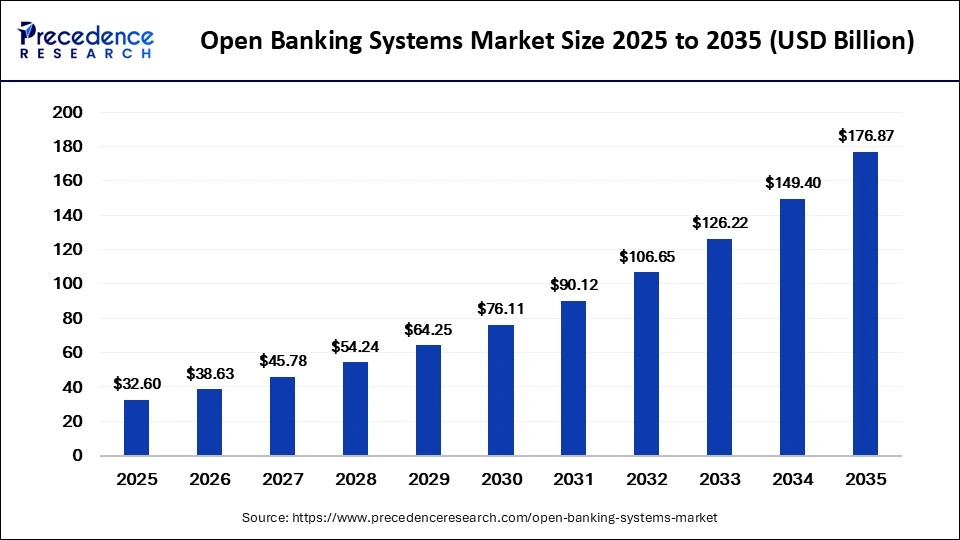
The global open banking systems market size was calculated at USD 32.60 billion in 2025 and is predicted to increase from USD 38.63 billion in 2026 to approximately USD 176.87 billion by 2035, expanding at a CAGR of 18.40% from 2026 to 2035. The market is rapidly growing due to the government’s critical regulation for open banking adoption and demand for personalized financial services with strict regulations of data security.
Key Takeaways
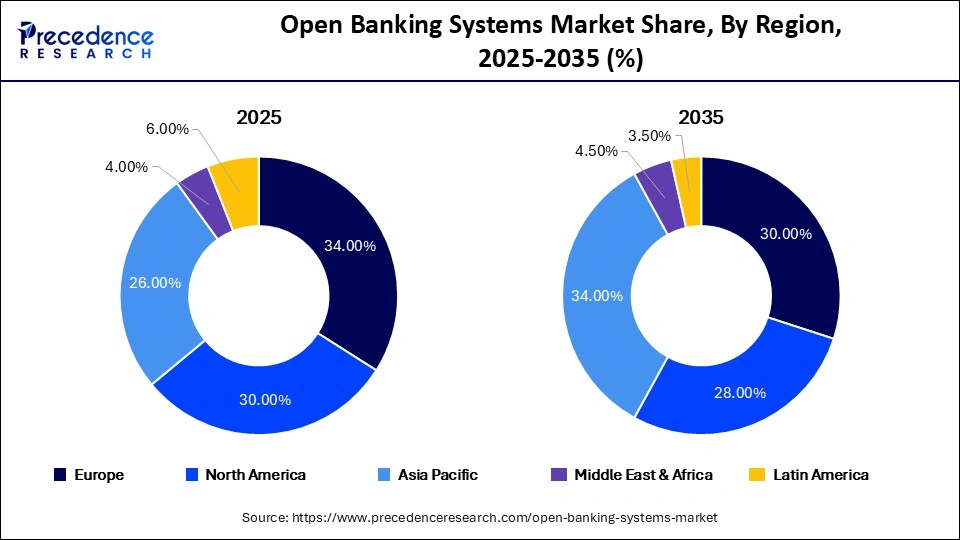
- Europe held the largest open banking systems market share of 34% in 2025.
- Asia-Pacific is expected to grow at the fastest CAGR of 24% during the foreseeable period.
- By solution type, the payments and transactions segment held the largest market share of 28% in 2025 and is expected to sustain its dominance with a CAGR of 20.5% during the forecast period.
- By solution type, the API management segment held the second-largest market share of 24% in 2025.
- By deployment mode, the cloud-based segment held the largest market share of 62% in 2025 and is expected to grow at the fastest CAGR of 22% in the coming years.
- By deployment mode, the on-premise segment held the second-largest open banking systems market share of 24% in 2025.
- By financial service, the banking and capital markets segment held the largest market share of 32% in 2025.
- By financial service, the payments segment held the second-largest market share of 24% in 2025 and is expected to grow at a CAGR of 22.5% during the foreseeable period.
- By end use, the retail banking segment held the largest market share of 38% in 2025.
- By end use, the corporate banking segment held the second-largest market share of 24% in 2025 and is projected to grow at a CAGR of 15.5% during the foreseeable period.
What is the Open Banking Systems Market?
Open banking is an emerging yet highly secure system by using banks to share customer financial data with third-party providers through APIs. The process is strictly done under the consent of the related customer. This process enables seamless transfer of money from one account to another, and the use of innovative financial management tools are used effectively.
The market growth is attributed to the increasing demand for embedded finance, where banking and payment features will be easily available for e-commerce and other digital platforms to accelerate transaction volumes. Also, stringent government regulations like the Payment Services Directive and PSD2 need a traditional banking system to securely open their data, compelling industry-wide modernization.
Open Banking Systems Market Trends
- The rapid integration of artificial intelligence and Agentic assistants is transforming the market. It allows the creation of agentic banking assistants that can smartly handle and automatically analyze spending, optimize savings, and easily offer customized loan and investment products.
- Open finance expands the secure API framework to include investments, insurance, and pensions that offer a unified view to consumers of their whole portfolio.
- Open banking is overpowering traditional card networks and embracing real-time account-to-account transfers. It allows consumers to perform direct and frictionless payments online, which reduces transaction fees for merchants and buyers.
- Many banks are offering premium APIs like advanced identity verification and real-time credit scoring as commercial products for fintech developers to convert API compliance into revenue sources.
Market Scope
| Report Coverage | Details |
| Market Size in 2025 | USD 32.60 Billion |
| Market Size in 2026 | USD 38.63 Billion |
| Market Size by 2035 | USD 176.87 Billion |
| Market Growth Rate from 2026 to 2035 | CAGR of 18.40% |
| Dominating Region | Europe |
| Fastest Growing Region | Asia Pacific |
| Base Year | 2025 |
| Forecast Period | 2026 to 2035 |
| Segments Covered | Solution Type, Deployment Mode, Financial Service, End-use, and Region |
| Regions Covered | North America, Europe, Asia-Pacific, Latin America, and Middle East & Africa |
Market Dynamics
Drivers
Rapid Digitalization of Banking Systems
The open banking systems market is majorly driven by the increasing consumers’ demand for digitalization and a strong regulatory push towards frameworks like PSD2 or account aggregators that enforce traditional banks to share customer data with high security protocols. Modern consumers need seamless digital experiences and expect real-time transactions, automated savings, and budgeting tools to pull data into a single interface from multiple banks.
Restraint
Misuse of Financial Data
Despite having many driving factors, the market is witnessing some barriers to grow further, including potential data breaches and possible misuse of sensitive financial data, which grows suspicion around open banking systems. Widespread data breaches and identity theft make mass adoption harder. Many users are not aware of the process of an open banking system and how third parties manage or store their sensitive financial data, leading to reluctance in adopting an open banking system by many consumers.
Opportunity
Embedded Finance
The market is observing a robust opportunity due to the increasing embedded finance and predictive banking backed by AI systems. Open banking enables retailers and non-financial platforms to integrate financial services, such as instant payment or small-term loans, directly into their checkout processes, which support new revenue streams. Traditional banks are increasingly partnering with fintech startups to modernize offerings and monetize their data securely.
Segmental Insights
Solution Type Insights
Open Banking Systems Market Share, By Solution Type, 2025-2035 (%)
| Solution Type | 2025 | 2035 | CAGR (%) |
| API Management | 24.00% | 22.00% | 16.00% |
| Payments & Transactions | 28.00% | 30.00% | 20.50% |
| Digital Banking Platforms | 18.00% | 20.00% | 19.00% |
| Data Analytics & Personal Finance Management | 12.00% | 13.00% | 18.50% |
| Identity & Fraud Management | 10.00% | 9.00% | 17.20% |
| Lending & Credit Solutions | 8.00% | 6.00% | 15.50% |
The Payments and Transactions Segment Held the Largest Market Share of 24% in 2025
The payments and transactions segment generated approximately USD 9.13 billion in 2025 and is projected to reach nearly USD 53.06 billion by 2035, growing at the fastest CAGR of 20.5% during the forecast period. The payments and transaction segment held a dominant revenue share of 28% in the open banking systems market in 2025. The segment is largely driven by the increasing demand for seamless payment ecosystems and the use of digital wallets and mobile banking transactions.
The API management segment accounted for approximately USD 7.82 billion in 2025 and is projected to reach nearly USD 38.91 billion by 2035, growing at a CAGR of 16% during the forecast period. The API management segment held the second-largest market share of 24% in 2025, driven by the growing demand for secure banking API integration, interoperability needs across financial institutions, and the rapid collaboration of fintech and traditional banks.
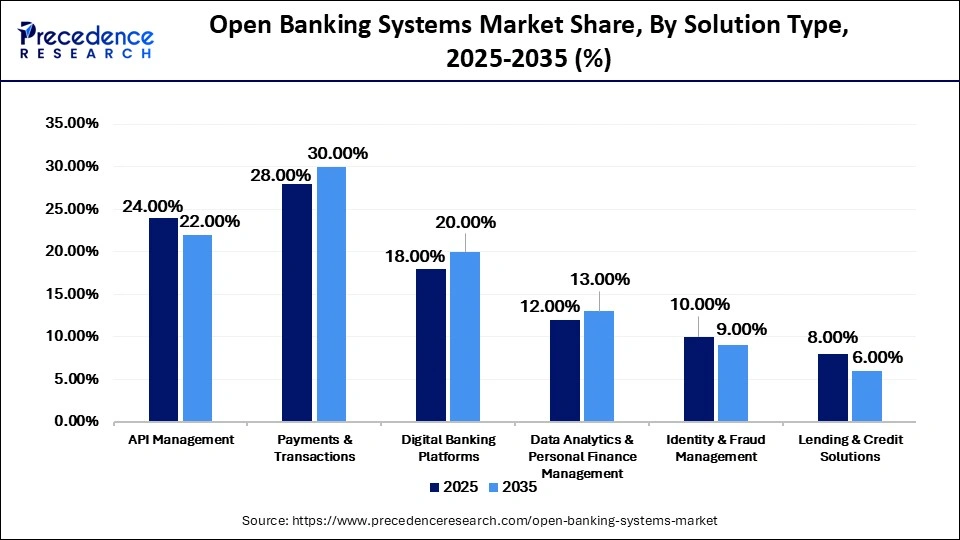
The digital banking platforms segment generated approximately USD 5.87 billion in 2025 and is projected to reach nearly USD 35.37 billion by 2035, growing at a CAGR of 19% during the forecast period. The digital banking platforms segment held the market share of 18% in 2025. The segment is growing due to the rapid use of omnichannel banking and the adoption of cloud-native banking systems.
The data analytics & personal finance management segment accounted for approximately USD 3.91 billion in 2025 and is projected to reach nearly USD 23.00 billion by 2035, growing at a CAGR of 18.5% during the forecast period. The data analytics and personal finance management segment held the market share of 12% in 2025. The segment is expanding due to the increasing use of predictive analytics in the finance sector and the adoption of personalized banking services.
Deployment Mode Insights
The Cloud-based Segment Held the Largest Market Share of 62% in 2025
The cloud-based segment generated approximately USD 20.21 billion in 2025 and is projected to reach nearly USD 127.35 billion by 2035, growing at the highest CAGR of 22% during the forecast period. The cloud-based segment dominated the open banking systems market with the highest market share of 62% in 2025, as cloud-based systems offer high scalability and flexibility for digital banking infrastructure, with growing adoption of AI and analytics in banking systems. Cloud-based deployment provides seamless real-time data accessibility.
Open Banking Systems Market Share, By Deployment Mode, 2025-2035 (%)
| Deployment Mode | 2025 | 2035 | CAGR (%) |
| Cloud-based | 62.00% | 72.00% | 22.00% |
| On-premise | 24.00% | 14.00% | 7.00% |
| Hybrid | 14.00% | 14.00% | 15.00% |
The on-premise segment accounted for approximately USD 7.82 billion in 2025 and is projected to reach nearly USD 24.76 billion by 2035, growing at a CAGR of 7% during the forecast period. The on-premise segment held the second-largest market share of 24% in 2025. The segment is driven by strict regulations for data-sensitive sectors like finance. Banking institutions are rapidly embracing the on-premises deployment to comply with strict data regulations.
The hybrid segment generated approximately USD 4.56 billion in 2025 and is projected to reach nearly USD 24.76 billion by 2035, growing at a CAGR of 15% during the forecast period. The hybrid segment held the market share of 14% in 2025. The segment is expanding due to the increasing need for improved operational resilience and flexible deployment strategies with higher safety and scalability at the same time.
Financial Service Insights
Open Banking Systems Market Share, By Financial Service, 2025-2035 (%)
| Financial Service | 2025 | 2035 | CAGR (%) |
| Banking & Capital Markets | 32.00% | 28.00% | 15.50% |
| Payments | 24.00% | 28.00% | 22.50% |
| Digital Wallets | 14.00% | 16.00% | 23.00% |
| Personal Finance Management | 12.00% | 12.00% | 17.50% |
| Insurance | 10.00% | 9.00% | 14.00% |
| Lending Platforms | 8.00% | 7.00% | 16.50% |
The Banking and Capital Markets Segment Held the Largest Market Share of 32% in 2025
The banking & capital markets segment generated approximately USD 10.43 billion in 2025 and is projected to reach nearly USD 49.52 billion by 2035, growing at a CAGR of 15.5% during the forecast period. The banking and capital markets segment dominated the open banking systems market with the highest share of 32% in 2025, due to the increasing digital transformation initiatives among leading banks, along with API-based banking innovation. The growing demand for personalized banking experiences is another driving factor of the segment’s growth.
The payments segment accounted for approximately USD 7.82 billion in 2025 and is projected to reach nearly USD 49.52 billion by 2035, growing at a CAGR of 22.5% during the forecast period. The payments segment held the second-largest market share of 24% in 2025. The segment is growing due to the increasing adoption of open banking payment APIs and embedded finance solutions. The rapid adoption of the instant payment ecosystem further fuels market growth.
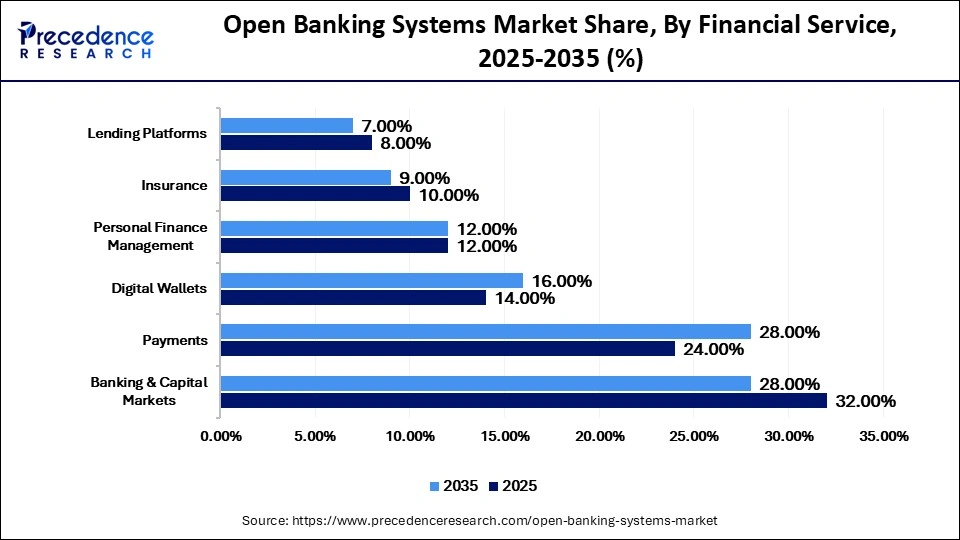
The digital wallets segment generated approximately USD 4.56 billion in 2025 and is projected to reach nearly USD 28.30 billion by 2035, growing at a CAGR of 23% during the forecast period. The digital wallets segment held the market share of 14% in 2025. The segment is growing due to the increasing adoption of contactless payment and QR code transactions.
The personal finance management segment accounted for approximately USD 3.91 billion in 2025 and is projected to reach nearly USD 21.22 billion by 2035, growing at a CAGR of 17.5% during the forecast period. The personal finance management segment held the market share of 12% in 2025. The segment is growing due to the increasing adoption of integrated AI-powered financial insights that translate into account aggregation services.
End-Use Insights
The Retail Banking Segment Held the Largest Market Share of 38% in 2025
The retail banking segment generated approximately USD 12.39 billion in 2025 and is projected to reach nearly USD 70.75 billion by 2035, growing at a CAGR of 20% during the forecast period. The retail banking segment dominated the open banking systems market with the highest market share of 38% in 2025, due to the increasing demand for mobile banking and online digital banking services. The significant adoption of open API integration for improving consumer experiences further supports the segment’s dominance.
The corporate banking segment accounted for approximately USD 7.82 billion in 2025 and is projected to reach nearly USD 38.91 billion by 2035, growing at a CAGR of 15.5% during the forecast period. The corporate banking segment held the second-largest market share of 24% in 2025. The segment is expanding due to the growing demand for real-time treasury and management of massive cash flow.
Open Banking Systems Market Share, By End-use, 2025-2035 (%)
| End-Use | 2025 | 2035 | CAGR (%) |
| Retail Banking | 38.00% | 40.00% | 20.00% |
| Corporate Banking | 24.00% | 22.00% | 15.50% |
| Investment Banking | 12.00% | 10.00% | 12.50% |
| Financial Institutions | 18.00% | 20.00% | 19.00% |
| Government & Regulatory Bodies | 8.00% | 8.00% | 13.50% |
The investment banking segment generated approximately USD 3.91 billion in 2025 and is projected to reach nearly USD 17.69 billion by 2035, growing at a CAGR of 12.5% during the forecast period. The investment banking segment held the market share of 12% in 2025. The segment growth is attributed to the increasing automation in capital market operations and demand for data-driven investment analytics.
The financial institutions segment accounted for approximately USD 5.87 billion in 2025 and is projected to reach nearly USD 35.37 billion by 2035, growing at a CAGR of 19% during the forecast period. The financial institutions segment held the market share of 18% in 2025. The segment is expanding due to the initiatives that focus on digital financial inclusion and the need for transparent and prompt financial ecosystems.
Regional Insights
Europe Open Banking Systems Market Size and Growth 2026 to 2035
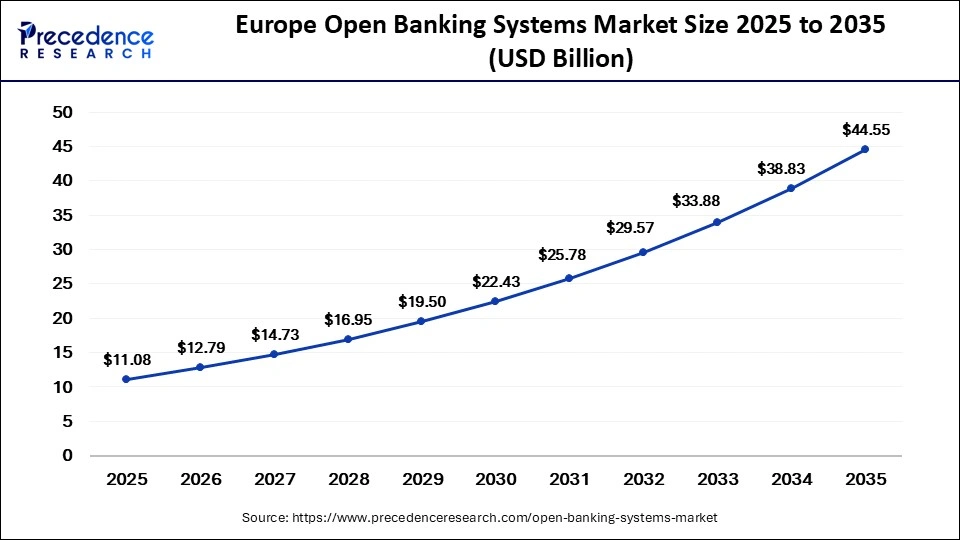
The Europe open banking systems market size was exhibited at USD 11.08 billion in 2025 and is projected to be worth around USD 44.55 billion by 2035, growing at a CAGR of 15.50% from 2026 to 2035.
Which Factors Drive the Open Banking Systems Market in Europe?
Europe held a major market share of 34% in 2025 due to the combination of factors like increased collaboration between banks and fintech companies, adoption of API-based banking systems, and a strong push for compliance with regulatory frameworks like PSD2.
Europe has already set the global benchmark with the revised payment services directive and legally compelled banks to open their datasets to authorized third-party providers. This step has further evolved into more refined frameworks like FIDA and PSD3, supported the market dominance globally.
Germany Market Analysis
Germany is at the forefront of the adoption of regulatory frameworks like PSD2 for open banking systems, which is a major reason that supports market dominance. Germany comprehensively implemented the need of regulatory frameworks more than many peers and established a stable and highly regulated environment that has bolstered early trust and data-sharing.
How is Asia-Pacific Growing in the Open Banking Systems Market?
Asia-Pacific held 26% of the market share in 2025 and is expected to experience the fastest growth with a CAGR of 24% during the predicted timeframe, due to increasing initiatives for digitalization across all banking processes in emerging countries of the Asia-Pacific, growing smartphone usage, and government support for open finance systems. Due to the huge unbanked population presence in the region, many emerging economies use open banking as a tool to extend credit and basic financial services, fueled further by smartphone penetration and a massive digital-native youth demographic.
China Market Analysis
China’s leadership stemmed from an expansion of mobile banking and payments, massive tech ecosystem development, and government-backed digital infrastructure. Tech giants like Alipay and WeChat integrated financial services like AI-powered lending and wealth management into daily routine that have further developed rapid expansion of open-ecology platforms in China.
Will North America Grow in the Open Banking Systems Market?
North America has significantly grown due to the rapid expansion of fintech innovation and embedded finance, growing demand for real-time payments, digital banking, and AI-powered analytics. The region hosts industry-leading API enablement and aggregation platforms. Providers like Plaid, which connect over 1200 financial institutions, have supported the market expansion.
U.S. Market Analysis
The U.S. market is significantly growing due to the rapid fintech innovation, huge consumer adoption, and market-driven financial ecosystem rather than top-down government mandates. The U.S. is a leading hub for the foundational API and cloud-native financial data providers like Plaid and Finicity. The companies have pioneered robust data-sharing methods that allow millions of users to link their existing bank accounts to third-party applications securely.
How is the Opportunistic Rise of the Middle East & Africa in the Market?
The Middle East & Africa (MEA) is expected to grow at a lucrative CAGR of 16% in the open banking systems market throughout the forecast period. This is mainly due to the increasing banking digitization initiatives in GCC countries, which are modernizing traditional banking systems and promoting cashless transactions. This transformation is further supported by the rapid adoption of fintech solutions and mobile payment platforms, enabling faster, more secure, and more accessible financial services for consumers and businesses.
UAE Market Trends
The UAE is a major contributor to the Middle East & Africa open banking systems market due to its strong regulatory push for financial innovation, rapid banking digitization, and early adoption of fintech ecosystems. The country’s advanced digital infrastructure, high smartphone penetration, and growing collaboration between traditional banks and fintech companies are further accelerating open banking adoption.
What Factors Influence the Latin America Open Banking Systems Market?
The market in Latin America is expected to grow at a CAGR of 14.2% in the upcoming period, influenced by the growing digital banking and fintech ecosystem, which is enabling greater innovation and competition in financial services. This expansion is being supported by the increasing adoption of instant payment systems, which are improving transaction speed, transparency, and convenience for both consumers and businesses. Additionally, rising consumer demand for more accessible, personalized, and inclusive financial services is encouraging banks and fintech companies to adopt open banking frameworks.
Brazil Market Trends
Brazil is leading the Latin American open banking systems market due to its strong regulatory framework promoting financial innovation and one of the most advanced fintech ecosystems in the region. The country’s widespread adoption of instant payment systems like PIX, along with high digital banking penetration and strong consumer demand for seamless financial services, is further accelerating open banking adoption.
Competitive Landscape
The open banking systems market is moderately consolidated, with a mix of global financial institutions, fintech companies, API platform providers, and cloud service vendors competing to build secure and scalable data-sharing ecosystems. Key players are focusing on strategies such as API-driven banking solutions, strategic partnerships between banks and fintech firms, and the expansion of digital payment and account aggregation services to strengthen their market position. Companies are also investing heavily in cybersecurity, regulatory compliance frameworks, and customer-centric digital platforms to enhance trust and ensure seamless financial data integration.
In the future, key players must focus on strengthening interoperability across banking ecosystems and expanding standardized API frameworks to enable smoother cross-border and multi-bank data connectivity. Additionally, companies must prioritize financial inclusion, expansion into emerging markets, and collaboration with regulators to shape favorable open banking policies, which are essential for sustaining long-term competitive advantage.
Open Banking Systems Market Companies
- Plaid Inc
- Tink AB
- Yodlee Inc.
- Finicity
- Salt Edge
- TrueLayer
- Token.io
- Mastercard Open Banking
- Visa Open Banking
- Finastra
- Mambu
- Temenos AG
- Oracle Financial Services
- IBM Corporation
- Accenture plc
Recent Developments
- In March 2026, a leading global provider of payments and financial technology solutions, Fiserv, Inc., introduced AgentOS. It is an operating system designed to help financial institutions deploy, manage, and scale AI agents across their banking workflows.(Source: Https://investors.fiserv.com)
- In December 2025, Regulated Open Banking went live in New Zealand to enable faster loan approvals, easier bill management, and personalized budgeting insights. Open Banking in New Zealand is supported by a set of regulations established under the Customer and Product Data Act 2025.(Source: https://www.openbankingexpo.com)
Segments Covered in the Report
By Solution Type
- API Management
- Payments and Transactions
- Digital Banking Platforms
- Data Analytics and Personal Finance Management
- Identity and Fraud Management
- Lending and Credit Solutions
By Deployment Mode
- Cloud-based
- On premises
- Hybrid
By Financial Service
- Banking and Capital Markets
- Payments
- Digital Wallets
- Personal Finance Management
- Insurance
- Lending Platforms
By End-use
- Retail Banking
- Corporate Banking
- Investment Banking
- Financial Institutions
- Government and Regulatory Bodies
By Region
- North America
- Latin America
- Europe
- Asia-pacific
- Middle and East Africa