
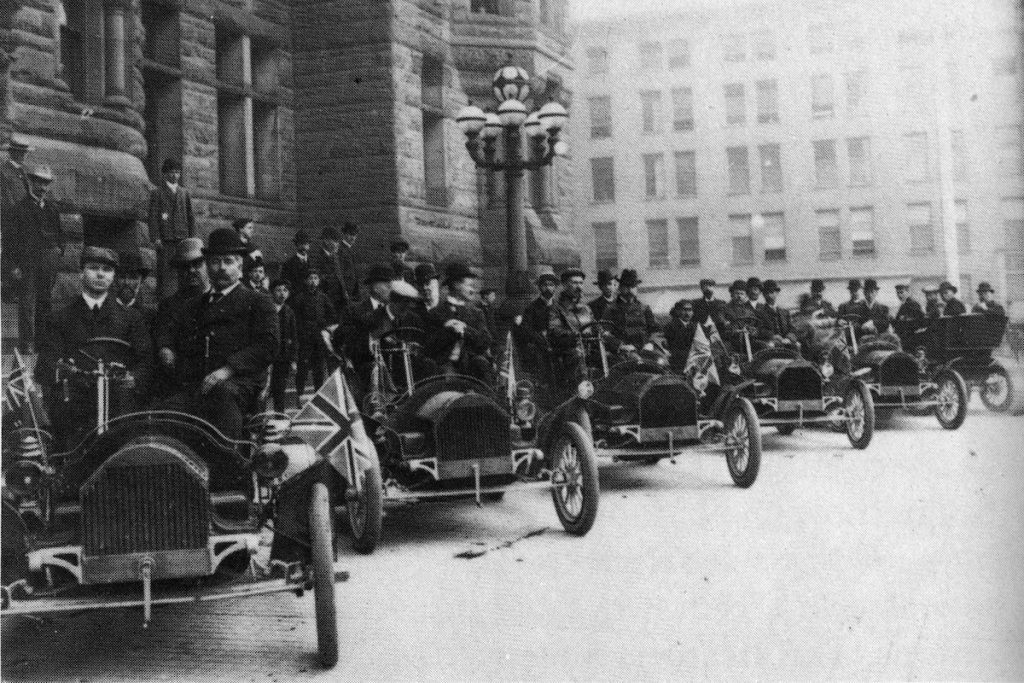
The first public display of Russell Model As in front of Toronto City Hall in 1905. Tommy Russell sits in the driver’s seat of the left-most car.Supplied
Dumaresq de Pencier is curator of exhibits for the Canadian Automotive Museum in Oshawa, Ont.
Canada produces around 1.3 million vehicles a year, made by the likes of Toyota, Honda, General Motors, Stellantis and Ford. However, none are produced by a Canadian company using entirely domestic parts.
There have been a great many Canadian vehicles throughout history. Car buffs will point to the acrylic-skinned Bricklin (1974-1976); the high-performance Manic (1969-1971); the determined struggle of Dominion (1931-1933) and later Studebaker (1963-1966) to survive despite the failure of their U.S. parent plants; or even the low-speed ZENN (2006-2010) and eccentric three-wheeled ElectraMeccanica electrics (2018-2023).
But long before these, there was an all-Canadian automobile designed and built by one of Canada’s least-remembered manufacturers, Toronto’s Russell Motor Car Company.
Canada Cycle & Motor Co. (CCM) was founded in September 1899 at the tail-end of the late 19th-century Canadian obsession with the safety bicycle. The “safety” – a diamond-framed, chain-driven and brake-equipped machine – was the direct ancestor of the modern bicycle, and its popularity took the British Empire by storm.
A conglomeration of five bicycle firms, CCM briefly controlled 85 per cent of all bike production in the country. As the “cycle craze” died down and bicycling became a normal part of life, the company turned to other revenue streams, including motor vehicles. CCM assembled Locomobile steam cars in Hamilton and manufactured gas-powered quadricycles under the Massey-Harris brand for the Toronto Post Office, among others. These, along with the Ivanhoe electric car introduced in 1902, made CCM the only company in Canadian history to manufacture and sell gas, electric and steam vehicles.
None did particularly well on the market.
CCM was failing. It had grown too large, too quickly, and the board’s questionable business decisions were attracting negative publicity and lawsuits. The company brought on 25-year-old Tommy Russell, known for his work boosting the Canadian Manufacturer’s Association, as the new general manager in 1902. Russell moved quickly, consolidating all of CCM’s production under one roof in Toronto, and dramatically downsizing the company’s vast and unwieldy international distribution network. By 1903, CCM was turning a profit again, and Russell focused on the growing market for gasoline cars.
Workers building Russell chassis at the Toronto area factory in 1907.Supplied
After the failure of the 1913 Russell-Knights, Russell worked to restore its image. A lavish two-page ad spread in the Sept. 1, 1914 edition of the Toronto World.Supplied
The first Russell car, the Model A, went on sale in 1905 and was an immediate success. Powered by a water-cooled 14-horsepower, two-cylinder engine and running on high, wagon-style wheels, its steel-reinforced ashwood frame was sturdy and flexible enough to take the battering inflicted by Canada’s notoriously terrible roads.
Though not particularly revolutionary, the Model A was Canadian-made with mostly Canadian parts. Its combination of good reliability and relatively low price – $1,300, at a time when the average Canadian industrial worker might earn $375 a year – made it a hot seller. There were less expensive vehicles on the market, such as the Oldsmobile, produced in St. Catharines, Ont., and retailing for around $800, but the Russell was dramatically larger, more comfortable and more powerful. Marketed as the “Thoroughly Canadian Car,” it sold across the British Empire to rave reviews.
Over the next several years, the Russell brand grew by leaps and bounds. Governor-General Earl Grey drove one in the Northwest Territories as part of his 1906 cross-Canada tour. In a publicity stunt in January 1907, a light touring car was raced across the frozen surface of Toronto Harbour on Lake Ontario against the Queen City Yacht Club iceboat It, winning by a hair. To extol its virtues, CCM held auto shows across the country, showcasing both its passenger cars and Russell delivery trucks that became a common sight on the streets of Toronto.
A Russell touring car races It, an iceboat owned and piloted by Queen City Yacht Club Rear-Commodore Fred Phelan, in the early spring of 1907. Contemporary reports called it “the most unique racing event ever pulled off in Canada.”Supplied
In 1910, Tommy Russell pulled off a coup for his growing automotive empire by acquiring the exclusive Canadian rights to the advanced Knight sleeve-valve engine, a quiet and reliable design considered one of the best on the market. The resulting Russell-Knights were the first Knight-engined cars built in North America, though the company imported its engines from England. In the spring of 1911, the company reorganized as the Russell Motor Car Company, while the CCM brand was retained as a branch organization focusing on bicycles and skating gear.
In late 1912, Russell was at the height of its success, announcing a new line of Model 28 cars with cutting-edge features such as electric starters and lights. More importantly, the 28s would feature Canadian-made engines. But the rush to switch over the Toronto factory to build the new design marked the first step on the road to Russell’s undoing. Initial production was painfully slow despite high demand, and the Canadian-built Knight engines proved to be chronically unreliable, prone to catastrophic valve failures. As sales collapsed, the company teetered on the verge of bankruptcy.
By 1914, a desperate engineering campaign to fix the problems with Canadian-built engines had largely succeeded. Famously, a locally built Knight engine ran for 300 hours in a lab at the University of Toronto without suffering any major mechanical faults. The company was down, but not out. However, plans to launch a new line of lower-cost vehicles for 1915 were swept aside by the outbreak of the First World War.
Tommy Russell was hurriedly recruited by the Ministry of Defence to procure motor transport for the Canadian Army. As a result, his company’s factories were increasingly converted to the production of wartime equipment. By 1915, the company made plans to discontinue the recovering but still shaky Russell brand.
Willys-Knight of Toledo, Ohio, was making inroads into the Canadian market while producing Knight-engined cars. In early 1916, CCM sold its automobile factory to the U.S. concern, ending the Russell car’s tumultuous yet deeply Canadian story. Exact production figures are unknown, but the company likely built around 3,500 vehicles between 1905 and 1916.
Tommy Russell continued to work for CCM, eventually becoming president of Massey-Harris in 1930. He passed away in 1940, remembered for his “serene and smiling front when the clouds lowered blackest.”
CCM endured as an equipment manufacturer until its bankruptcy in 1983. However, the brand survived; Canadian Tire holds the rights to the CCM name for bicycles, outdoor gear and sporting goods, while CCM’s hockey division continues independently as a global equipment giant.
Around 30 original Russells survive in collections worldwide. This includes a recently restored 1915 touring car at the Canadian Automotive Museum in Oshawa, Ont., which was once owned by Tommy Russell’s granddaughter, Patricia Russell.
It reminds us of an era when a Canadian car company proudly proclaimed its vehicles were “Built up to a Standard – Not down to a Price.”
The restored Russell-Knight belonging to Patricia Russell, in the collection of the Canadian Automotive Museum.Supplied