
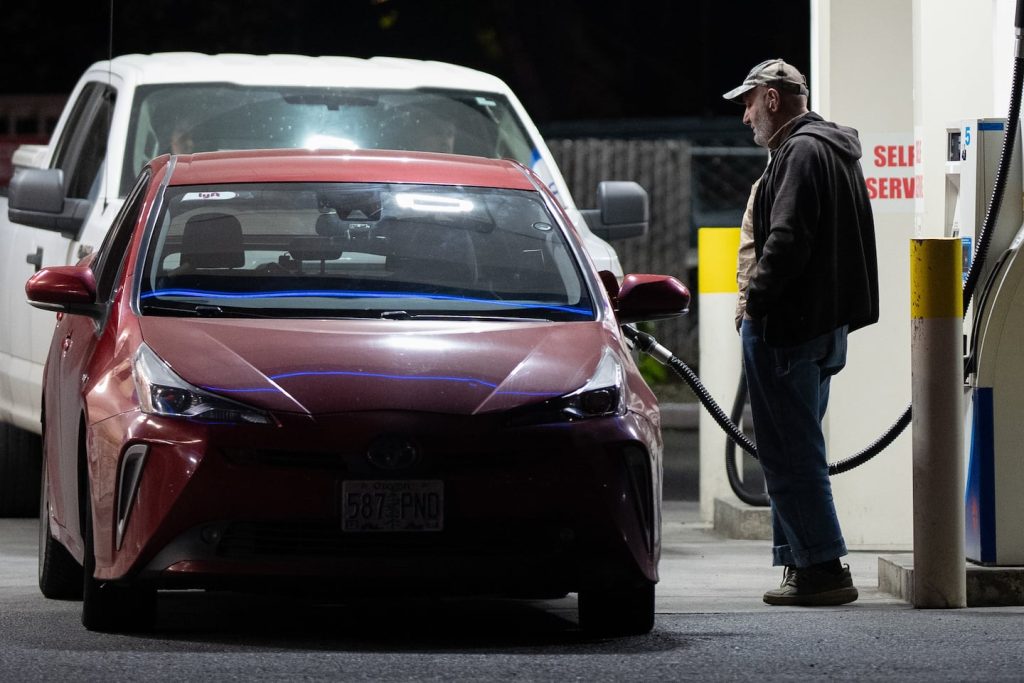
Taking a gas-powered road trip will be much more expensive this Memorial Day weekend than it has been for the past few years, since the US-Israeli war with Iran has sent fuel prices soaring.
The nationwide average price for regular unleaded gasoline climbed to $4.533 per gallon on Tuesday, up $1.353 (about 43 percent) from a year prior, according to the American Automobile Association. Meanwhile, the risk of further hostilities still looms large, and shipping traffic through the Strait of Hormuz remains largely frozen.
Compared to the national average, prices across New England are a few cents cheaper per gallon ($4.485 in New Hampshire, $4.489 in Rhode Island, $4.497 in Massachusetts, $4.516 in Maine, $4.564 in Vermont, and $4.643 in Connecticut), according to AAA data.
Ben Reynolds, a senior policy analyst at the New Hampshire Fiscal Policy Institute, said the elevated cost of fuel is creating “real financial pressure” for many households that are already strained by rising costs for other essentials.
Reynolds said travel demand appears to be “somewhat inelastic,” meaning people don’t necessarily cut back on their driving just because fuel costs rise. But that varies by income, with wealthier families generally better equipped to absorb higher fuel costs without skipping their weekend road trip or otherwise curtailing their daily driving habits.
A new study authored by Reynolds, which the institute published Tuesday morning, shows the higher gas prices are particularly challenging for those with lower incomes, longer commutes, less-fuel-efficient vehicles, or fewer transportation options, including people living in rural areas where driving is a necessity.
Reynolds noted the ramifications of elevated gas prices might not be limited to the near-term financial pressures.
“These higher fuel costs could also create longer-term challenges for maintaining and improving New Hampshire’s roads and bridges,” he said.
Reynolds was referring to New Hampshire’s Motor Fuel Tax, which has generated between $170 million and $189 million per year for the past decade, providing a major source of revenue for the state’s highway fund. That tax — currently 23.75 cents per gallon, the lowest rate in New England — is based on the volume of fuel sold, not the price, so if higher prices prompt consumers to buy less gas, that could take a bite out of the state’s revenues.
While leaders in some other Republican-led states, including Indiana and Georgia, have temporarily suspended their state gas taxes to reduce the pain people are feeling at the pump, Governor Kelly Ayotte said in a statement Monday she’s not planning to do likewise in New Hampshire.
“I’m always concerned about the affordability of energy for Granite Staters,” she said, “and I will continue looking for ways to reduce energy costs for families.”
A parallel debate is unfolding in Congress, where Republicans are reportedly split after President Trump endorsed suspending the federal gas tax, which is 18.4 cents per gallon.
President Biden had similarly urged Congress to suspend the federal gas tax in 2022 after Russia’s full-scale invasion of Ukraine. His push was unsuccessful. The national average price for unleaded regular gas surpassed $5 per gallon that summer for the first time ever.
A version of this story appears in Globe NH | Morning Report, a free email newsletter focused on New Hampshire, including great coverage from the Boston Globe and links to interesting articles elsewhere. Sign up here.
Steven Porter can be reached at steven.porter@globe.com. Follow him @reporterporter.