
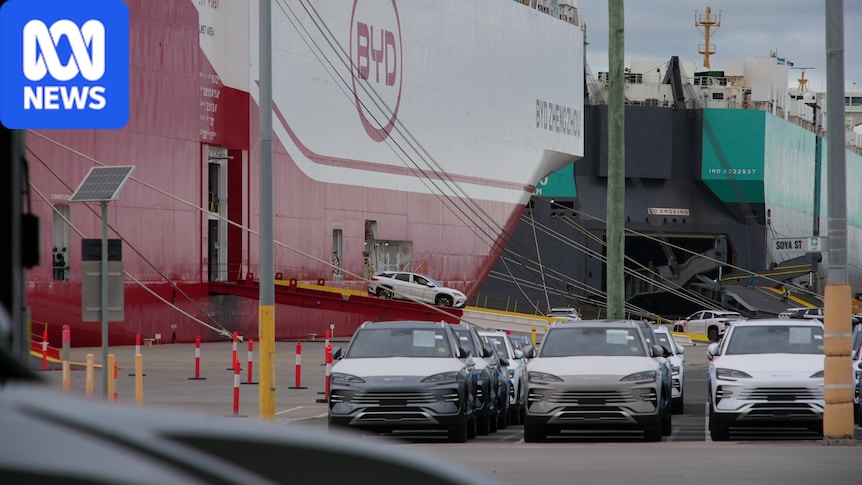
In June, China sounded an ominous warning to its global rivals on, of all places, the Melbourne docks.
Decked out in shiny red and white livery, an impressive-looking, purpose-built LNG-powered bulk carrier pulled into the Port of Melbourne on its first voyage to Australia.
On board the BYD Zhengzhou was a cargo of 5,000 newly built electric vehicles.
The largest-ever single EV shipment to Australia illustrated a changing of the guard in the automobile industry, here and globally.
Australia acts as something of an international auto industry litmus test.
With no domestic industry since its demise a decade ago and little in the way of trade barriers, Australia has become a valuable gauge of consumer taste for an industry in the midst of its greatest upheaval in more than a century.
The BYD Zhengzhou, seen here in 2025, sends a message to the auto industry. (Facebook: BYD Malaysia)
The shipment came after a period of lingering pandemic-era disruptions that left frustrated customers waiting more than a year for new cars.
Momentum for EVs was building, with Tesla in the driver’s seat, but Australians had remained sceptical about the design and build quality of Chinese-made automobiles.
That’s no longer the case.
In the space of just a year, BYD, the Chinese automobile giant, has quickly narrowed the sales gap with leader Toyota, and is on the cusp of becoming the country’s most popular vehicle brand.
“I’m driving one right now,” says Riz Akhtar, the founder of research group carloop, mid-journey from Bendigo to Melbourne.
“It costs around $40,000. It’s quiet, it’s comfortable, drives well and is loaded with technology.”
The equivalent Japanese- or European-built vehicle would be more than 25 per cent more expensive, he says.
“Consumers aren’t stupid. They’re not going to spend money they don’t need to.“
From green warriors to cost worries
In the decades following World War II, Australians drove locally made American cars.
General Motors, Ford and Chrysler dominated the field, with high-end European vehicles holding the luxury end.
And then Japanese cars, led by Toyota, captured the Australian passenger car market.
Toyota and Mazda still stand tall over the Australian motoring landscape when measured by total sales.
But their positions are crumbling, with both losing ground as Chinese EVs — cheap and loaded with technology — bound ahead.
Spurred on by the onset of a once-in-a-generation fuel crisis, there is now a sudden widespread consumer acceptance of battery-powered vehicles, here and elsewhere.
But the world’s automobile establishment has been caught napping.
Japan, Europe and especially America have dabbled with the new technology, mistakenly believing they could slowly transition towards an electric future.
In America’s case, it has reversed course back to its gas-guzzling past, a decision that threatens to undermine its long-term future.
A quick look at the most recent Australian sales figures illustrates the undeniable trend.
In the first half of this year, sales for every major Japanese auto manufacturer bar Honda sank.
Mazda shed 17 per cent compared with the same period last year, Toyota was down 21 per cent, Subaru and Mitsubishi dropped 25 per cent each, and Nissan was off 32 per cent.
Each of the Chinese suppliers, meanwhile, notched up spectacular gains.
All were off a much smaller base, which exaggerates the percentage gain. But there’s no denying the trend.
BYDs from the consignment of 5,000 delivered to Melbourne. (ABC News: Lachlan Bennett)
BYD sales jumped 124 per cent, Chery leapt 77 per cent, and Geely soared 495 per cent.
The dramatic decline in Japanese vehicle domination has been coupled with a sudden shift away from fossil fuel-powered cars.
Last month, almost a quarter of all cars sold in Australia were fully electric. A year ago, it was just 7 per cent. Add in hybrids, and EVs are now neck and neck with petrol- and diesel-fuelled automobiles.
According to Pitcher Partners’ Steve Bragg, the Iran war has helped shift the dial.
“Five years ago, most people who wanted to drive an EV were doing it for environmental reasons,” he says.
“Now it’s financial reasons.”
Japan, South Korea and Europe roll over
The global auto industry is suddenly in a panic.
Toyota vice-chairman Koji Sato has called for greater cooperation between Japanese producers in a desperate bid to streamline production and lower costs.
“Unless things change, we will not survive,” he told an annual supplier meeting in March.
But it’s too little too late, according to Akhtar, especially in Australia.
“They have no product in the pipeline,” he says.
Most Japanese manufacturers, he explains, are scrambling to deliver EVs, but most of the new models are underpinned by Chinese manufacturers and components and, in some cases, are simply rebadged Chinese-made cars.
“Japan had the lead on EVs,” he says.
“The very first EV I drove was a Mitsubishi i-MiEV back in 2010, but they lost that lead because they were too busy propping up their internal combustion engine cars, hybrids and hydrogen-fuelled models.”
In Europe, meanwhile, Volkswagen chief Oliver Blume has foreshadowed staff lay-offs of up to 100,000 workers after years of turmoil which has seen VW drop the ball on technology.
VW’s share price has halved since his predecessor was brutally axed four years ago as it strains under the weight of Donald Trump’s tariffs and China’s rapid march to auto industry dominance.
That’s prompted asset sales and massive new investments in China, with VW determined to produce cars for the hotly contested Chinese market.
China’s EV dominance is no accident.
Loading…
It forged a strategic policy as far back as 2000, poured cash and financial incentives into the project in 2009 and encouraged battery firms such as BYD and others to shift into automobiles.
Driving the initiative was a desire to reduce China’s reliance on imported oil, which made it captive to foreign powers, and reduce pollution.
It simultaneously embarked on a strategy of dominating the refining and production of almost all industrial metals.
In addition to steel, China dominates minerals crucial to battery production, such as lithium, cobalt, manganese and graphite. And it churns out almost all the world’s anode and cathode production.
South Korea once went head to head with China on batteries but concentrated on the more expensive nickel-magnesium-cobalt option while China opted for the cheaper lithium-iron-phosphate version.
China won.
Loading…
It now accounts for 90 per cent of the world’s battery production, giving Chinese auto producers a competitive edge.
But like many of its programs, China’s EV strategy has been almost too successful. It now produces far more cars than it can consume, which has tightened profit margins at home and forced producers to shift into export markets aggressively.
Tariffs bring the Detroit Three undone
The opening line read: “Well, this is awkward.”
The review on specialist website MotorTrend was for a spanking new American-built EV, a van from Detroit Big Three stalwart Chevrolet, which appeared late last year.
The magazine delivered thumbs up all round for the machine.
There was just one problem.
According to a New York Times investigation into the demise of American-built EVs under the Trump administration, in the fortnight between the time the marketing team had dropped the van off for review and its publication, the BrightDrop had been binned.
Major manufacturers that scrapped EV projects have taken a bath. “2026e” denotes BloombergNEF’s forecast for this year. (BloombergNEF)
It wasn’t the only one.
In the past two years, Ford, Buick, Dodge, Jeep, Honda, Nissan and Acura have scrapped a series of US-built SUVs, pick-ups and passenger cars. Volvo junked an entire all-electric line-up.
The Trump government’s removal of Biden-era tax credits and tailpipe emissions standards are the root cause. Almost all have retreated to thirsty ICE pick-ups and SUVs.
The losses were staggering. The write-downs on the scrapped projects cost the Detroit Three close to $US50 billion.
And while the Trump administration’s tariffs have built a protective wall around the US auto industry, helping juice margins and boosting profits, they’ve cordoned off the rapidly evolving electric revolution and stifled domestic innovation.
“America is now sandwiched since both Mexico and Canada have relaxed tariffs and are importing Chinese-made EVs,” Akhtar says.
That’s made cars on either side of the border significantly cheaper than in the US.
In the mid-’60s, American auto manufacturers accounted for about 95 per cent of all cars sold around the world. By 2015, that had shrunk to less than half as Japan ate into market share.
All indications are that EV production and demand have suddenly reached a global tipping point, as witnessed in Australia.
But America has all but abandoned them, now building less than 5 per cent of global EVs, while China accounts for more than 75 per cent.
Given the pioneering role that Elon Musk’s Tesla played in building high-end EVs, the shift has been nothing short of remarkable.
Tesla still holds an exalted place in the world of electric cars. But the technological edge that stood it apart from the competition is narrowing, while the cost of buying one has widened considerably.
Loading