
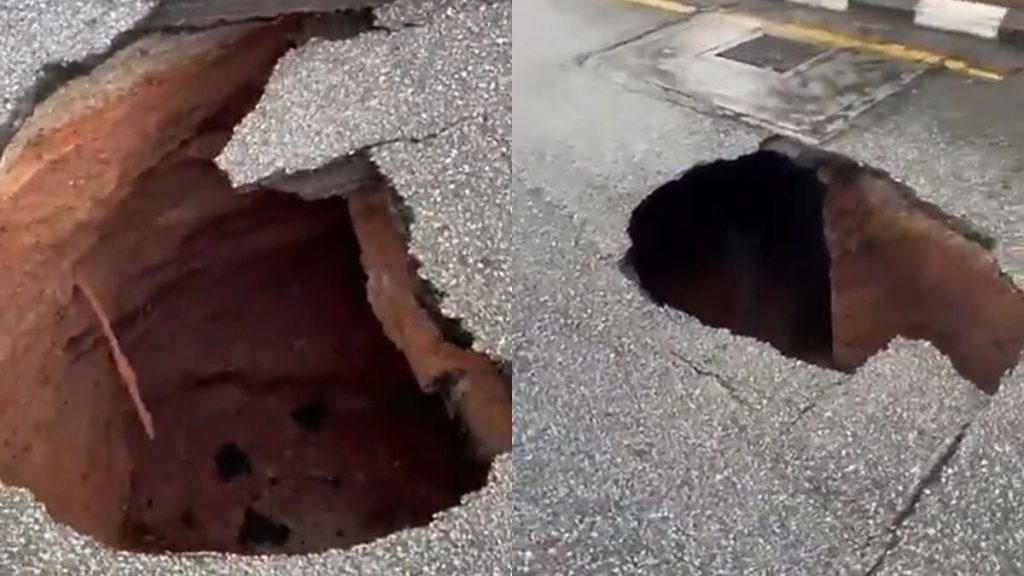
A sinkhole that appeared along Jalan Wangsa Delima 4 in the Wangsa Maju area of Kuala Lumpur was likely caused by damage to a drainage structure linked to underground utility maintenance works rather than land subsidence, city authorities said on 12 May 2026.
Kuala Lumpur Mayor Datuk Seri Fadlun Mak Ujud said investigations were ongoing to determine the exact cause of the incident, while the affected area would remain closed for two weeks to allow repair and assessment works to be carried out.
Speaking at a press conference at Menara Dewan Bandaraya Kuala Lumpur (DBKL), Fadlun said preliminary inspections found that a sump wall or water-retention structure within a 1.5-metre-diameter main drainage system had likely collapsed.
“We found that the sump wall had broken, and we could not locate where the collapsed wall had gone,” he said.
He added that underground utility works using the Horizontal Directional Drilling (HDD) method may have struck the structure without any visible signs on the surface.
“There is a possibility that the work hit the wall, causing it to break and allowing drainage water to flow directly into the soil, which then caused the sinkhole,” he said.
According to Fadlun, the affected section currently measures about four metres in length, four metres in width and four metres in depth.
The mayor said DBKL was conducting detailed investigations together with all utility providers involved to identify the precise cause of the incident.
Authorities rule out broader land subsidence issue
Fadlun said the incident was not believed to be linked to wider land subsidence problems but was instead associated with damage to the drainage system.
“When the wall broke, drainage water flowed directly into the ground and created a cavity,” he said.
He added that DBKL had established a special task force to address sinkholes and potholes across the capital.
“In many pothole cases, they are caused by broken sewer pipes or drainage systems, which leave underground cavities,” he said.
“When the surrounding ground collapses, it can result in either small or large potholes.”
Fadlun said temporary road closures would continue to be implemented at pothole locations before inspections were conducted to determine whether leaking pipes or other utility failures were involved prior to permanent reinforcement works.
The press conference was also attended by Minister in the Prime Minister’s Department (Federal Territories) Hannah Yeoh and Federal Territories Department director-general Datuk Muhammad Azmi Mohd Zain.
Additional sinkhole detected in city centre
Separately, Fadlun said another small sinkhole had been detected near a bank along a pedestrian walkway on Jalan Tun Perak on Monday.
He said the incident involved only a shallow hole measuring about one foot in depth and was not linked to utility-related issues.
Utility mapping work near completion
Meanwhile, Fadlun said utility mapping works in the Jalan Masjid India area were nearly 90 per cent complete, covering a 32-kilometre alignment.
He said repair works on pedestrian walkways in the area were expected to begin in October.
DBKL also plans to install settlement markers at several locations to monitor ground movement in real time.
“If there is any ground movement, we will receive real-time readings so immediate action can be taken in the Masjid India area, from Semua House to Masjid India,” he said.
Fadlun added that DBKL was still awaiting a report from the Malaysian Public Works Institute (IKRAM) regarding the number of settlement markers to be installed.
He said similar technology would also be used at 1,120 slope areas across Kuala Lumpur to monitor any ground movement.