
Published on
July 9, 2026

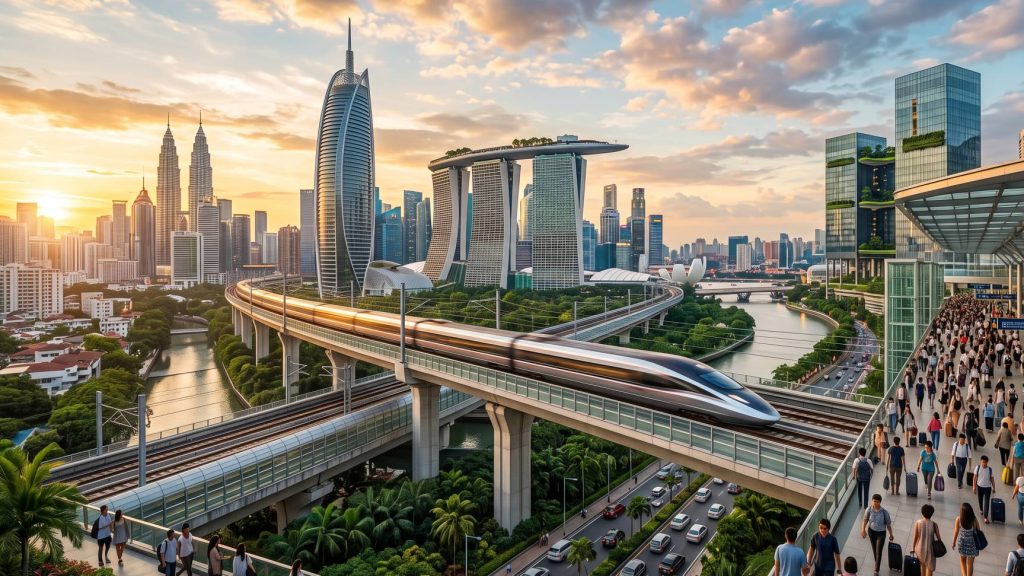
Image generated with Ai
Southeast Asia is moving into a new era of railway development as countries accelerate plans to create faster, smarter and more connected high-speed rail networks. Major cities including Kuala Lumpur, Singapore, Bangkok and Ho Chi Minh City are becoming central points in a regional transport transformation designed to improve tourism, trade, business mobility and economic growth. Governments across the region are no longer viewing railways as simple passenger services. They are developing them as strategic infrastructure corridors that can connect economies, strengthen regional cooperation and create seamless travel experiences. The expansion of high-speed rail is reshaping how people and businesses move across Southeast Asia.
The region’s railway ambitions are being driven by several major priorities. Governments want to reduce pressure on roads, improve sustainable transport options and create stronger links between urban centres. High-speed rail is also becoming an important tool for tourism growth because it allows travellers to explore multiple destinations more efficiently.
From Malaysia’s proposed Kuala Lumpur–Singapore High-Speed Rail vision to Vietnam’s ambitious North–South High-Speed Railway and Thailand’s connection towards China, Southeast Asia is building a future where cities are increasingly connected through advanced railway technology.
Official transport authorities across the region have highlighted rail connectivity as a long-term economic priority. Singapore’s Ministry of Transport continues to expand its rail network strategy, while Malaysia, Thailand and Vietnam are developing large-scale projects aimed at improving national and international mobility.
Advertisement
Advertisement
The result is a regional railway landscape that could eventually link major economic hubs across mainland and maritime Southeast Asia.
Kuala Lumpur And Singapore Push Forward With A New Cross-Border Rail Future
The relationship between Kuala Lumpur and Singapore remains one of the most important elements in Southeast Asia’s future rail development. The two neighbouring economic centres have long explored the potential of high-speed rail connectivity to transform travel between Malaysia and Singapore.
The proposed Kuala Lumpur–Singapore High-Speed Rail (HSR) remains one of the region’s most ambitious transport concepts. The planned project was designed to create a dedicated high-speed connection between Malaysia’s capital and Singapore, dramatically reducing travel time between the two cities.
The original proposal included a railway corridor of approximately 335 kilometres. It was designed to connect Kuala Lumpur with Singapore in around 90 minutes. The planned Malaysian stations included Bandar Malaysia, Sepang-Putrajaya, Seremban, Ayer Keroh, Muar, Batu Pahat and Iskandar Puteri, while Singapore’s terminal was planned at Jurong East.
Advertisement
Advertisement
The Malaysian Ministry of Transport has identified high-speed rail as a strategic infrastructure opportunity capable of strengthening economic links between the two countries. The project has experienced changes in direction, including previous suspension and review periods, but the concept continues to represent a major connectivity ambition.
Beyond the high-speed rail vision, Malaysia and Singapore are already advancing another major cross-border railway project. The Johor Bahru–Singapore Rapid Transit System (RTS) Link is designed to improve daily movement between Malaysia’s Johor Bahru and Singapore.
The RTS Link will connect Bukit Chagar in Johor Bahru with Woodlands North in Singapore. Although it is not a high-speed rail service, it represents a major step towards stronger cross-border railway integration.
The project covers around four kilometres and is designed to handle up to 10,000 passengers per hour in each direction. The system will also include integrated border procedures, allowing passengers to complete immigration checks before boarding.
Singapore’s Ministry of Transport has continued expanding its domestic rail infrastructure as part of a broader strategy to increase rail usage. The city-state plans to expand its rail network to approximately 360 kilometres by the early 2030s.
This approach shows how Singapore is preparing for a future where rail becomes the backbone of urban and regional mobility.
Bangkok Positions Thailand As A Gateway Between ASEAN And China
Bangkok is emerging as one of the most important railway gateways in mainland Southeast Asia. Thailand is developing high-speed rail links designed to connect the country with neighbouring nations and strengthen its position as a regional transport hub.
The Thailand–China High-Speed Railway is the country’s flagship railway project. It aims to connect Bangkok with Nong Khai near the Laos border, creating a major transport corridor between Thailand, Laos and China.
The project forms part of a wider regional vision where railway networks can support passenger travel, tourism expansion and international trade.
Thailand’s government has continued cooperation with China on railway development and technical planning. The country’s transport authorities have highlighted the importance of connecting Thailand’s rail network with wider regional corridors.
The Bangkok–Nong Khai railway is expected to improve connections between Thailand’s capital and northeastern provinces while creating stronger links towards Laos and China.
The importance of this corridor extends beyond Thailand’s borders. Once connected with the Laos–China Railway, the route could become part of a wider mainland Southeast Asian railway chain.
The Laos–China Railway has already changed regional connectivity by creating a direct rail connection between China and Laos. The railway connects Boten on the Chinese border with Vientiane, Laos’ capital.
The railway covers approximately 422 kilometres and operates with speeds of up to 160 kilometres per hour. While it is not classified as a high-speed railway by global standards, it represents a significant regional infrastructure achievement.
For tourism, the railway has created new opportunities by making travel between China and Laos easier. It has also strengthened Laos’ role as a transit country between China and ASEAN markets.
Thailand’s long-term railway strategy shows how individual national projects are gradually becoming part of a larger regional network.
Ho Chi Minh City Becomes Central To Vietnam’s High-Speed Rail Revolution
Ho Chi Minh City is at the centre of Vietnam’s biggest railway transformation. The country is planning one of the most ambitious transport projects in Southeast Asia through its North–South High-Speed Railway.
The proposed railway will connect Hanoi in northern Vietnam with Ho Chi Minh City in the south. The project is designed to create a national high-speed transport backbone that can transform movement across the country.
The planned railway would stretch approximately 1,541 kilometres. It is designed for speeds of up to 350 kilometres per hour and would include 23 passenger stations and five freight stations.
Vietnam’s government has identified the railway as a national strategic priority. The project aims to modernise the country’s transport system, strengthen economic connections and improve mobility between major population centres.
Today, travel between Hanoi and Ho Chi Minh City relies heavily on aviation and existing railway services. The future high-speed railway could significantly reduce journey times and provide a new alternative for millions of passengers.
For tourism, the project could create new opportunities by making it easier for international visitors to combine multiple Vietnamese destinations within one journey.
Travellers could potentially move between cultural attractions in Hanoi, coastal destinations in central Vietnam and economic centres around Ho Chi Minh City through a faster and more efficient transport network.
The railway also reflects Vietnam’s broader ambition to improve sustainable transport and support future economic growth.
Although detailed construction updates for 2026 remain limited in official information available, the project continues to represent one of Asia’s largest planned railway developments.
The North–South High-Speed Railway demonstrates how Southeast Asian countries are using infrastructure investment to prepare for future travel demand.
Advertisement
Advertisement
