
Published on
June 13, 2026

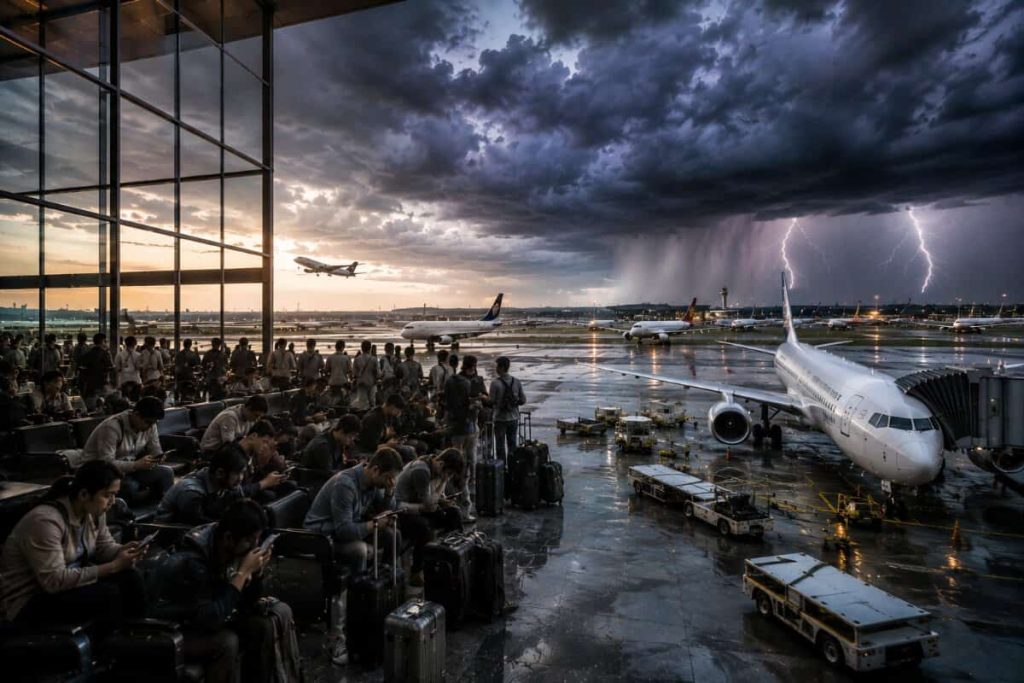
Image generated with Ai
Air travel disruption spread across key Asian and Latin American aviation corridors as China Eastern, Shanghai Airlines, Air China, Batik Air, Garuda Indonesia and Flybondi recorded a combined 96 cancelled flights and 607 delays, creating pressure on major airports in China, Indonesia and Argentina while also affecting connecting passengers moving through wider regional travel markets.
A Major Flight Disruption Wave Hits Six Airlines
A fresh wave of flight cancellations and delays has hit several major carriers, with China Eastern, Shanghai Airlines, Air China, Batik Air, Garuda Indonesia and Flybondi together posting 96 cancelled flights and 607 delayed services. The combined figure shows a heavy operational strain across domestic and regional networks, especially in China, Indonesia and Argentina.
China Eastern and Air China recorded the highest cancellation numbers, with 20 cancelled flights each. Batik Air followed closely with 19 cancellations. Shanghai Airlines reported 17 cancellations. Garuda Indonesia and Flybondi each recorded 10 cancelled flights.
The delay picture was even more serious. China Eastern faced 320 delays, making it the most affected airline by delayed operations. Air China followed with 196 delays. Shanghai Airlines recorded 40 delays. Batik Air reported 27 delays, Garuda Indonesia 22, and Flybondi 2.
Advertisement
Advertisement
Together, these figures created 703 total disrupted flight operations across the six carriers.
China Eastern Faces Heavy Pressure With 20 Cancellations and 320 Delays
China Eastern emerged as the most heavily delayed carrier in the dataset. The airline recorded 20 cancellations and 320 delays, meaning it alone accounted for more than half of all reported delays among the six airlines.
Advertisement
Advertisement
Its cancelled flights affected several Chinese airports. These included Chongqing Jiangbei International Airport, Beijing Daxing International Airport, Changsha Huanghua International Airport, Harbin Taiping International Airport, Shenzhen Bao’an International Airport, Kunming Changshui International Airport, Nanchang Changbei International Airport, Qingdao Jiaodong International Airport, Nanjing Lukou International Airport, Shanghai Hongqiao International Airport, Beijing Capital International Airport, Guangzhou Baiyun International Airport, Taiyuan Wusu Airport, Ningbo Lishe International Airport, Lancang Jingmai Airport, Jieyang Chaoshan International Airport and Hefei Xinqiao Airport.
The cancellations touched important routes such as Chongqing to Taiyuan, Beijing Daxing to Nanchang, Changsha to Ningbo, Harbin to Beijing Daxing, Shenzhen to Beijing Daxing, Kunming to Lancang, Qingdao to Nanchang, Nanjing to Chongqing and Shanghai Hongqiao to Guangzhou.
Advertisement
Advertisement
This shows that the disruption was not limited to one city. It spread across several major Chinese aviation points.
Air China Records Equal Cancellations and Major Delays
Air China also reported 20 cancellations, matching China Eastern in cancellation volume. It also recorded 196 delays, making it the second most disrupted airline by delay count.
Affected Air China routes included Hami to Beijing Capital, Beijing Capital to Shanghai Hongqiao, Chengdu Shuangliu to Guangzhou Baiyun, Wuhan Tianhe to Huizhou Pingtan, Hangzhou Xiaoshan to Guangzhou Baiyun, Shanghai Hongqiao to Beijing Capital, Beijing Daxing to Penglai, Beijing Capital to Nanning Wuxu, Guangzhou Baiyun to Chengdu Shuangliu, Chongqing Jiangbei to Guangzhou Baiyun, Chengdu Tianfu to Korla and Beijing Daxing to Yiwu.
Major affected airports included Beijing Capital, Beijing Daxing, Shanghai Hongqiao, Guangzhou Baiyun, Chengdu Shuangliu, Chengdu Tianfu, Wuhan Tianhe, Hangzhou Xiaoshan, Chongqing Jiangbei, Nanning Wuxu, Hami, Korla, Huizhou, Penglai and Yiwu.
Advertisement
Advertisement
The scale of Air China’s delays shows a wider network pressure. When a major airline faces 196 delays, passengers often face missed connections, long waiting times, aircraft rotation problems and schedule uncertainty across the day.
Shanghai Airlines Adds 17 Cancellations and 40 Delays
Shanghai Airlines reported 17 cancellations and 40 delays. Its disruption centred strongly around Shanghai Pudong and Shanghai Hongqiao, but several other Chinese cities were also affected.
The cancelled routes included Zhengzhou to Wenzhou, Guiyang to Shanghai Pudong, Shanghai Hongqiao to Shenzhen, Shanghai Pudong to Jieyang Chaoshan, Shenzhen to Shanghai Hongqiao, Jieyang Chaoshan to Shanghai Pudong, Shanghai Hongqiao to Wuhan, Xi’an to Shanghai Hongqiao, Wenzhou to Chongqing, Wenzhou to Shanghai Pudong, Wuhan to Shanghai Hongqiao, Shanghai Pudong to Wenzhou, Chongqing to Wenzhou, Shanghai Hongqiao to Kunming, Shanghai Pudong to Shenyang and Shanghai Pudong to Zhangjiang Wuchuan.
The affected airport list included Shanghai Pudong, Shanghai Hongqiao, Zhengzhou Xinzheng, Wenzhou, Guiyang Longdongbao, Shenzhen Bao’an, Jieyang Chaoshan, Wuhan Tianhe, Xi’an Xianyang, Chongqing Jiangbei, Kunming Changshui, Shenyang Taoxian and Zhangjiang Wuchuan.
This pattern highlights the pressure on Shanghai’s dual-airport system. Any disruption around Pudong or Hongqiao can quickly affect both business and leisure travellers.
Batik Air Disruption Hits Indonesia’s Domestic Network
Batik Air recorded 19 cancellations and 27 delays. The disruption affected several important Indonesian airports and domestic travel routes.
Advertisement
Advertisement
Affected airports included Sultan Mahmud Badaruddin II in Palembang, Halim Perdanakusuma in Jakarta, Sultan Syarif Qasim II in Pekanbaru, Jakarta Soekarno-Hatta, Hang Nadim in Batam, Juanda International Airport in Surabaya, Kuala Namu International Airport near Medan, Sultan Hasanuddin International Airport in Makassar and Adisumarmo International Airport near Solo.
Key cancelled routes included Palembang to Halim Perdanakusuma, Pekanbaru to Jakarta Soekarno-Hatta, Jakarta Soekarno-Hatta to Batam, Surabaya to Halim Perdanakusuma, Medan to Jakarta, Jakarta to Surabaya, Jakarta to Makassar, Jakarta to Pekanbaru, Makassar to Jakarta and Jakarta to Solo.
The impact was serious because Indonesia’s aviation system depends heavily on domestic flights. Many routes connect island economies, business centres, family travel markets and tourism gateways. Cancellations in Indonesia can quickly create long rebooking queues because road or rail alternatives are not always practical between islands.
Garuda Indonesia Reports 10 Cancellations and 22 Delays
Garuda Indonesia recorded 10 cancellations and 22 delays. The airline’s affected operations included services touching Jakarta Soekarno-Hatta, Sultan Hasanuddin in Makassar, Ahmad Yani International Airport in Semarang, Minangkabau International Airport in Padang, Juanda International Airport in Surabaya, Hang Nadim in Batam, Sepinggan International Airport in Balikpapan, Syamsudin Noor in Banjarmasin and Ngurah Rai International Airport in Bali.
The cancelled flights included Jakarta to Makassar, Semarang to Jakarta, Padang to Jakarta, Jakarta to Surabaya, Batam to Jakarta, Balikpapan to Jakarta, Jakarta to Banjarmasin, Makassar to Jakarta and Jakarta to Bali.
This disruption affected both business and leisure demand. Jakarta remains Indonesia’s main aviation centre. Bali is one of the country’s most important tourism gateways. Surabaya, Makassar, Batam and Balikpapan also support strong commercial movement. Even 10 cancellations can create pressure when they touch these important nodes.
Advertisement
Advertisement
Flybondi Cancellations Hit Argentina Routes
Flybondi recorded 10 cancellations and 2 delays. Its disruption was smaller than the Asian carriers in total numbers, but it still affected passengers across Argentina’s domestic network.
Affected airports included Jorge Newbery Airport in Buenos Aires, San Carlos de Bariloche International Airport, Libertador General José de San Martín Airport in Posadas, Ministro Pistarini International Airport in Ezeiza and Vicecomodoro Ángel de la Paz Aragonés Airport in Santiago del Estero.
Cancelled routes included Buenos Aires Jorge Newbery to Posadas, Bariloche to Posadas, Posadas to Buenos Aires, Ezeiza to Bariloche, Bariloche to Buenos Aires and Santiago del Estero to Buenos Aires.
The disruption was especially important for leisure travellers because Bariloche is a major tourism destination. Buenos Aires also works as a key domestic and international connection point. When low-cost flights are cancelled, passengers may face fewer same-day alternatives.
Total Disruption Breakdown
| Airline | Cancellations | Delays | Disruption Overview |
|---|---|---|---|
| China Eastern | 20 | 320 | Recorded the highest number of delays among all six airlines and shared the top cancellation count. |
| Air China | 20 | 196 | Matched China Eastern with 20 cancellations and ranked second in total delays. |
| Shanghai Airlines | 17 | 40 | Faced moderate cancellations and delays, mainly adding pressure to China’s domestic network. |
| Batik Air | 19 | 27 | Stood out in Indonesia with nearly as many cancellations as the two largest Chinese carriers. |
| Garuda Indonesia | 10 | 22 | Reported lower cancellations, but disruptions still affected Indonesia’s key domestic routes. |
| Flybondi | 10 | 2 | Had the fewest delays, but 10 cancellations still created pressure on Argentina’s domestic network. |
| Grand Total | 96 | 607 | Across all six airlines, the disruption reached 96 cancellations and 607 delays. |
China Eastern carried the largest delay burden. Air China followed. Batik Air stood out in Indonesia with nearly as many cancellations as the two largest Chinese carriers. Flybondi had fewer delays, but its 10 cancellations still caused visible pressure on Argentina’s domestic network.
Major Reasons Behind the Cancellations
The supplied cancellation data does not confirm one single official cause for all disruptions. However, large multi-airline cancellation and delay clusters usually happen due to a mix of operational and external pressures.
Advertisement
Advertisement
Weather can be a major factor. Thunderstorms, low visibility, strong winds and seasonal weather shifts can slow departures and arrivals. This is especially relevant in countries with large domestic networks and dense airport schedules.
Air traffic control flow restrictions can also trigger delays. When airports reduce arrival or departure rates, aircraft may wait on the ground or in holding patterns. This can create a chain reaction across the network.
Aircraft rotation problems are another common reason. A delayed aircraft on one route may not arrive in time for its next service. This can force an airline to delay or cancel later flights.
Crew scheduling can also create pressure. If flight crews exceed duty limits after long delays, airlines may need replacement crews before a flight can operate.
Technical checks and maintenance requirements may also cause cancellations. Airlines cannot operate aircraft until safety checks are complete.
Hub congestion is another likely contributor. Beijing, Shanghai, Guangzhou, Jakarta and Buenos Aires are busy aviation centres. When disruption hits one hub, it can spread quickly across connected routes.
Advertisement
Advertisement
Passenger Tips During This Disruption
Passengers should check airline apps, airport websites and booking notifications before leaving for the airport. Flight status can change quickly during disruption waves.
Travellers should avoid tight connections where possible. A delay of even one hour can cause missed onward flights.
Passengers should keep receipts for food, transport and hotel expenses. These may be useful for insurance claims or airline compensation requests, depending on the ticket rules and local regulations.
Travellers should contact the airline directly for rebooking. In many cases, airline apps provide faster options than airport queues.
Passengers flying through cities with two airports should check alternatives. In China, Beijing Capital and Beijing Daxing may offer different routing options. Shanghai Pudong and Shanghai Hongqiao may also provide separate choices. In Jakarta, Soekarno-Hatta and Halim Perdanakusuma may create alternative domestic options.
Tourists should inform hotels, tour operators and airport transfer providers if arrival times change. This can prevent missed check-ins and extra charges.
Advertisement
Advertisement
Conclusion
The latest disruption involving China Eastern, Shanghai Airlines, Air China, Batik Air, Garuda Indonesia and Flybondi shows how quickly flight problems can spread across large domestic and regional networks. With 96 cancellations and 607 delays, the impact was wide enough to affect business travellers, tourists, families and connecting passengers.
China carried the heaviest disruption load through China Eastern, Air China and Shanghai Airlines. Indonesia saw strong pressure through Batik Air and Garuda Indonesia. Argentina felt the impact through Flybondi’s cancelled domestic routes.
The most important message for passengers is simple. Check flight status early. Keep backup plans ready. Avoid tight connections. Stay close to airline updates. In a disruption wave of this size, fast action can make the difference between a short delay and a missed journey.
Author’s Observation: The information in this report has been manually collected from FlightAware’s official website. Flight status, cancellations and delays remain subject to change as airlines update their operations in real time. Airlines may revise schedules, routes and itineraries at short notice to protect passenger safety and maintain operational stability. Passengers are advised not to panic during such disruptions. Instead, they should monitor live flight updates, check airline rebooking policies, stay in contact with their carrier or travel agent, and remain flexible with alternative travel options to reach their destinations safely.
Source: Different airports and FlightAware

Advertisement
Advertisement
