
Published on
July 1, 2026

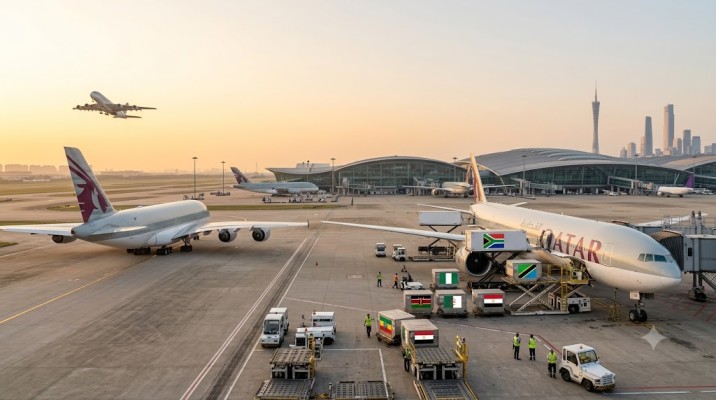
Image generated with Ai
Qatar Airways has officially dropped its iconic Airbus A380 superjumbo from its Guangzhou route for the upcoming winter season starting October 25, 2026, pivoting instead to the smaller Boeing 777-300ER. This sudden scheduling shakeup leaves the Gulf carrier with a staggering 54% fewer A380 flights worldwide this November compared to last year. If you are a corporate travel manager, supply chain strategist, or a premium frequent flyer, this isn’t just a minor fleet adjustment—it is an urgent signal that the economics of long-haul aviation are radically shifting away from empty luxury toward high-density utility.
The Sudden Superjumbo Retreat
The latest schedule updates submitted to Cirium Diio confirmed that the massive 517-seat double-decker quadjet will not be making its highly anticipated winter return to Guangzhou Baiyun International Airport (CAN). This decision follows hot on the heels of Qatar Airways removing the superjumbo from both Singapore Changi Airport (SIN) and Sydney Kingsford Smith Airport (SYD), effectively wiping the aircraft from its entire Australian and East Asian regular networks.
The daily flight layout will remain intact, but the metal on the tarmac is changing significantly. The updated winter schedule consists of the following rotations:
- Flight QR874: Departs Doha (DOH) at 1:45 AM, arriving in Guangzhou (CAN) at 2:25 PM.
- Flight QR875: Departs Guangzhou (CAN) at 12:55 AM, arriving back in Doha (DOH) at 4:35 AM.
Both legs will now be operated continuously by the 412-seat Boeing 777-300ER. While the passenger capacity drops by 105 seats per flight, the structural business goals behind this swap run far deeper than standard seasonal trimming.
Advertisement
Advertisement
What Others Are Missing: The Historic 2026 Cargo Play
Most aviation analysts are looking strictly at passenger load factors and the premium cabin downgrade, but they are entirely missing the massive geopolitical and macroeconomic forces at play. On May 1, 2026, the Chinese government made a historic trade move by implementing a unilateral, full-coverage zero-tariff policy for all 53 African nations maintaining diplomatic ties with Beijing. This legislative shift has completely supercharged the industrial and agricultural supply chains moving between China and the African continent.
Why does this matter for an airline based in Qatar? Look at the hard numbers:
Advertisement
Advertisement
- Booking data reveals that over 240,000 annual passengers flying to or from Guangzhou connect via Doha.
- Nearly six out of ten (60%) of those passengers are traveling directly to or from African trade hubs.
- The busiest connecting route on this network is the CAN-DOH-Algiers corridor, followed heavily by Lagos, Entebbe, Casablanca, Nairobi, and Johannesburg.
Here is the secret weapon of the Boeing 777-300ER: belly cargo capacity. While the Airbus A380 is a passenger magnet, its immense size severely restricts its efficiency and volume capabilities for heavy commercial freight. The Boeing 777-300ER, on the other hand, boasts an optimized cargo hold designed to carry massive payloads of electronics, textiles, and consumer goods. By shifting to the Triple Seven, Qatar Airways is quietly maximizing its freight revenue to cash in on the explosive 2026 China-Africa trade boom, sacrificing first-class luxury to capture dominant shares of the global supply chain.
This corridor is becoming so competitive that on June 25, 2026, TAAG Angola Airlines launched its own direct Luanda-Guangzhou route using a Boeing 787 Dreamliner to claim a slice of this $348 billion trade ecosystem. Qatar Airways knows that it must optimize for freight and high-density traffic if it wants to stay ahead of regional competition.
Premium Downgrade vs. Economic Reality
For luxury travelers, this aircraft swap represents a starkly different inflight experience. The premium profile of the route is being systematically reduced to favor higher efficiency.
| Feature / Metric | Airbus A380-800 | Boeing 777-300ER |
| Total Passenger Capacity | 517 seats | 412 seats |
| First Class Cabin | 8 Ultra-Premium Suites | None |
| Premium Capacity Ratio | 11% of total cabin | 6% of total cabin |
| Belly Cargo Optimization | Limited by passenger weight | Highly optimized for heavy freight |
The removal of the superjumbo effectively eliminates the ultra-premium first-class experience on the Guangzhou route. However, with partner airlines like China Southern operating Boeing 787-8s and 787-9s on the same route on behalf of Qatar Airways, the airline can maintain its market share while letting its own twin-engine aircraft handle the heavy lifting.
The Winter 2026 Survival Strategy
The broader reality is that Qatar Airways’ A380 fleet is facing structural headwinds. Geopolitical realities forced all eight of the carrier’s active superjumbos to sit completely idle between mid-April and mid-June 2026 due to airspace constraints over the war in Iran. While half of the subfleet has safely returned to service—flying to London Heathrow (LHR), Paris Charles de Gaulle (CDG), and Bangkok (BKK)—the remaining four aircraft are currently parked in Doha.
Internal reports from late 2025 indicated that the airline was already strongly considering retiring half of its A380 fleet due to high operational costs. By consolidating the active superjumbos onto just three high-density, slot-constrained European and Thai routes, Qatar Airways is protecting its fleet longevity while routing its most flexible twin-engine assets to industrial gateways where they can generate maximum profit.
Advertisement
Advertisement
What You Should Do Next
The era of flying the world’s largest passenger jets to secondary Asian hubs is rapidly drawing to a close. To stay ahead of these systemic changes, global travelers and logisticians should take immediate action:
- Review Premium Bookings: If you hold a first-class ticket or premium award seat booked on Qatar Airways to Guangzhou for late 2026 or early 2027, contact the airline immediately to check your re-accommodation options or look into alternative luxury connections via Emirates.
- Leverage Cargo Corridors: For supply chain managers routing goods out of the Pearl River Delta into Africa or the Middle East, look into the increased belly hold availability provided by the incoming Boeing 777 fleet shifts.
- Track the Fleet Shifts: Keep a close eye on upcoming winter schedule changes. As airlines continue to prioritize dual-engine efficiency over quad-engine prestige, expect further A380 route prunings before the year ends.

Advertisement
Advertisement
