
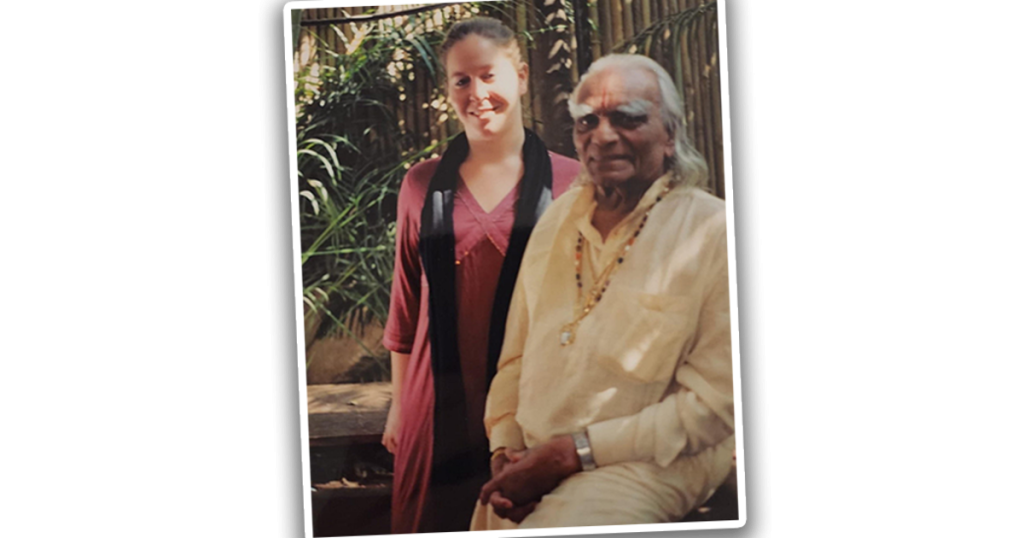
1. Pune
Quiet descended on the hall. In the splashes of light created by the large windows a few dozen bodies – folded, twisted, wrapped up in themselves – glowed, their limbs stretched in geometrical precision on the colored yoga mats. Shai Kaplan sank slowly onto a curved wooden platform with slats, arching her back until her head hung upside-down, arms spread. The Dwi Pada Viparita Dandasana pose.
Dozens of strange Sanskrit terms had flooded her world in the past few weeks – and they were the less peculiar things that she had encountered that year: Indeed, 2005 will undoubtedly be recorded as a turning point in her life. She no longer sees only death looming before her.
Her fragile body seemed to freeze in the pose. In the past few years she had felt like she was forging a path through a jungle without knowing where she was going. She wasn’t sleeping, wasn’t eating. At the age of 24 she weighed 40 kilograms (88 pounds), vomiting frequently and in pain. Everything was closing in on her. She saw herself as a collection of symptoms, incurable. And here, suddenly, she had touched ground.
During the past winter, an MRI had showed that after two operations to remove tumors from her brain, Shai was still not out of danger. But she no longer cared about diagnoses and prognoses. When she had set out to wander the world a few years earlier (four? five? she had lost all sense of time), she had come to the conclusion that it was all right to die young.
She’d been immersed in this nightmare since age 14. It started when she experienced excruciating headaches and began throwing up, and then one morning she was paralyzed from the neck down. In the hospital three tumors were found. Within minutes she underwent emergency surgery. Her life was saved but the physicians were unable to remove the growths completely; a few years later she had to undergo another operation – again, with partial success.
By this point, Shai had already lost 70 percent of her sight. The pain and other symptoms rendered her life unbearable. A third operation was more than she could take. She decided to embark on a journey around the world – with the 30 percent of her vision that remained.
Shai wandered about aimlessly, from Europe to Asia, from New Zealand to South America. One decision guided her: to say yes to every experience she was capable of absorbing. That’s how she arrived for a week-long trial program with a yoga teacher in the city of Dharamsala, in the foothills of the Himalayas in India. There, for the first time, she felt that something right was happening in her life.
Long minutes went by. Shai, frozen on the wooden device, checked again to ensure that her body was correctly positioned according to the instructions. Shoulders relaxed. Chest open wide. Arms bent back. The pedantic precision of the teachers she met later here in Pune transformed each pose into a veritable work of art that demanded the deepest concentration. Indeed, the poses only worked when she was aware of every part of her body.
Maybe that’s the source of the odd quiet she discovered in yoga. The guru, B.K.S. Iyengar, believes that one’s breathing must reach every pore of the body.
It was her teacher in Dharmsala who told her, after a few months, that in her condition she must meet the guru. So she traveled to Pune, a not-especially attractive city in western India, and entered the gates of Iyengar’s yoga institute. She’d been there only a few weeks and was still having trouble accustoming herself to the strangeness of the place.
The strangeness started with Iyengar himself, at 87, with his stark and unusual facial features, his thick, unruly eyebrows and his ability to fold his body up in impossible poses. Her jaw dropped the first time she entered the hall and saw his photographs on the walls. The idea of a guru whom everyone bowed to didn’t especially enchant her, either. But something had worked for her in Dharmsala, and it would be possible to check it out for real here. She was not asking herself now whether she would stick it out. What does sticking it out mean, anyway, when you’re going to die?
On her first day at the institute, Shai met Geeta, Iyengar’s daughter. Geeta interviewed her about her condition, read the medical reports and reviewed the MRI findings. She created a sequence of poses for Shai to be performed over the course of two hours, twice a day, in the morning and the afternoon. “This is what I’m doing now?” she had kept thinking during the past weeks. “I’m 24. My friends are climbing in the Himalayas, living their life.”
But something inside her moved, and every day she chose to stay on. She sensed some improvement. But above all, there was a feeling of control: Even now, when she feels unsettled at night in her room, she can always go back to the poses – and it works.

A year passed. The monsoons swept Pune and brought relief from the sweltering heat. Geeta noticed that Shai, like many Westerners who come to the institute and start to feel better, wanted to do everything and was trying to take on too much. Westerners get addicted to the practice and become imbued with a sense of urgency, she thought. They feel their time is limited and must be calmed down a bit. Indeed, Shai had already rebuilt most of her daily capabilities and, under the watchful eye of Geeta was developing strength and stability.
And then one day Iyengar himself appeared.
He intervened in the practice and created a new sequence of poses for Shai. That moment marked the start of a particularly intense period. She worked under his close supervision; he broke the boundaries of her imagination every day anew. The poses increasingly stretched the outermost limits of her abilities – quite literally.
Local people, too, noticed her extreme dedication. Every morning, as she entered the institute on the path that passes the guru’s home, like hundreds of students from all over the world who regularly make a pilgrimage to Pune, she peeked at the entrance to his house and wondered: What is he doing now?
The awe and admiration for Iyengar among his community of students is boundless; his photo adorns thousands of halls around the world, in which his form of yoga is practiced. But Shai, for one, felt he was actually quite accessible. During his lectures he sat on the floor in the back rows, with everyone else. During morning sessions he rolled out his mat among the others in the big hall.
Shai would practice her sequence devotedly for three and a half hours in the morning. Afterward she would return to the small room she was renting from a family in the city, have lunch and hurry back to the yoga center. She would spend her time before the afternoon session in the library there. Her impaired vision prevented her from being able to read, but she sat there so as to be close to Iyengar. He would study, and occasionally people would enter and ask him questions, and Shai would listen – thinking, maybe she’ll overhear something, maybe one day she will also understand what he’s saying.
Most of the knowledge Shai gleaned from the guru was transmitted via the body. He sometimes answered her technical questions, about particular poses, but beyond that she heard no explanations, no theorizing. He would not be able to erase her tumors, he told her at one point. Don’t expect me to do magic and make them disappear, he said. At most we will succeed in curbing their development.
Iyengar designed the practice based on how Shai responded. Even before she could tell him whether a particular pose offered any relief, he discovered this by observing her lips and neck. When a pose was too difficult for her, the outer corners of her eyelids narrowed and her temples became swollen. Gradually he added challenges. His instructions were rigid; his style, uncompromising.
As time passed, Shai noticed that the practice offered much more than physical relief. Iyengar taught that according to yoga, a person is built of layers – like an onion or a Russian nesting doll, with parts nestled inside each other. The physical body is outermost and within it are a mental layer, an energetic layer, an emotional layer … with the innermost one being the soul.
Shai imagined that in each of these layers there is a window, and that her practice synchronizes them so that all the windows align and her gaze can penetrate deeper and deeper.
One morning, Iyengar tossed out a comment that rattled her. Shai stood next to the wall of ropes that are used for support in various poses. It was Iyengar who added props to yoga, mainly to the type practiced in his own school – cushions, blocks, vaulting horses, straps, platforms – to enable students to achieve poses that are otherwise beyond their ability. A person who, because of an injury, can’t do the Downward-facing Dog pose, for example, can hang from their pelvis by means of a rope attached to the wall. In the beginning, Iyengar himself would hold his students in various poses. He collected items that would help support them after discovering that this was beneficial to the body and consciousness.
On that morning, the guru passed the rope wall and exchanged a few words with Shai. Suddenly, he said, in his offhanded way, “What’s the big drama? How big is the compromise really – 30 percent, 40 percent? Just how big is the flaw in you, in your body, in who you are, in your abilities? And what about the other 60 percent or 70 percent? Maybe we can work with them, to the benefit of the flawed 30 percent?”

Shai froze and leaned against the wall, digesting his words. In Israel she was considered to be a walking tumor. The growths affected her sight, her balance. You must be careful of this, you should do that, she was told. Throughout her adolescence she felt that she was no more than a growth in the brain. No one ever told her there were other things inside her that were working properly.
Yet in Pune no one seemed to get worked up about tumors in the brain, to the point where she sometimes wondered if they even cared about it. She would say “brain tumor” and the world wouldn’t come to a screeching stop. And then her teacher told her that not only is there more than that within her, there is more within her that is good and that can also be of benefit. He taught her how to help herself. And that knowledge was now in her possession.
More than two years passed. Shai hardly ever left Pune. The poses were challenging and intense; the learning process was slow. She often asked herself why Iyengar didn’t teach her certain aspects of the poses from the outset. If he had told me that earlier, she thought, I could have performed them better.
The Upanishads, the ancient Hindu scriptures, relate how the god Indra went to the creator of the universe, Prajapati, in order to understand what the self is, and was asked to stay and study with him for 32 years. At their conclusion Prajapati tells him that the self is the image that is reflected in a bowl of water. Indra returns to the dwelling of the gods, but is gnawed by doubt. It can’t be that the body alone is the self, he thinks.
He hurries back to Prajapati and demands the truth, whereupon he is asked to stay for another 32 years. Thereafter, Prajapati reveals that the self is the one that appears in dreams. Again Indra returns home, is consumed by doubt and hurries back to Prajapati – and so on. Only after 101 years of learning does Indra receive the complete answer from Prajapati, the lofty truth about the self. Why was it not entrusted to him from the outset?
For her part, as time passed, Shai realized she could not have understood everything from the outset. There was a certain measure of understanding contained in every moment. Progress is slow.
It was Shai’s fourth year at the Pune institute. The serious symptoms with which she arrived have disappeared completely. She was stronger, more independent, free from “the afflictions of body and mind,” as the guru put it … And then she contracted malaria, and was again on the verge of death. The disease attacked her blood, liver and spleen. She was hospitalized locally for two weeks.
After her discharge she returned to the center and approached Iyengar’s desk in the library. He peered at her as she stood next to him with much difficulty, and declared: “You are now going back to Israel. See you later.” After such a difficult illness, he told her, she must recuperate in a place where the water and food to which she is accustomed are found.
Shai obeyed. But her stay in Israel dredged up childhood anxieties and within a month she hurried back to her Prajapati. Landing in Mumbai, she was overcome by extreme distress. She hurried to a taxi and urged the driver to get to Pune as fast as he could – as fast as possible to the practice, as fast as possible to her guru. She felt like a child running back home from school. Once she had traveled the whole world and enjoyed visiting new places, she thought; now nothing else interests her.
Iyengar scolded her for returning so quickly, but built a new, slow, sequence of poses for her. She remained in each one for 45 minutes. Slowly she was rehabilitated.
One morning, as she was practicing yet another difficult sequence, Iyengar stormed in. Before she understood what was happening, he arched her back into the Bridge Pose and pushed her upper body down between her legs, until her pelvis was above the head, with her chin on the ground and her hands hugging her ankles. Ganda Bherundasana.

A chilling feeling of serenity descended upon her. She sensed something happening in the fluid surrounding her spinal cord and vertebrae. The intensity of the pose morphed into a vague feeling of understanding. She came out of the pose and lay on her back, flabbergasted. Iyengar wagged a finger at her and asserted: “No questions! Take it in for a minute and go home. The lesson is over.” From that day on, Shai’s practice became clearer – as though the moment she first struck that impossible pose had exposed its whole purpose.
The days passed. In 2009, after four and a half years at the institute, Shai went for MRI tests again, in India. The tumors were found to have shrunk by 40 percent; apparently not an unheard of development, but rare. When Shai, thrilled, informed Iyengar of the results, he looked at her and said: “Now it’s your turn. You must go back to Israel and pass this on to others.”
Why Israel, she protested. I experienced so much trauma there. When she had first left the country, about a decade earlier, she told everyone that she wanted to see the world before losing her eyesight. But the real reason was that in Israel she felt that she was causing pain to everyone around her: that everyone was afraid to talk to her, that they were always looking at her with baleful eyes. It was small-town Ramat Hasharon, and they all whispered behind her back, and she always heard them. But Iyengar was insistent. You have to go back home to the place where you were raised and give something back there, he urged her. The innermost window is starting to turn.
2. Tel Aviv
The yoga room in Reuth Rehabilitation Hospital in Tel Aviv is so small that Assaf Lahat has a hard time finding an angle from which to check the young man’s pose. Lahat leans back and observes Erez Levanon – patients are always called “students” in this room – who is hanging in a position reminiscent of that rendered in engravings of the dungeons of the Inquisition.
“At the start of the session the goal is to get the patient into a calmer condition,” explains Lahat, who met Levanon in 2020 when he arrived at the hospital seeking treatment that could offer relief from his suffering.
“I had lived with chronic pain since the age of 15,” Levanon, who is 40 today, says now. “I went through a series of operations before being diagnosed with CRPS [complex regional pain syndrome].” Six years ago, after seven operations, he arrived at Reuth for half a year of rehabilitation. He weighed 50 kilos (110 pounds) and was treated with opioids for pain along his left side.
The rehabilitative pain-relief protocol at the hospital – including physiotherapy, occupational therapy, group therapy, special workouts and more – improved his functioning significantly, but the pain persisted. When the rehabilitation period ended, and Levanon was still being injected with steroids in his back, he decided to try yoga.
“Within weeks I understood that this was something else,” he says. “After a year and a half I got my last spinal steroid injection. The most significant turning point came two years ago, when I suddenly realized that I had gone a whole day without pain.”
Levanon has gotten through the bouts of pain he’s had in the interim by means of yoga. “It’s no longer chronic,” he says. “I’m a normal person.”
While he underwent an extreme process, the relatively rapid relief he felt is not unusual. “It’s something that happens here a lot,” Lahat, his teacher, says. “Some people feel it in the first session, others after a month.”
Lahat is on the staff at AnuYoga, a therapeutic and rehabilitative organization founded by Shai Kaplan to introduce Iyengar Yoga to local medical centers. The initiative started in 2012, in Reuth, which was apparently a world pioneer in integrating yoga at a hospital in this form. Since then it has become part of protocol at Shaare Zedek Medical Center in Jerusalem, and at Soroka Medical Center in Be’er Sheva. Last year, experts trained by AnuYoga were integrated into a hospital in Brussels; Kaplan is currently training personnel there. A medical center in Ghent, Belgium, is slated to begin using the organization’s yoga teachers in January, and hospitals in France, Germany and Holland are also already taking an interest.
In recent years, Kaplan has presented her achievements in integrating Iyengar into rehabilitative institutions at conferences in Israel and Europe. Today, some 40 certified Iyengar yoga teachers working with AnuYoga are helping hundreds of patients strike poses in the very heart of the medical establishment – and the sky’s the limit.


Levanon, an entrepreneur whose private pain engendered a startup for measuring chronic pain, never stops doing yoga. Today he has all the necessary equipment at home, and on work trips to the United States, for example, he takes apart sofas and “borrows” accessories from his hotel gym – whatever is needed to maintain his regimen.
“At first I approached yoga like physiotherapy,” he says, “to have someone move my body – not in order to care for myself.”
What’s the difference?
Levanon: “After decades of hospitalization and rehabilitation, I had gone through all types of physiotherapy. It seemed to be an attempt to correct a specific problem. But I have neural damage that cannot be healed. In yoga I felt that we found bypass routes – other ways to activate my arm that don’t hurt me. Three years ago I couldn’t even write with a pen, and today I can. That’s something that didn’t happen after any other type of therapy. And I tried them all.”
How do you explain that?
“Even when it’s aimed at my arm, yoga practice is very systematic. Encompassing the arm, back and legs as well as one’s mindfulness. With all the other methods, the focus was on the arm alone. I was all-in during physiotherapy, too, but there it was all highly specific. Here it fits like a glove; with PT, the glove is too loose. When you suffer from pain, the difference is tremendous.”
Can you point out key moments along the way?
“The hardest thing for me at first – although today I connect with it the most – was holding the poses. To keep one for 45 minutes. I think that holding the poses, when you allow your body to become accustomed and can get past the physical peak to reach the stage of coping mentally, is a very significant part of the story. And that totally doesn’t happen in PT or occupational therapy.”
Levanon is today a member of the AnuYoga board and a volunteer in spreading the Iyengar word. “We are missing out big-time when it comes to therapy and healing,” he says. “Israel today is in first place in the world in administering opiates. What led in the United States to tens of thousands of deaths a year, is now coming here. We are using band-aids. Instead of healing people, we’re drawing them into a cycle of chronicity: We manage the illness in a narrow, symptom-focused way, but at the same time we create dependency and undermine people’s independence.”
Conflict management.
“Yes. I think the right way is integration. If I hadn’t had some of the shots when I first started out, I probably wouldn’t have survived the first year in yoga. But it also can’t only be about Western medicine.“

Every few minutes a question comes up during our conversation that makes Shai Kaplan leap to her feet, as though she wants to reply with some sort of movement. “In another second I’ll give you a lesson. Talking about yoga is a lot harder than simply experiencing it.”
What’s the connection between yoga and healing?
Kaplan: “We get a body that has all sorts of systems and abilities, like your cellphone. For some reason, we know more about phones than about the machine we were born with. We don’t understand how it works, but it has magic. It knows how to rebuild, repair, create bypass routes. It has ways and connections that can better every process you would like. Through yoga, people heal themselves.”
Kaplan recalls one of the first cases she received after starting to work at Reuth in 2012: a young girl who wasn’t able to breathe independently because of a disease that attacked her spine.
“How do you even start doing yoga with someone who is ventilated and bedridden?” she says. “There are very simple ways. The damage affected the nerves that descend from the spine toward the diaphragm. The signal didn’t arrive the way it should. What else can make the diaphragm work? There’s a known connection between the quadriceps and the diaphragm. I can let you feel it now. So I tried to stimulate the system to work in another form. I don’t deal only with what’s not there – I deal with what is there. And her legs worked.”
And…?
“And she went back to breathing by herself.”
How?
“After a period of treatments. After a cumulative effect aimed at changing habits for the better, at a regular rate. And that was only one small detail by means of which we started to unravel the knot. In Iyengar Yoga everything is very precise, which is why it’s so appropriate vis-à-vis the realms of rehabilitation and medicine. We can give the patient tools that will influence their condition in a way that’s hard to describe. They get the reins back. People don’t understand the degree to which the resources are in their hands. There is a lot more room for negotiation than you imagine.”
Is searching for bypass routes a central principle in the process?
“You don’t always need a bypass. But part of the idea is definitely being prepared to discover other paths, new alleys leading to the same place.”
It would not be the last time a diaphragm sprang back to life, as it were, in Reuth’s small yoga room, which has witnessed more than a few breathtaking dramas. Maya Elyashiv, director of the hospitalized respiratory rehabilitation division, recalls a patient who was in the ward for an entire year because she needed a ventilator.
“We have a very senior physiotherapist in the hospital who also, by the way, practices yoga,” Dr. Elyashiv says. (On principle, AnuYoga offers classes to the medical staff in the institutions where it operates.) “She gave a talk to all the physicians in which she explained that yoga helps activate muscles that are not activated in regular exercise. So I said, maybe we’ll try to help this patient. Within two and a half months she no longer needed the ventilator.” Elyashiv herself practices Iyengar in the hospital.

Zamir Halpern, a world-renowned expert in gastrointestinal diseases, encountered Kaplan in the wake of a disease that struck his muscles and nervous system, leaving him almost totally paralyzed. Prof. Halpern also suffered from terrible pain. Kaplan came to his home every morning at dawn in order to integrate her treatment into his demanding routine. After about a year he went to work and forgot his cane at home; he’s been practicing Iyengar devotedly ever since – for the past 15 years.
Halpern: “I am not a yoga fanatic, I believe I would have made achievements with Pilates, too. Yoga is very significant when it comes to working with the psyche, because the psyche is also very damaged by chronic disease. There are terrible pains, one’s independence is affected – career, life, everything is harmed. And yoga makes the integration between body and mind possible. For me yoga is very appropriate, but rehabilitation can also be found in other ways to accomplish that integration.”
In the wake of his personal experience, Halpern too has become a member of the board of directors at AnuYoga. He also follows developments in the medical literature dealing with the influence of yoga on health. “Most of the publications present correlations and not causality” between them, he explains. “There is considerable testimony to the effect that yoga influences different systems in the body, and not only the classic realms of muscle or nerve damage.
“The connection approaches the level of ‘evidence-based medicine,’ but in medicine we also require causality. We have not yet reached that [in this context], because the basis of medical research is experiments with randomized control, and it’s very difficult to conduct an experiment of that kind, because yoga affects each person differently.”
Indeed, in recent years, many articles have been published about the multitude of advantages that yoga presents – though they are usually very cautious in their conclusions. These include a meta-analysis that reveals that yoga might alleviate symptoms of breast cancer; systematic surveys of its effectiveness in reducing inflammations in chronic conditions, in treating irritable bowel syndrome and in easing symptoms of menopause; and controlled experiments that show that yoga increases the prospects for helping people to stop smoking, and that it can be beneficial in treating clinical depression.
“Not a month goes by without an article in a good journal about testing yoga with some disease,” Halpern notes. “But it will take a long time until its influences are taught in medical schools.”
And is that going to happen?
Halpern: “Yes, definitely. But it’s a very slow process. Like in the field of nutrition, where research is also very complex. It took me years to get nutrition into med schools, and it only entered on the margins [Prof. Halpern is the founder and chair of the National Council of Nutrition]. With yoga it will be a lot slower.”
But you envision it being integrated in the medical establishment.
“Yoga will certainly enter the therapeutic mainstream. Will it enter the establishment? Those are two different things. Will there be a Form 17 for AnuYoga [meaning its form of treatment will be covered by HMOs]? That’s an establishment thing. On one hand, it’s a very complicated process. For example, you need certification that will be recognized by the Ministry of Health. On the other hand, ultimately, at the top of the pyramid there is a politician who is supposed to be attuned to the will of the public. And the public wants it, because people know that it [yoga] has a good effect on them. I do yoga, because a day that I start with a yoga session is a better day. You know, we provide Form 17 for horse-back riding – and the fact is that it happened due to pressure from below. So why a horse and not yoga? I’m optimistic.”
Still, politics aside, on what basis do programs with no solid scientific basis enter the hospitals? Staff at Reuth note that yoga is integrated into the system solely on the basis of in-depth acquaintance with the patients, close cooperation between the therapists and medical personnel, and the certainty that there is no potential for damage. The approach at the hospital is multi-professional and holistic. Rehabilitation is like an orchestra that surrounds the patient – and yoga is only one instrument in it.
Orit Stein Reisner, Reuth’s director, emphasizes the importance of integrating body, mind and spirit in therapeutic yoga. “It’s not evidence-based, but hundreds of millions of people aren’t wrong,” Dr. Stein Reisner notes. “Yoga has proved itself in a great many interfaces, it has followers, it’s not something esoteric. In the end there is something here that doesn’t require research in order to know that it does good for a great many people worldwide. And the satisfaction is incredible – that’s also a type of index.”

Are there types of alternative medicine that you would disqualify? Morning prayer is also spiritual, ancient and has hundreds of millions of followers.
Stein Reisner: “I have already disqualified treatments that seemed esoteric to me. These things are each examined on their own merits. In recent years we have cultivated the use of therapy dogs, for example. Is that evidence-based? No. But I have seen with my own eyes how amazing it is. We’re not talking about life-endangering methods. These are ‘soft’ ones.”
For her part, Shai Kaplan emphasizes that yoga is integrated into treatment in cooperation with the physicians, as a tool that supports medical procedures and never as a substitute for them. Without the surgery that she herself underwent, she always says, she would not have encountered Iyengar in Pune. But part of the idea is definitely being prepared to discover other paths, new alleys leading to the same place.”
Iyengar Yoga may not be the most popular style of yoga today, but there’s a reason it features so prominently in scientific research. It is characterized by the meticulousness of the poses, with the props helping to achieve uncompromising precision. Obtaining certification to teach Iyengar Yoga is also tougher, takes many years and is approved at Pune only after rigorous tests. B.K.S. Iyengar, the founder of the method, removed from yoga the dance-like transition between the poses, which is often found in other streams, and placed the emphasis on holding the pose, in some cases for lengthy periods.
The guru is considered the most important figure in dissemination of yoga in the 20th century in the West and elsewhere. Indeed, by means of his connections with famous people in mid-century – the virtuoso violinist Yehudi Menuhin maintained that Iyengar had improved his playing, and the Queen of Belgium practiced headstands with him in her 80s – Iyengar and the method he created have gained popularity everywhere. The canonical collection of poses that he gathered in his 1966 book “Light on Yoga,” is still considered the Bible of modern yoga.
At the start of his path, Iyengar’s focus on the physical practice of the poses marginalized yoga’s philosophical underpinnings. He himself maintained that he arrived at the basis of the philosophy only at the age of 42 – 26 years after he started practicing yoga. Historically, in fact, the connection between the poses that Iyengar and the founders of the other streams of modern yoga taught, and ancient yogic philosophy is not self-evident.
In a study that slaughtered no few sacred cows, yoga scholar Mark Singleton argued that there is no evidence in Indian tradition of the type of practice we are familiar with today. Moreover, Dr. Singleton says, poses were not a central matter in yoga before the 20th century. The roots of modern yoga are connected more to the body culture that reached India from Europe at the end of the 19th century, which urged Indians to discover local sports traditions. Yoga integrated many techniques, including the iconic Sun Salutation sequence, that originated in bodybuilding exercises.
Iyengar’s followers say that the philosophy and the practice of yoga are inseparable, and a whole body of knowledge, including books written by the guru himself, deal with the connections between them. The transformative power of yoga, Kaplan explains, stems from the fact that it can’t be practiced like an automaton or absentmindedly, like running – it demands one’s full and total presence.
“It’s highly technical work, but its results are spiritual,” Kaplan says. “Yoga is meditation.”
Deep practice halts the “fluctuations of the mind,” according to the classic definition. “A lamp does not flicker in a place where no winds blow.”
As elsewhere in Israel, October 7 marked a turning point in AnuYoga, too. “There was a moment on that day when I started to get calls from departments in Soroka – ‘Come now!'” Kaplan recalls. “I thought they must think we’re doctors, but they said, ‘You’re doing yoga, no? That’s what we need.’ The cooperation with the medical staff was so successful that they pushed to integrate it into the rehabilitation process as soon as possible. That’s how we started to work with very complex cases, sometimes even as they were taken from helicopters that evacuated them.”
Staff from AnuYoga was at Soroka from the first day, and treated people who began to breathe again thanks to yoga – this time not only in the physical sense.
“In one case a combat soldier arrived in serious condition, and he had also undergone an unbearable mental experience,” Kaplan relates. “It was a challenge in the ward to persist with yoga – between the operations, the tests and the visits – but he refused to miss a class. The medical team was worried that he wasn’t talking about what had happened to him. After seven months, he suddenly hugged the teacher and said to her, ‘Yoga days are the only ones when I don’t experience flashbacks on the nights that follow, when I can sleep.'”


In the wake of the Soroka experience and the resulting demand for it, AnuYoga’s activity expanded significantly into the realms of the psyche. The organization created the Carmel Program, named for Carmel Gat, who was abducted from Kibbutz Be’eri and murdered in captivity. Returning hostages testified that Gat herself had strengthened them and helped them survive through yoga practices and meditation.
The Carmel Program took AnuYoga out of the hospitals into the community. Its staff address serious trauma in bereaved families, returning hostages, families of hostages and soldiers. In February, within the framework of the Carmel Program, a new center was inaugurated for members of Be’eri on the kibbutz itself.
“One of the most difficult things in trauma is that the possibilities end,” Kaplan says. “When a person is caught in a loop, he is not present in the here-and-now. Either he’s in a state of helplessness in the face of what happened, or he’s fearful about what is going to happen. In yoga we are in the body, and to be present in the body you need to be present in the here-and-now. That provides a very critical breathing space.”
Kaplan adds that she is very upset about the scale of posttraumatic stress disorder in Israel. “We must treat our society,” she stresses. “The numbers known to the system are tens of thousands, but the true numbers are far higher. I lose sleep over this, because we can help them easily.”
Easily?
“Yes. Sometimes, when we don’t have options, the problem looks a lot worse, and when we start to see alternatives, the pressure is released. The infinite possibilities in Iyengar Yoga can do wonders. It helps people process their difficulty and store it in the right place. It does not make it disappear, but it turns it into something that can be lived with. That is important for me at the moment, because everyone these days really wants not to talk about it, to move on, or their head is already in the next war and they don’t know what lies ahead. All that makes us shunt this problem aside.”
3. Pune
Shay stepped into the hall once again. She was home.
Nearly a decade had passed since she had first stood here – fragile and at a loss. She lingered for a moment at the entrance, smiling inwardly at the thin, frightened young woman who had gazed around in wonder in this very place back in 2005, and then walked in with a confident stride.
This time, she was different. Patients were waiting for her in Israel. The initiative she had launched was beginning to spread its wings. If only that young woman could have known how much joy still lay ahead of her in life.
When guru Iyengar sent her to Israel, she had to cope anew with all the anxieties and fears of childhood. But even back then she was beginning to be a different person. The return to Israel, which she had feared so much, had been a tikkun, a healing experience, for her. With it she made great peace with herself, with her family and with the whole environment in which she had grown up.
Shai walked across the cold marble floor toward Iyengar, who was lying on an arched wooden prop at the far end of the hall, his head hanging downward, illuminated by the gentle morning light. At 94, she thought, he looked more vital than ever. The syllable “gu,” Iyengar once taught, means darkness, and “ru” means light. The guru is the one who spreads darkness and brings enlightenment. Shai felt that she owed him her life, literally, and her devotion to his way was her way of thanking him.
She went over to greet him with a bow. He signaled for her to approach. “Uttanasana,” he ordered. A simple pose. Shai bent forward and placed her palms on the floor, her chest pressed against her thighs, her back facing the upside-down teacher. Again she heard his instructions, in the voice that had accompanied her for so many years. “Toes together.” “Ankles raised.” And suddenly: “That’s all. You are my senior student now. I have taught you all I could. The rest you will have to understand by yourself. It is over.”
Shai stood up and looked at him, stunned. “I will see you again in December,” she said. “You will not see me,” he replied.
A few months later, he died.