
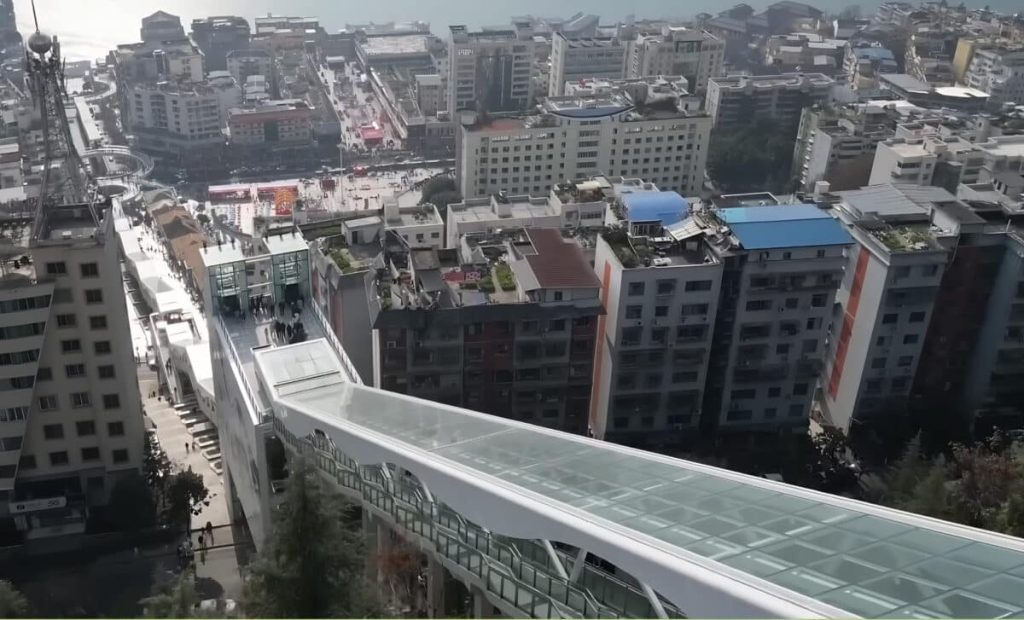
Wushan County sits in the municipality of Chongqing, a city so defined by its cliffs and slopes that it has earned the nickname “the Mountain City.” The county itself carries an additional layer of history: it was relocated during the construction of the Three Gorges Dam, leaving residents with a landscape defined by a average slope of 35%, with some sections approaching 60%. For years, getting from the lower parts of town to the upper neighborhoods meant either an hour of strenuous climbing or navigating congested roads during peak hours.
Before settling on the escalator solution, local authorities considered other options. Both a train and a cable car were studied and ultimately abandoned. What emerged instead was a modular escalator system specifically engineered to follow the natural contours of the mountain, a design choice that preserved the surrounding landscape while solving a decades-old mobility problem.
An Engineering First With No Equivalent Anywhere in the World
Inaugurated on February 17, 2026, during the Chinese New Year celebrations, the Wushan Goddess Escalator stretches 905 meters in length and climbs 242.14 meters in elevation, roughly equivalent to an 80-story skyscraper. It is not, however, a single continuous escalator. The system is a complex assembly of 21 escalators, 8 elevators, 4 moving walkways, and a series of pedestrian bridges connecting them into one continuous route.

Huang Wei, chief engineer at China Railway Eryuan Engineering, has been unequivocal on this point: no similar project exists anywhere else in the world. The system was built to withstand both the steep terrain of Chongqing and the area’s harsh weather conditions, with transparent glass facades chosen to lighten the visual weight of the structure against the mountain. Three panoramic platforms were integrated along the route, offering unobstructed views of the Wu Gorge and the Three Gorges throughout the journey.
The mechanical components were manufactured by Swiss company Schindler, in a factory located near Shanghai, the same company that has already supplied 1,400 escalators to the Chongqing metro network. Construction lasted four years and cost 23 million dollars.
A Daily Artery for 9,000 Commuters, Not Just a Tourist Attraction
While the glass design and panoramic viewpoints give the infrastructure a distinct tourist appeal, and at night, lighting installations transform it into what has been described as a ribbon of light, the system’s primary function is practical. Around 9,000 people use it daily to travel between the lower and upper districts of the city. The escalator directly connects riverside roads to essential public services including museums, hospitals, and schools.
Chongqing’s Wushan has built an outdoor escalator of length 905 meters. It’s also known as as the ‘Wushan Goddess Escalator’
by
u/straightdge in
Damnthatsinteresting
During the Chinese New Year holiday in 2026, the system recorded 450,000 trips in just a few days. Residents of the Gaotong area in particular no longer have to navigate dangerous narrow roads or steep slopes to reach workplaces or run errands. According to Interesting Engineering, the system has officially surpassed the city’s previous Crown Escalator to become the longest outdoor escalator system in the area.
During its current trial phase, the fare is set at 3 yuan, approximately $0.40. Authorities are monitoring performance data before establishing a permanent price.
Chongqing, a City That Has Long Turned Altitude Into Infrastructure
The Goddess Escalator takes this tradition further, integrating multiple transport modes into a single three-dimensional network and reconnecting previously isolated neighborhoods. Other mountain cities around the world are now reportedly studying this modular approach. As noted by Science et Vie, China continues to demonstrate its capacity to transform geographic constraints into laboratories for urban innovation, with Wushan as its latest proof.
The Wushan system did not emerge in isolation. Chongqing has spent decades engineering solutions to its extreme topography. As far back as the 1990s, the city had already built a 112-meter escalator to connect two train stations. Trains run through apartment buildings. The city’s monorail passes directly through a 19-story residential building at Liziba Station. Subway stations have been dug deeper than some bunkers.