The US and Israeli military campaign in Iran — and the far-reaching response from the Iranian regime —has complicated international relations between the White House and its traditional allies.
The result is a potential shift in the balance of power between the US and the world’s second-largest economy, China, several experts told Yahoo Finance.
In recent public appearances and online statements, President Trump has repeatedly derided Europe as a “paper tiger” and threatened to withdraw the US from one of its most critical international defense cooperatives.
He has told Europe, which depends much more directly than the US on energy flows from the Persian Gulf, to “build up some delayed courage, go to the Strait, and just TAKE IT.”
Statements such as those from President Trump, along with threats to annex Danish territory Greenland and other international maneuvers, have rattled foreign confidence in the US commitments to its allies, creating a potential opening for Beijing, said Henrietta Levin, a senior fellow at the Center for Strategic and International Studies
“China wants the United States’ most important partners to question whether it will actually be there for the long term, whether the US will actually be there when it’s difficult,” Levin told Yahoo Finance.
“The US commitment to allies in Europe is immediately relevant to deterrence in Asia, so that just makes the situation more precarious,” she added.
For Beijing, the United States’ increasingly withdrawn posture toward international commitments could open up opportunities in the Indo-Pacific region, throughout the South China Sea, and, crucially, Taiwan — critical to US economic and national security due to the country’s semiconductor factories.
China is unlikely to use the conflict in Iran as an opportunity to move militarily on Taiwan, Patricia Kim, senior fellow and Chinese foreign policy specialist at the Brookings Institution, told Yahoo Finance.
Yet even the appearance that the US is less focused on projecting strength abroad could provide China with an opportunity to press its influence, several geopolitical experts told Yahoo Finance.
Over the past week, several Chinese vessels — including one coast guard or navy vessel — have moved to control access by the Philippines to the Scarborough Shoal, a key site in the South China Sea that has become one of the region’s most disputed hot spots. Experts have warned that further action at the shoal could escalate into armed conflict.
“China is unlikely to move on Taiwan simply because the United States is preoccupied elsewhere,” Kim told Yahoo Finance. However, she said, “US distraction in the Middle East may offer China some indirect strategic breathing room by stretching American attention and resources.”
That’s not to say Beijing has escaped the conflict unscathed.
Compared to other Asian nations, China is far less exposed to global oil shocks after years of domestic policymaking intended to reduce its reliance on foreign energy. The country has invested heavily in electric vehicles and solar power while stockpiling oil reserves that far exceed domestic consumption, according to several China experts who spoke with Yahoo Finance.
Even so, the Persian Gulf accounts for anywhere from a third to half of China’s oil imports, meaning a major loss of supply from the region will still squeeze the country’s refining complex.
Prices in the physical market on Dubai and Oman oil, key grades for the Asian market, soared to prices above $160 per barrel in late March. ·Bloomberg
The US Navy’s blockade of the Strait of Hormuz may already have turned back China-linked vessels seeking to exit the Gulf. On the morning of April 14, a US-sanctioned oil and chemical tanker under Chinese ownership moved to pass through the strait before abruptly turning around and heading back, according to satellite and ship-tracking data reviewed by Yahoo Finance.
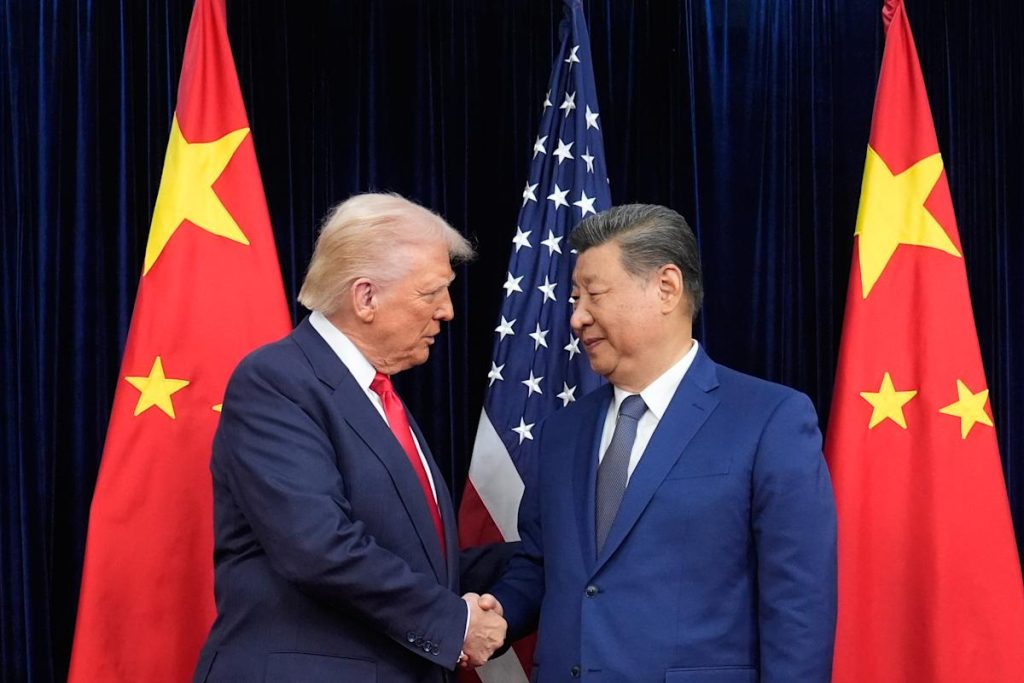
All of this is reshaping the context for the upcoming meeting between Trump and Xi Jinping, scheduled for the middle of May, even if the tenor of the meeting is likely to remain relatively stable, according to China and geopolitics experts who spoke with Yahoo Finance.
“Both sides seem to be committed to a successful summit, to extending the trade truce and keeping things stable in the bilateral relationship,” Brookings’ Kim said.
The summit comes roughly seven years after President Trump last traveled to Beijing, in 2017. In December 2025, the US signed an arms sales package with Taiwan worth $11.1 billion, severely frustrating Chinese leadership, according to the Brookings Institution.
When the two world leaders meet in May, Trump and Xi are expected to negotiate over a slew of trade provisions, including the White House’s loosening of restrictions around sales of Nvidia’s (NVDA) H20 and H200 chips to China and whether the US would be willing to allow sales of even higher-grade AI infrastructure to Chinese firms.
Xi is also likely hopeful that the US will, for the first time, voice opposition to Taiwan’s independence, Levin said, even if Trump has repeatedly dodged the question, refusing to answer what he would do if China were to move on Taiwan.
In February, the president said he would discuss US arms sales to Taiwan in his upcoming meeting with XI. Experts have said that may violate policy principles that have guided US-Taiwan relations for the past 60 years and dictate that weapons agreements between the two countries not be discussed with China, and that the announcement may telegraph a shift for the US away from Taipei and toward Beijing.
“President Xi will give me a big, fat, hug when I get there in a few weeks,” Trump wrote. “We are working together smartly, and very well! Doesn’t that beat fighting??? BUT REMEMBER, we are very good at fighting, if we have to.”
Jake Conley is a breaking news reporter covering US equities for Yahoo Finance. Follow him on X at @byjakeconley or email him at jake.conley@yahooinc.com.