
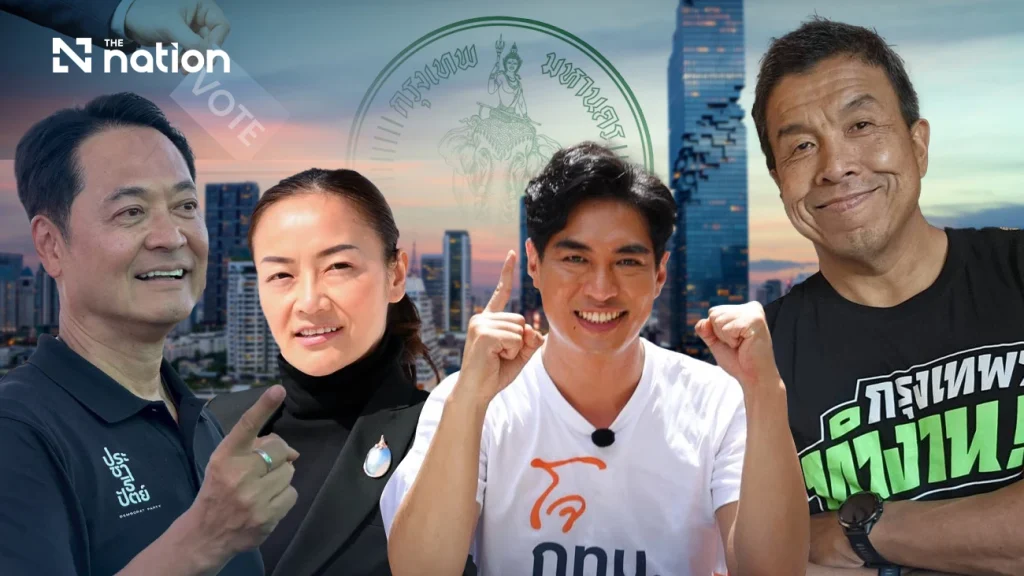
While the governor race appears to show a stable lead for Chadchart, the BMA councillor race is producing a different political signal.
All three polls point to rising support for independent candidates and local working groups, suggesting that many Bangkok voters are giving more weight to people with local experience than to national party labels.
Bansomdej Poll gave independent candidates and local working groups the highest support at 39.6%, followed by Suan Dusit Poll at 33.96%. Nation Poll gave 21.59% to the “working team” group, which is fielding candidates in only 33 districts.
The People’s Party ranked second overall in the BMA councillor field, with 31.81% in Suan Dusit Poll, 20.84% in Nation Poll and 19.5% in Bansomdej Poll.
The Democrat Party received 21.6% in Bansomdej Poll, 17.22% in Nation Poll and 8.78% in Suan Dusit Poll.
Pheu Thai received 10.62% in Suan Dusit Poll, 6.90% in Nation Poll under the “Pheu Thai Life Long Tua” group, and 5.1% in Bansomdej Poll.
The surveys also point to a split-ticket trend among Bangkok voters. Nation Poll found that 45.75% of respondents believed BMA councillors did not need to be from the same team as the governor.
That finding is broadly in line with Bansomdej Poll, which found that only 32.7% of voters intended to choose candidates from the same party or group for both positions.
The pattern suggests that many Bangkok voters may choose a governor based on overall leadership and personal appeal, while selecting BMA councillors based on district-level performance and local familiarity.
Swing voters could still affect the final result, especially in several inner-city and suburban districts.
Nation Poll estimated that around 20% of voters may decide in the final 48 hours before polling day.
The districts with high proportions of late-deciding voters include Dusit at 64.71% and Nong Chok at 55.00%. Among these voters, 33.95% said performance in the area was the main factor in their decision.
Suan Dusit Poll, meanwhile, found that 55.66% of respondents who had already made up their minds said they would definitely not change their decision.
The policy issues shaping voter decisions also differ across polls. Bansomdej Poll found that voters gave the greatest importance to economic policy and job promotion at 24.8%, followed by education and quality of life at 23.5%.
Nation Poll found that flood management and community welfare for older people, children and people with disabilities were the top urgent issues, each at 20.46%.
Bansomdej Poll also identified public safety and property protection at 19.8%, followed by corruption at 18.8%, as issues voters wanted addressed urgently.
Taken together, the three polls suggest that Chadchart remains in a strong position in the governor race, supported by a stable voter base and a clear lead across all surveys.
However, the race for the BMA council appears more fragmented. Independent candidates and local working groups are emerging as important players, reflecting a shift towards individual performance, district-level work and practical problem-solving.
For whoever wins, the immediate challenges are clear: the economy, welfare, flood management, public safety and city-level governance will be among the first issues Bangkok voters expect to see addressed.