
SUNGAI UDANG, Malaysia – Near the river mouth on mainland Penang, sea bass ponds stretch as far as the eye can see, shimmering under the morning sun as birds wait for a chance to snatch a fish.
For years, lorries would roll out every day from Sungai Udang carrying sea bass bound for Thailand.
The farms in Sungai Udang used to collectively supply up to 80 tonnes of sea bass a day, about 16 truckloads, to Thailand. But such exports have come to a complete halt as a result of stricter inspections by Thailand.
One of the 20 or so sea bass farms in the area is CS Fishery, which is among the largest in northern Malaysia, with an area of more than 80ha and about 200 workers.
“Our sea bass industry is dying,” said CS Fishery director Khor Kok Hooi, who also chairs the North Malaysia Aquaculture Entrepreneur Society, which represents about 200 farms across the region.

Workers harvest sea bass from a pond at a fish farm in Sungai Udang, Penang, on July 1.
ST PHOTO: HAZLIN HASSAN
Some farms have folded, while others have switched to farming tilapia or prawns in order to survive.
“We keep rearing the fish while waiting for the Thai market to reopen. But the fish still need to be fed every day. Our cash flow is drying up,” said Khor.
The crisis began after the Thai authorities subjected Malaysian sea bass shipments to stricter inspections and laboratory testing over alleged chemical and antibiotic residues, claims which Malaysian farmers deny.
Shipments are held until test results are released – a process farmers and exporters say can take up to 20 days. By then, the fish will have spoilt. If any violations are found, the exporter will be fined.
“We see this as a form of trade barrier that restricts Malaysian sea bass from entering the Thai market,” said Khor.
Malaysian exporters and officials said tighter scrutiny of Malaysian sea bass shipments began in November 2024, around one and a half years before the issue came into wider public focus in May 2026.
In 2024, Thailand was Malaysia’s largest overseas market, accounting for 80.6 per cent of the country’s RM115 million (S$36.5 million) worth of sea bass exports that year, according to Malaysia’s Fisheries Department.

Sea bass ready for packing and distribution at a seafood processing and packing facility in Sungai Udang, Penang, on July 1.
ST PHOTO: HAZLIN HASSAN
In 2024, Malaysia exported to Thailand 9,286 tonnes of sea bass worth RM92.6 million. However, these exports plunged by around half to 4,320 tonnes or RM42.6 million in 2025.
In retaliation against Thailand’s stricter sea bass checks, Malaysia placed a temporary ban on five types of Thai shrimp from June 1, 2026, prompting Thailand to seek a resolution.
Both sides have been having talks on the seafood trade issues since June.
On July 9, Malaysia Prime Minister Anwar Ibrahim said at a joint press conference with visiting Thai Prime Minister Anutin Charnvirakul that outstanding fisheries issues between the two sides had been resolved.
A day later, Malaysia’s Fisheries Department said the two countries will continue talks to resolve issues related to the trade of sea bass and shrimp “constructively”.
Its director-general Adnan Hussain said in a statement: “Malaysia views this process as a technical alignment between the competent authorities of both countries rather than a trade dispute.”
Both countries are refining sea bass import requirements covering areas such as certification, food safety and risk management measures to support continued trade, said the Fisheries Department.
Malaysia sea bass, Thailand market
For communities around Sungai Udang, the impact has spread far beyond fish farms.
Almost every family in the area has a connection to aquaculture, whether through farming, transport, ice production, packaging or feed supply.
Some feed suppliers have also had to extend credit for up to six months because farms no longer have enough cash to pay on time.
“Some payments have dragged on for five to six months, because of their cash flow problems,” said a feed supplier, who declined to be named given the commercial sensitivity of the issue.
Farmers said feed prices have risen sharply in recent years. Meanwhile, higher prices of diesel, needed for paddle wheels, pumps, transport lorries and backup generators, have increased the cost of operating ponds and transporting fish.
The industry had already rebuilt itself once before.
Following similar restrictions by Thailand on imports of Malaysian shrimp in 2017, many aquaculture operators in Sungai Udang said they were forced to abandon shrimp farming and invested heavily in sea bass instead.
Farmers spent years redesigning ponds and building supply chains to serve Thailand’s demand for Malaysian sea bass, valued by buyers for its appearance and consistent quality.
Now, many say they are facing the same uncertainty again.
‘The fish just keep getting bigger’
Unlike frozen seafood or agricultural products that can be stored, live sea bass must be fed every day.
Feed accounts for around 70 per cent of production costs, at around RM120 to RM130 per sack.
For farmers, the longer the fish remain unsold, the heavier the burden becomes.
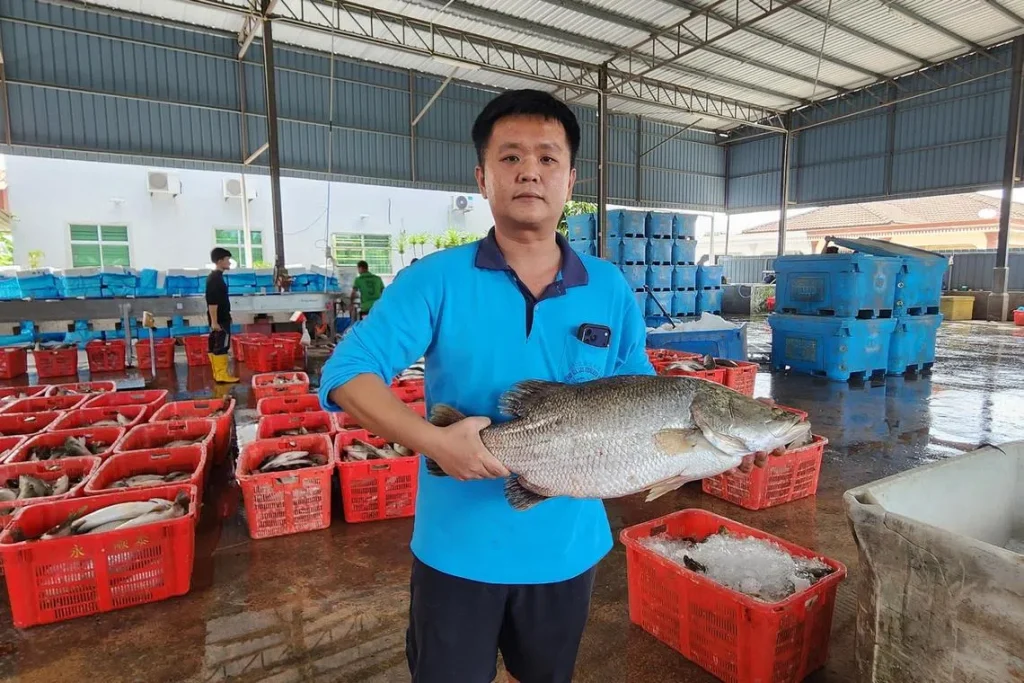
Before the disruption, Khor Cean Miah, who runs Chop Aik Lee Fisheries, a sea bass farm inherited from his family in Sungai Udang, exported between five tonnes and 10 tonnes of fish to Thailand daily.
“The fish just keep getting bigger now,” said Khor, showing a sea bass weighing around 6kg at his packing factory.
“Thailand is no longer an option for us. They said that my fish contained antibiotic levels 10 times above the limit, even though we submitted the shipment together with the Certificate of Analysis (COA). But it wasn’t accepted,” he told The Straits Times.
The COA is a laboratory report issued before export to verify that seafood shipments comply with safety requirements, including checks for chemical and antibiotic residues.
“After that, we stopped sending them there. The fish that couldn’t be shipped eventually became spoilt.”
Today, his sales are limited to Malaysia, Singapore and local processing factories, reducing his daily revenue by as much as 40 per cent.
Khor Chin Hua, a fish farmer from Tanjung Piandang in neighbouring Perak, said he has taken a RM1.5 million bank loan simply to continue feeding his stock while waiting for the market to reopen.
“We need to borrow money just to feed the fish,” he said.
“We invested everything according to the government’s requirements. We obtained myGAP certification and followed all the standards. But the Thai market is still closed,” he said, referring to Malaysia’s government-backed good agricultural practices standard for aquaculture.
Farmers rejected suggestions that their fish are unsafe.
Malaysian exporters said every shipment is accompanied by a COA issued by accredited local laboratories before leaving the country. Many farms are also certified under myGAP.
CS Fishery said it uses probiotics instead of antibiotics in its ponds and undergoes regular audits by Malaysia’s Fisheries Department.
Appeal for help
Before the disruption, sea bass could sell for around RM15 per kg. Prices have now fallen to about RM12.50 per kg, close to the production cost of around RM12.
Farmers are now urging the government to help resolve the dispute and protect an industry that they say has operated for decades without subsidies.
“We hope the government can subsidise the sea bass and shrimp aquaculture industry to ensure our livelihoods. We have studied other countries that help their farmers when the price is low to ensure food security,” said Khor.
Among the society’s requests is for myGAP-certified farms to receive priority access to the Thailand market.
Malaysia has strengthened myGAP requirements for sea bass farms and invited Thai officials to inspect Malaysian farms, according to a dialogue session held in May by the Ministry of Agriculture and Food Security.
Beyond sea bass, Malaysia is also seeking progress on other fisheries trade issues with Thailand, including a resolution to restrictions on Malaysian shrimp, which have been in place since 2017.
The Fisheries Department said on July 10 that addressing the issue through a technical approach could help create a more balanced market access for aquaculture industries on both sides.
Official data showed Malaysian shrimp exports to Thailand dropped by 66 per cent, from 8,834 tonnes in 2017 to 3,024 tonnes in 2024. Adnan said the decline resulted in an estimated cumulative export opportunity loss of RM34.02 million between 2018 and 2024.
In comparison, Thailand exported to Malaysia shrimp valued at RM90.8 million and sea bass worth RM92.6 million in 2024.
Smaller fish preferred in Malaysia, Singapore
For Malaysian seafood farmers, finding new markets has proved far more difficult than simply redirecting exports.
Thailand could absorb sea bass weighing up to 8kg, while consumers in Malaysia and Singapore generally prefer much smaller fish – up to 1.2kg in Malaysia and about 600g in Singapore.
Larger fish often command lower prices domestically or require additional processing, leaving farmers with stock that no longer matches market demand.
Exporters have explored opportunities in China, Taiwan and the Middle East, but market access, tariffs and logistics remain major obstacles.
“You cannot replace a market overnight,” said CS Fishery’s director Khor.
For now, the fish continue growing and the bills continue rising.
Chop Aik Lee Fisheries’ Khor said: “There is no way out. What can we do? We keep waiting.”