
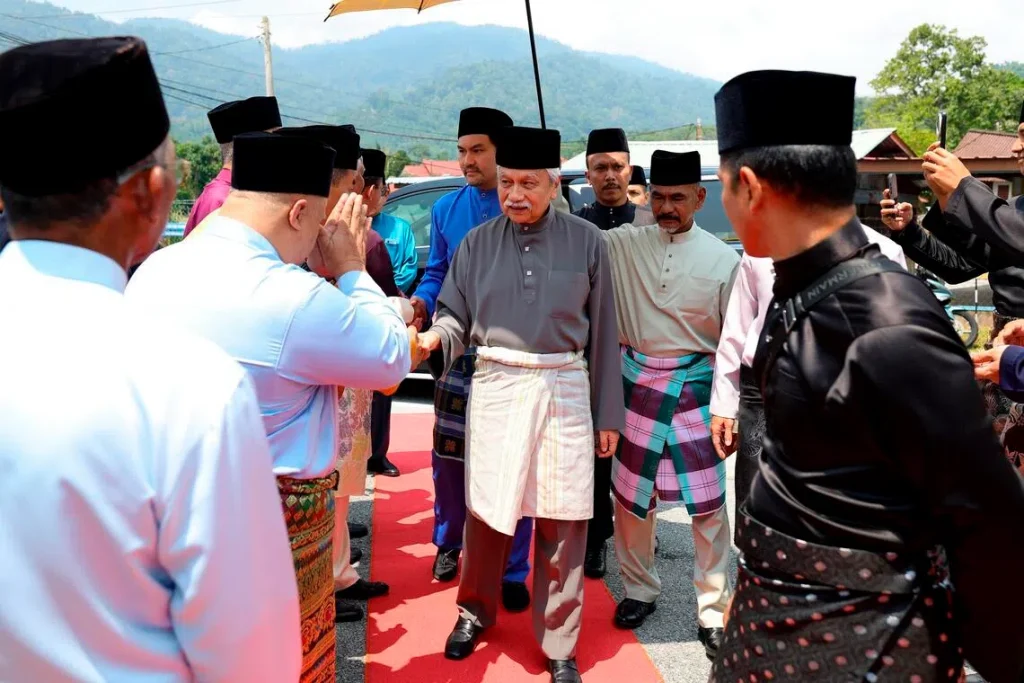
KUALA LUMPUR – One state, two rulers?
A royal feud in the state of Negeri Sembilan has resulted in two claimants to the throne. Observers are now waiting to see which of the two will sit among Malaysia’s other state rulers when they gather later in June.
The convening of the Conference of Rulers from June 23 to 25 comes on the back of a months-long tussle between Negeri Sembilan’s Yang di-Pertuan Besar Muhriz Munawir and four territorial chieftains who have declared another royal, Nadzaruddin Ja’afar, as the new ruler.
As long as Muhriz takes his seat among his peers, the weight of authority from not just the federal and state executive arms but also the royal apparatus would give him nearly unimpeachable moral standing.
Any other scenario will spark greater uncertainty, deepening the scrutiny over Negeri Sembilan’s royal family and whether the upcoming state election scheduled for Aug 1 can proceed.
Given that both the federal and Negeri Sembilan governments recognise Muhriz as the rightful ruler, also known as the Yamtuan, “it would be perverse if he is uninvited, especially as it is his turn to chair the conference”, a legal expert familiar with several royal households told The Straits Times.
Usually held at regular intervals thrice a year, the Conference of Rulers has veto power over some legislation including constitutional amendments and the right to deliberate on government policy, especially matters related to Islamic and Malay issues.
But the chieftains have not given up.
They sent a letter dated June 5 to the King, Sultan Ibrahim Iskandar of Johor, to say that they have removed Muhriz and chosen his successor, sources told ST off the record.
The royal feud in Negeri Sembilan has put the spotlight on the growing power of Malaysia’s constitutional monarchy in recent years. The King, also called Agong, has intervened to pick a prime minister at least thrice since 2020. Several rulers have also used their influence to push policies from armed forces procurement to pig farm bans to infrastructure spending.
The feud also comes amid the deterioration of the relationship between Prime Minister Anwar Ibrahim’s Pakatan Harapan (PH) coalition and ruling partner UMNO, which has declared that it would contest the Johor state polls, scheduled for July 11, on its own without cooperating with PH.
In return, PH, which has governed Negeri Sembilan for two terms, dissolved the state assembly to pave the way for elections.
Under Negeri Sembilan’s unique Adat Perpatih customs, the state’s chieftains, called Undangs or lawgivers, elect the state ruler and can remove him if an inquiry establishes serious grounds for his dismissal.
On April 17, the Undangs’ years of disgruntlement with Muhriz came to a head when he chaired a special meeting of the Dewan Keadilan dan Undang (DKU), the state’s highest authority on Malay customs.
Muhriz affirmed the sacking of one of the Undangs by the territories’ own tribal chiefs. The Undangs then retaliated with an April 19 ceremony to remove Muhriz.
On April 27, UMNO withdrew support for Negeri Sembilan chief minister Aminuddin Harun of PH. UMNO alleged that he had interfered in royal affairs by declaring that Muhriz remains as the state’s ruler.
This led to the state government dissolving the legislature to pave the way for polls, announcing it in a rushed press conference close to midnight on June 4. This was meant to pre-empt a move by the chieftains to install a new ruler on the morning of June 5.
On June 5, the police blocked the gates to the venue where the installation ceremony was supposed to be held, forcing the Undangs to retreat to a hotel in neighbouring Melaka.
At the hotel, the Undangs swore in Nadzaruddin, the son of the previous Yamtuan, leading to online mockery such as congratulating his appointment as the “Sultan of Melaka”.
On the same day, the High Court in the state capital Seremban granted interim injunctions barring any meetings of or changes to the DKU until the suit pitting the Undangs against the Yamtuan and the state administration is settled.
Yet, the Undangs persisted in proclaiming Nadzaruddin as the new ruler. They also wrote to Malaysia’s King on the matter ahead of the Conference of Rulers, risking contempt of court.
Part of the Undangs’ defiance stems from the claim that as “co-rulers” with the Yamtuan – the state Constitution defines “ruler” in some clauses to include the Undangs – they enjoy a level of immunity.
UMNO has also been pushing the narrative that the Undangs occupy a similar status to the sovereign; the de facto spokesman for the rebel chiefs is the party’s former Negeri Sembilan chief minister Rais Yatim, who served in the Cabinet of three UMNO prime ministers.
The feud between the chieftains and the head of state is not just about glory and status, but a battle for power and influence, stretching into politics and business.
The Undangs have clashed with Muhriz and the Negeri Sembilan government on several occasions in recent years, most notably in the awarding of state honours.
After the pandemic hit, the state administration and Yamtuan halved each Undang’s annual quota of the Darjah Setia Bakti Negeri Sembilan (DBNS), which carries the title of “Datuk”, to just one.
This was prompted in part by embarrassing events such as the 2020 revocation of a DBNS from businessman Ibrahim Yahaya. Official sources told ST that investigations found that the nomination was made fraudulently. Another episode in 2024 involved a recipient of a state decoration who had faked his resume.
The Jelebu Undang Maarof Mat Rashad has also been issuing mining licences despite not having the power to do so under prevailing land laws.
On June 8, the chieftains made a formal request to the High Court for the dispute to be resolved via mediation.
Explaining the move on June 10, Maarof’s lawyer Azam Aziz said what are probably the truest words on the saga: “Letting this impasse drag on is not in the best interest of the state and the people.”
-
Sign up for our weekly Asian Insider Malaysia Edition newsletter to make sense of the big stories in Malaysia.