
PUTRAJAYA (July 22): The World Bank said Malaysia should move away from treating government data as confidential by default and encourage wider sharing across agencies to improve policymaking, public services and productivity.
Despite having strong legal and digital foundations, Malaysia has yet to fully benefit from data sharing due to a “secrecy-by-default” culture, where access often requires multiple approvals and at the discretion of the data owner.
“Unlocking public value from data requires more than infrastructure and policies — it demands an ‘open-by-default’ culture where data is routinely shared and reused to improve services,” the report said. Such an action should be adopted unless there are legitimate reasons — such as national security, privacy or confidentiality — to withhold it.
The argument comes at a time when over the past years, Malaysia has made significant progress in building a data-sharing ecosystem through the Data Sharing Act 2025 (Act 864), the National Data Sharing Policy (NDSP), and the Public Sector Digitalisation Strategic Plan (PSDSP). It has also built digital platforms including the Malaysian Government Central Data Exchange (MyGDX), data.gov.my and OpenDOSM.
_20260722201100_theedgemalaysia-20260722201433_r003jc.jpg)
World Bank country manager for Malaysia Judith Green (Photo by Shahril Basri/The Edge)
_20260722201046_theedgemalaysia-20260722201433_6bolin.jpg)
World Bank senior public sector specialist Dr Marco Larizza (Photo by Shahril Basri/The Edge)
However, the policy implementation has not kept pace with infrastructure development like the use of the recently enacted Data Sharing Act 2025, the report said. The Act’s impact itself remains limited because it applies only to federal ministries and statutory bodies, excludes information protected under the Official Secrets Act 1972 and other secrecy provisions, and does not extend to state or local governments.
These limitations reduce data integration in policy areas requiring coordination across multiple levels of government, including climate change, housing and health. It also led to public sector data remaining secret by default, with sharing treated as an exception rather than a norm, the report said.
“As a result, while Act 864 clarifies whether data can be shared, it does little to change how or how often sharing occurs,” it said. “The Act primarily allows rather than requires data exchange, reassuring agencies already inclined to share while leaving more reluctant ones unaffected.”
Such a shift from a “secrecy-by-default” to “open-by-default” would strengthen evidence-based policymaking, improve public services, enable wider use of artificial intelligence (AI) and big data, and enhance transparency and accountability, the bank said.
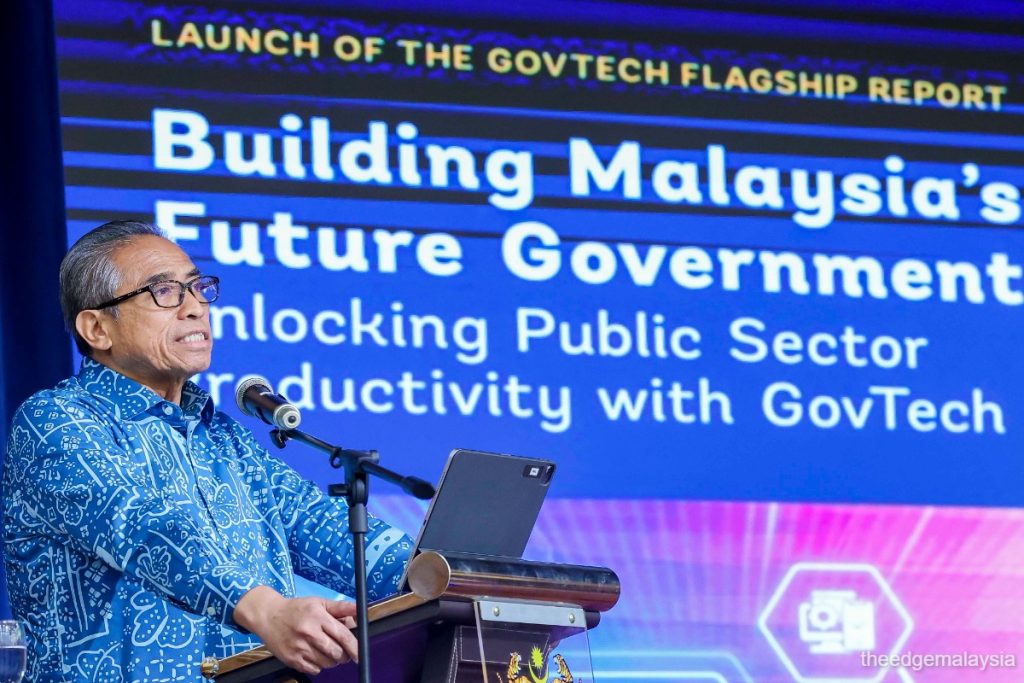
The findings are contained in a report titled Building Malaysia’s Future Government: Unlocking Public Sector Productivity with GovTech, prepared by the World Bank in collaboration with the Ministry of Digital and other government agencies. The report is based on the GovTech Skills Survey covering more than 16,500 civil servants across 28 ministries.
Civil servants cite tech, policy gaps slowing data sharing
The report also found that even with numerous policies being introduced, the technical and institutional barriers continue to slow data sharing across government.
Among civil servants surveyed, 59% cited technical incompatibility as the biggest obstacle, followed by unclear policies or guidelines (54%), legal and regulatory restrictions (50%), lack of trust between agencies (44%), insufficient resources (36%) and limited awareness of the benefits of data sharing (35%). Only 3% said they faced no barriers.
Still, 70% of respondents agreed that sharing data across agencies improves government decision-making. Officials in the Ministry of Economy were the most frequent users of inter-agency data, with 91% requesting information from other agencies at least quarterly.
The report was launched by the Chief Secretary to the Government Tan Sri Shamsul Azri Abu Bakar, together with the presence of the World Bank country manager for Malaysia Judith Green.
The report also found that there is an uneven institutional readiness across ministries to support Malaysia’s digital transformation agenda, with participation in whole-of-government digital initiatives varying considerably. It also highlighted a shortage of advanced digital skills among public servants as another constraint on digital transformation.