
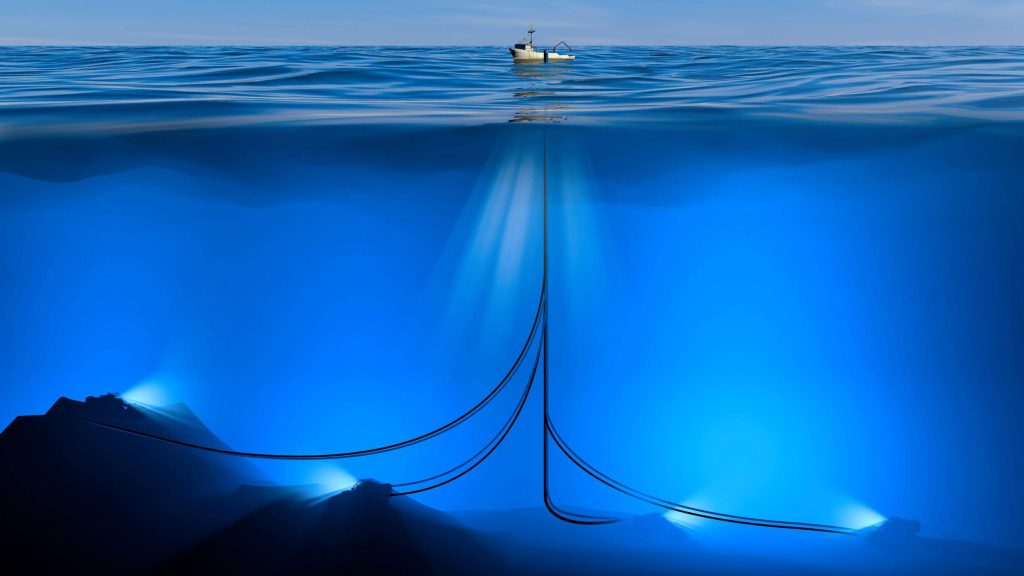
Image: Deep Reach Technology.
When President Donald Trump met with Japanese Prime Minister Sanae Takaichi in March at the White House, little attention was paid to their discussions about a tiny Japanese island in the Pacific Ocean, barely big enough for human visitors but inhabited by dangerous snails.
Minamitorishima, a pancake-flat speck of land about the size of a few city blocks with little more than a weather station and a runway, lies over 1,000 miles southeast of Tokyo. It also sits astride deep-sea rare earth deposits — ones that could “meet centuries’ worth of industrial demand,” a US-Japan statement about cooperation to consider mining them heralded after the summit.
The response was widespread skepticism. Despite decades of global seabed exploration and mapping, no such mining projects have reached commercial scale and international guidelines are still debated. Minamitorishima’s bounty, encased in mud, also happens to be some of the deepest considered for extraction, at around six kilometers (3.7 miles) beneath the ocean’s surface.
“Minamitorishima is an ambitious project, but one that could enable Japan and the US to possess a fully closed-loop, mine-to-magnet rare earths supply chain, helping to break China’s leverage over them,” said William Chou, a senior fellow at the Hudson Institute.
Plans now appear to be taking shape for how the Minamitorishima project might proceed. Japan’s Cabinet Office recently reported back the results of test samples retrieved earlier this year, showing significant levels of yttrium, gadolinium and dysprosium – so-called heavy rare earths that China is particularly dominant in producing. More test drilling is planned, with a target of developing a plan.

A handful of North American companies, including Houston-based Deep Reach Technology, have expressed interest in the project to extract the Minamitorishima deposits, according to people familiar with the situation, although those conversations are at a very early stage. Work so far has been entirely handled by Japan, which has advanced deep sea exploration capabilities, but the heft of US companies with experience in oil and gas drilling would likely become part of the solution.
American support has become all the more significant as China shows its own interest in the seabed deposits, in the form of repeated visits from oceanographic survey ships near Minamitorishima. A Bloomberg News analysis of commercial tracking data from one Chinese research ship shows it has conducted surveying of the seabed in recent years right up to Japan’s exclusive economic zone — the area of sea 200 nautical miles from a coastline that guarantees the nation sole exploration and exploitation rights for resources.
For Beijing and Tokyo alike, the challenges would be formidable. Offshore oil drilling projects to date only reach around half the depth of the Minamitorishima seabed. Water pressure at the site is around 600 times greater than at sea level and little is known about life forms that could be impacted by commercial mining. If successful, the project would likely require billions of dollars of investment over more than a decade to produce rare earths at around three times the cost of land-based extraction in China, according to one private sector estimate.
Under any other Japanese prime minister, the project might have been viewed as mostly aspirational given its cost, complexity and long timeline. But for Takaichi, it has become a core part of her plan to wean Japan off its reliance on China and something she has been passionate about since her time as Japan’s economic security minister for two years through 2024.
In a national election stump speech earlier this year, she touted her involvement in pushing the project forward: “This means Japan won’t have to worry about securing rare earths — not for our generation, and not for the next generation either.”
China’s throttling of rare earth supplies to Japan since late last year as punishment for remarks Takaichi made about Taiwan has only added to her determination. Her long-term growth strategy anticipates around $5.7 billion in public and private sector funding by 2040 for deep sea resource development, including the Minamitorishima project.
In Trump, she has found a partner with a similar desire to lessen China’s leverage over the US in rare earths and open up seabed mineral exploration and mining for US businesses. In April, the Republican leader ordered federal agencies to quickly review and issue licenses and permits for projects in the US and internationally.
There are other reasons Takaichi has sought to bring the US into the project. As a conservative who views Japan’s alliance with the US as an important asset in defending national interests from China, joint production of rare earths from Minamitorishima would help her bind the two countries closer together by creating supply chain security for materials China otherwise has a stranglehold on.
In doing so, it would send a clear strategic message to Beijing — in an area where Chinese interests stretch far back.

Decades ago, China secured exclusive rights for deep sea exploration in blocks near to Minamitorishima and the US territory of Guam from the International Seabed Authority, the United Nations affiliated organization that manages the mineral resources of the seabed beyond national jurisdiction. The recent survey ship activity suggests Beijing’s interest in mineral exploration in the area is growing, as does a growing volume of research papers published in China about the region, according to Tokyo University professor Kentaro Nakamura, who is part of a team that has studied the area.
In June 2025, events became more ominous when one of China’s aircraft carriers entered the Minamitorishima EEZ, the first time any Chinese naval vessel had been in the area. The visit was brief and wasn’t a breach of international law, but Tokyo was alarmed and protested to Beijing. It recently moved an anti-ship missile battery to the island for live-fire training and is working on plans to add more radar and other defense facilities nearby to monitor Chinese and Russian military activity.
“That felt almost like someone pointing a blade at us,” Shoichi Ishii, the program director for the Minamitorishima rare earth project at Japan’s Cabinet Office, said of the Chinese carrier approach.
In response to questions from Bloomberg, the Spokesperson’s Office of the Chinese Ministry of Foreign Affairs said China’s marine scientific research activities “serve peaceful purposes and strictly abide by relevant provisions of international law.” It also said “China consistently pursues a defensive national defense policy, and the activities of Chinese warships in the relevant waters are entirely in accordance with international law and international practice.”
From samples retrieved by Japanese survey ships, Nakamura and his colleagues estimated in 2018 that mud on the seabed south of Minamitorishima contained more than 16 million tons of rare earth minerals, the vital ingredients of modern economies, essential for everything from semiconductors to electric vehicle motors to missile guidance systems. Deposits of one of the elements, yttrium, used in LED screens and semiconductor equipment, were sufficient to meet 780 years of global demand, they forecast.
After some initial excitement, progress was slow in considering how to retrieve the minerals. But by the time Trump and Takaichi met in March, the hunt for rare earth supplies had rocketed up the priority list for both governments. In retaliation for Trump’s trade tariff offensive, China imposed export controls on rare earths to the US, using its leverage as the supplier of around 90% of the minerals globally. Beijing used the same tactic against Takaichi.
Trump’s interest in Minamitorishima was sparked by the scale of the potential supply it offered after Takaichi first raised it with him on a visit to Tokyo in October 2025, according to people familiar with his response. Then before Takaichi traveled to Washington in March this year, Japan made it clear that it wanted the matter to be high on the agenda, these people said.
Little has been said publicly by the US since the two countries signed a memorandum of understanding for deep sea mining after the March summit. However, Deep Reach Technology, an offshore engineering consultancy and project management company, has held initial meetings with Japanese officials, according to Jim Wodehouse, vice president of projects at the company.
Deep Reach is already working on a separate project related to the extraction of polymetallic nodules – avocado-sized clusters of cobalt and other critical minerals found on the seabed – in the Minamitorishima EEZ. “I’m positive about research in the Minamitorishima EEZ,” Wodehouse said in an interview. “The rare earths are very rich and include important heavy elements, as well as having low levels of radioactivity.”
Among elements found in the Minamitorishima mud are so-called heavy rare earths such as dysprosium and terbium that are among the most tightly controlled by China and also some of the most essential industrial inputs. Exports from China to Japan of dysprosium and terbium, used by Japanese firms to make high-performance magnets for electric vehicles, have been at zero all year.
Another advantage of the Minamitorishima deposits is that while extracting heavy rare earths from traditional surface mines often releases potentially harmful radioactive elements, samples from Minamitorishima were not found to have significant levels of radiation, making them easier to process.
Nakamura and the University of Tokyo team estimate around 3,500 tons of mud could be retrieved each day through a suction pump system used in deep-sea oil mining, but there isn’t a consensus yet on an effective extraction method. Deep Reach holds patents in both the US and Japan for technologies that could be used in sea bed mining. Refining and processing of ores is a field dominated by China but Japan is developing its own capabilities, and Nakamura said these could be scaled up.
“There aren’t any major technical obstacles,” Nakamura said, arguing that test extractions have shown that the depth of the deposits isn’t a significant obstacle. “It’s just about political will and the challenge from China.”
Japan has already had some success in reducing its dependency on China for rare earths, after Beijing restricted shipments to Japan during a political spat in 2010 following a boat collision near disputed islands in the East China Sea. Still, despite investing in a rare earth separation facility in France and long-term financial backing for Australian miner Lynas Rare Earths Ltd., Tokyo still imports around two-thirds of its total rare earths from China and almost all of the heavy rare earth elements.
Off limits
Up until recent years, the island of Minamitorishima wasn’t widely known among Japanese. A central government proposal to bury waste from Japan’s nuclear reactors on the island as well as the rare earth discovery thrust the tiny outpost into the news.
The EEZ around the island is a circle larger in area than the entire landmass of the Japanese archipelago, giving Tokyo rights to a huge area of ocean for exploration.
The island is off limits to ordinary citizens and the only travel method there is a six-hour Japanese C-130 military transport flight to the island once a week that delivers supplies to weather observation station staff and military officials responsible for maintaining the runway.
Masahito Tanaka, a 50-year old Navy pilot who was commander of the Minamitorishima military detachment for a year through March 2022, said in an interview that one of the challenges was keeping the runway clear of huge numbers of migratory birds. Staff also had to be careful of fist-sized giant African snails on the island that appear after heavy rains and can carry parasites, he said.
On a visit to the nearby island of Iwoto, also known as Iwojima, in March, Defense Minister Shinjiro Koizumi warned of a “security vacuum” among lightly defended islands on Japan’s Pacific side. Since then, the Defense Ministry has created a new team of officials responsible for bolstering surveillance of foreign ships and aircraft and defense of the islands. Plans under consideration include the deployment of new radar systems, runway extensions and new harbor facilities for ships.
In June, a Type 12 Surface-to-Ship Missile launcher arrived in Minamitorishima along with an electronic warfare system and Scan Eagle II drone, a deployment described by defense officials as intended for live-fire testing of missiles into the sea.
Lasting US interest?
Despite geopolitical frictions over Japan’s Pacific islands, the deep sea exploration is pushing ahead.
A full-scale mining test lasting one month is planned for February 2027 that will include refining and smelting, with an aim to complete an assessment of the feasibility of commercializing domestically produced rare earths in Japan a year later. If successful, it would be Japan’s only rare earths mine, enabling it to close the loop on rare earths magnet production, said William Chou of the Hudson Institute.
Privately, some Japanese government officials acknowledge that there’s no prospect of the project getting up and running during the remainder of the Trump presidency. That could raise questions about sustained US backing as Washington looks for other solutions to tackle China’s dominance of rare earths in the more immediate future.
But while the prospects for a successful project remain unclear, the message it sends to China also resonates for the US as it remains locked in a stand-off with Beijing.
“You can make the argument that the American enthusiasm for Minamitorishima is also part deterring China and trying to convince them that ‘We are not entirely reliant on you,” Chou said. “We have options, too.’ “
(By Alastair Gale, Akemi Terukina and Yoshiaki Nohara)