
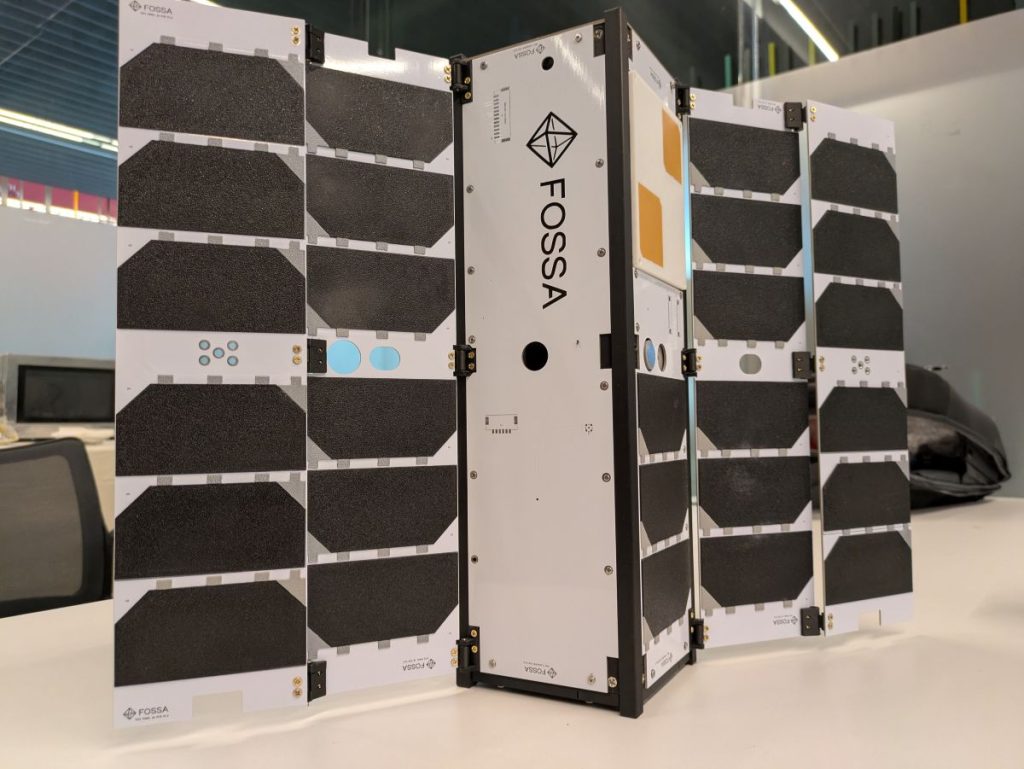
In an era of shifting geopolitical alliances and growing demand for space-based security capabilities, a Spanish aerospace company is quietly building what it calls the future of sovereign satellite technology—and it has set its sights on Japan.
FOSSA Systems, founded in Madrid in 2020, has launched more satellites into orbit than any other Spanish company in history and was recently selected for NATO’s DIANA defense innovation program. The company has also just opened its first office outside Europe in Shinagawa, Tokyo, and signed a strategic partnership with Japanese conglomerate Kanematsu Corporation, marking its entry into the Asia-Pacific market.
At South Summit Madrid 2026, Japan Forward sat down with the company’s COO and co-founder Vicente Gonzalez to discuss why Japan was chosen as FOSSA’s gateway to Asia, what “sovereign” technology really means, and how small satellites could play a growing role in Japan’s national security strategy.
FOSSA describes itself as a ‘vertically integrated operator.’ What does that mean in practice?
We design, build, and operate satellite constellations ourselves. So far, we’ve launched 25 satellites into orbit—more than any other Spanish company in history. We have a plan to launch more than 140 satellites in the coming years to provide near real-time connectivity and awareness services worldwide, covering the gaps left by cellular and terrestrial connectivity.
FOSSA emphasizes ‘sovereign’ satellite technology. What does sovereignty actually mean in this context?
Sovereignty is not about putting a flag on a satellite or a ground station. It’s about controlling the end-to-end system. We’ve seen in other parts of the world a huge reliance on third-country systems, and if you want to adapt those systems to your specific needs, it’s almost impossible—the owner of the technology has a backdoor that can block you.
What we want to provide is a real customer-controlled system that can be adapted to their needs without relying on third parties. The strategy is also to partner with local entities so the system could be integrated and built in Japan—to be fully Japanese.
Why Tokyo for your first office outside Europe?
We had the chance of having one Japanese investor—Nabtesco, a top Japanese corporation—which helped us analyze the feasibility of establishing a subsidiary there. We honestly see Japan as the main driver to enter the Asia-Pacific region. It’s a top-notch technology country, well regarded across the region, and we’ve seen huge opportunities for collaboration with different companies.
What specific needs in Japan’s defense and industrial sectors can FOSSA address?
We can help both the commercial and defense sectors deploy their own satellite infrastructure. A Japanese company—the Ministry of Defense, Mitsubishi, whoever—could manage its own constellation to monitor data sets.
Japan is an island surrounded by countries that may be seen as a threat. Having the capacity to identify what’s happening in the electromagnetic spectrum could really help the Japan Self-Defense Forces maintain situational awareness and keep frontiers protected.
We’ve also seen strong interest in the maritime domain—installing devices in buoys to monitor wind, temperature, salinity, and atmospheric conditions to optimize maritime routes.
How does the Kanematsu partnership help you enter this market?
Japan is quite a different country—the culture is so different. It’s not easy for foreign companies to get to know decision-makers in top industrial companies or defense and national security agencies.
Partnering with Kanematsu has been key to reaching potential agencies, gathering feedback and requirements from end-users to help build our technology roadmap. They are our right hand in Japan—part of the FOSSA team. It’s really necessary to have a Japanese presence in order to sell to those big potential customers.
What are the main real-world use cases you’re targeting in Japan?
There are two main groups. First, asset tracking and monitoring—installing technology in vehicles, helicopters, pipelines, and critical infrastructure that can’t rely on terrestrial connectivity. Japan faces huge challenges with earthquakes and tsunamis, so you might want to monitor the structural health of buildings or detect leakages in oil and gas pipelines without depending on ground networks.
Second is tactical messaging—a deployed soldier could carry a small device and send secure messages between units, like a medical evacuation request, in a hostile or communications-denied environment. On the signals intelligence side, we can record the electromagnetic spectrum, detect anomalies such as GPS jamming or spoofing, and locate threats using multiple satellites.
One civilian example: detecting vessels engaged in illegal fishing that have switched off their AIS identification transponders—the ship’s radar or satellite phone can still be detected from space.
What did selection for NATO’s DIANA program mean for FOSSA?
It’s been a leap forward—a seal that truly makes the difference. It enables us to gather information from top-tier end-users. With that feedback and those requirements, we can build a technology roadmap to make products that are operationally feasible, robust, and tailored to defense needs. It’s been a key milestone in the history of FOSSA.
What would success in Japan look like in three to five years?
For me, success would mean having 20 to 25 employees in Japan with manufacturing capabilities there, selling to the major keiretsu or partnering with the main agencies—and why not, having JMSDF satellites built by FOSSA up in space.
RELATED:
Spain and Japan Seek a New Strategic Balance
Author: Daniel Manning