
Grid congestion and interconnection backlogs have emerged as critical bottlenecks in renewable energy transitions across many global economies, and Japan is no exception. However, Japan’s challenge is rooted less in resource availability than in institutional design.
Although Japan’s renewable energy pipeline continues to expand, the conversion of projects from application to physical grid connection remains weak, particularly for transmission-dependent technologies such as offshore wind and battery storage. This has resulted in a widening gap between queue capacity and capacity that is actually integrated into the power system.
Japan’s renewable energy bottleneck is therefore not primarily a question of ambition or resource constraints. Rather, it reflects structural issues in how the interconnection system allocates costs, manages queue discipline, and coordinates transmission expansion. Until these institutional challenges are addressed, renewable capacity is likely to continue accumulating in the pipeline without materially reshaping the country’s electricity generation mix.
Grid connection queue gap
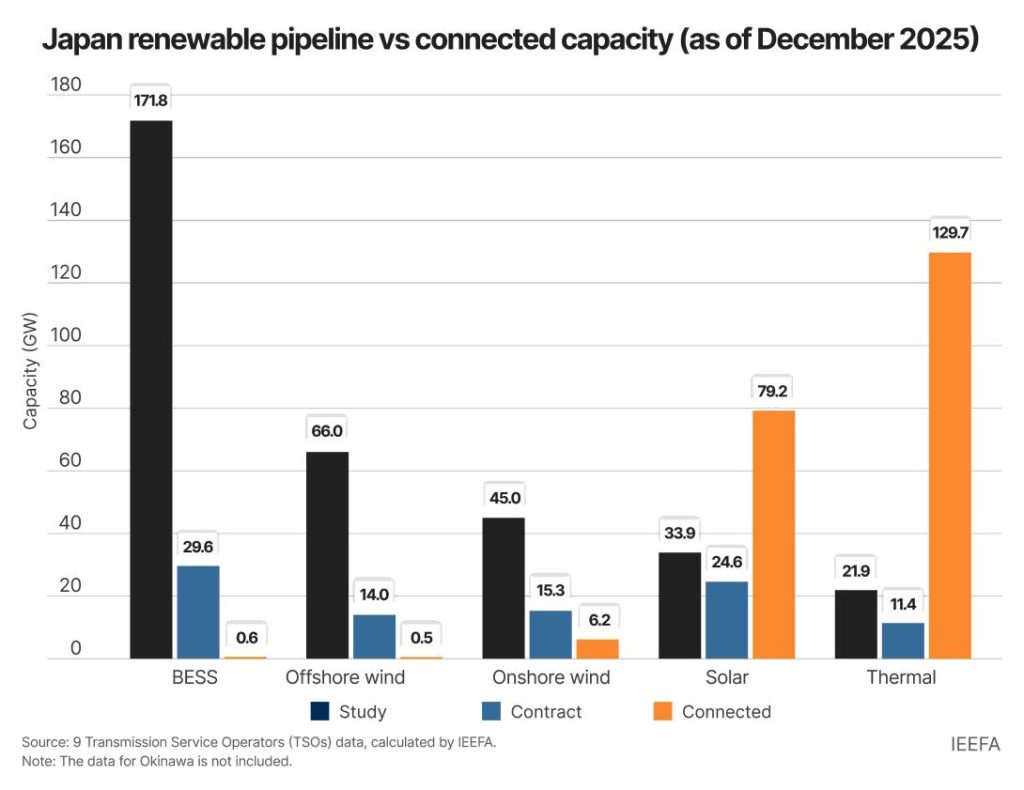

Japan’s grid application data suggest that the country’s renewable energy pipeline continues to expand. However, a widening gap has emerged between projects in the interconnection queue and those that have been physically connected to the grid.
According to data from Japan’s nine Transmission System Operators (TSOs) as of December 2025, the imbalance across technologies is significant. Of the approximately 317 gigawatts (GW) of wind, solar, and storage capacity under study, only around 87GW (27%) had been physically connected to the grid. Solar shows the highest realization rate, with connected capacity equivalent to about 2.3 times the current study-stage volume. This high solar realization rate reflects the earlier feed-in-tariff (FIT)-driven build-out and the comparative ease of connecting solar projects at the distribution level.
By contrast, wind and battery storage projects show much lower conversion rates from study stage to physical connection, reflecting their reliance on high-voltage transmission access and longer development timelines. Onshore wind has converted only around 14% of study-stage capacity into operational assets. The offshore wind conversion rate remains below 1%, partly due to long auction-to-construction lead times and the need for dedicated transmission links. Battery storage shows the lowest rate at roughly 0.35%, as projects compete for scarce firm capacity in already congested grid regions.
Thermal power capacity, meanwhile, remains structurally dominant. Connected thermal capacity exceeds study-stage volume by more than five times, reflecting the persistence of an established generation base rather than significant new expansion.
Why projects stall in the queue
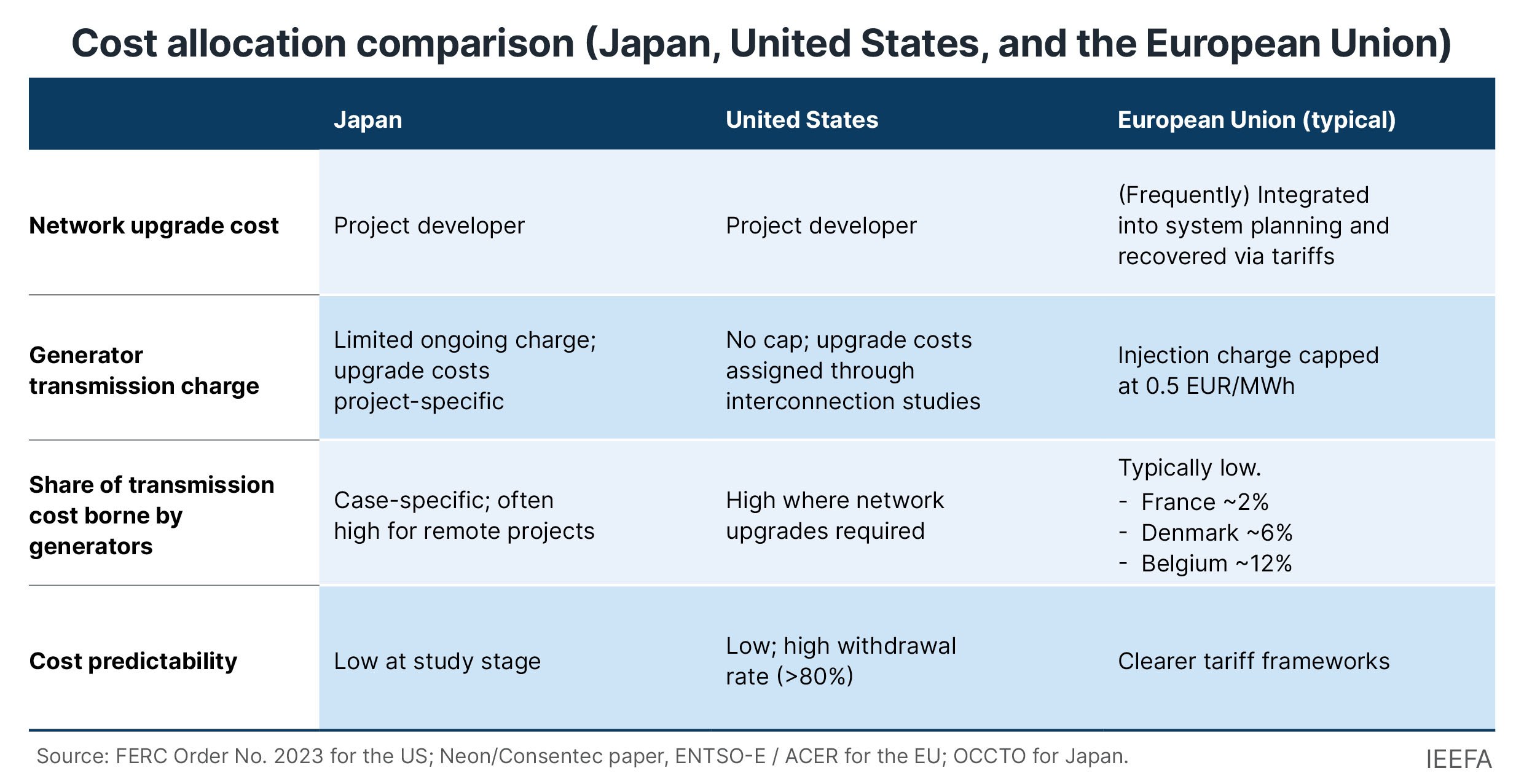
Grid congestion is not unique to Japan. Globally, 3,000GW of renewable energy projects were waiting in interconnection queues in 2022. In Europe, over 500GW of wind and other renewable projects await grid connection assessments. In the United States (US), more than 2,600GW of generation and storage capacity has sought interconnection — more than double installed capacity — with over 80% eventually withdrawing due to high and uncertain upgrade costs.
Japan therefore faces a challenge common to many advanced economies, although its institutional design differs. Under European Union (EU) electricity market and renewable energy rules, member states must provide non-discriminatory grid access and priority connection and dispatch for renewables, subject to system security. Generation transmission charges are capped at EUR0.5 per megawatt-hour (MWh) (USD0.59/MWh), and a significant share of reinforcement costs is socialized through regulated tariffs. While queues persist, cost allocation rules and connection rights are defined ex ante at the regulatory level. In practice, however, delays increasingly reflect physical grid constraints and broader implementation challenges.
By contrast, Japan’s grid connection bottleneck is shaped by three structural features of its interconnection framework: cost allocation, queue design, and geographic transmission constraints.
Cost allocation
In Japan, inter-regional transmission reinforcement is primarily funded by developers, who are required to bear a significant share of the new connection costs.
Under the interconnection process, the required reinforcement costs are determined by transmission or distribution operators following technical studies. Developers therefore lack certainty over the final reinforcement cost burden. Instead, they receive a cost estimate after the study phase and must decide whether to proceed under the specified conditions. Once defined, there is limited scope to renegotiate the underlying cost allocation framework.
This interconnection framework shifts a substantial portion of upgrade cost risk onto developers at a stage when project permitting and revenue certainty are often incomplete, thereby increasing early-stage financial exposure. In effect, Japan’s framework applies a strong “causer pays” principle to connection-related grid upgrades.
Queue design
Queue design further compounds Japan’s grid connection challenge. Historically, the country’s interconnection system has operated on a first-come, first-served basis. In congested regions, firm transmission capacity is often already occupied by incumbent assets, forcing new entrants to rely on non-firm connections that carry significant curtailment risks. As a result, many renewable energy projects depend on non-firm access to secure grid connections.
Despite reforms to non-firm connection rules, queue discipline and prioritization remain weak, allowing early-stage and speculative projects to compete with ready-to-build projects for scarce capacity. As a result, capacity accumulates without clear prioritization based on grid system value.
Geographic transmission constraints
Renewable energy potential is concentrated in regions such as Hokkaido, Tohoku, and Kyushu, while demand is centered in major consumption hubs like Tokyo and Kansai. Limited cross-regional transmission capacity has therefore created structural bottlenecks between regions where renewable energy is generated and where it is ultimately consumed.
The Organization for Cross-regional Coordination of Transmission Operators (OCCTO) grid master plan aims to strengthen inter-regional transmission links, while Japan’s Ministry of Economy, Trade and Industry has discussed the need for more planned and proactive reinforcement of intra-regional backbone networks.
However, many projects currently in the interconnection queue remain constrained by regional transmission limitations and project-specific reinforcement needs that cannot be resolved quickly through long-lead network expansion alone.
Pathways toward renewable energy integration
The widening gap between study-stage projects and connected capacity suggests that Japan’s renewable energy bottleneck is fundamentally institutional in nature. The current framework places significant upgrade cost risk on developers, relies heavily on first-come, first-served queue management, and provides limited prioritization for transmission-dependent technologies.
If left unchanged, this structure could continue to slow renewable energy deployment, not because projects are lacking, but because the interconnection framework constrains the conversion of applications into operational capacity. Without reforms to improve cost transparency, project prioritization, and transmission coordination, renewable energy capacity is likely to continue accumulating in the queue without translating into large-scale transformation of the power system.