
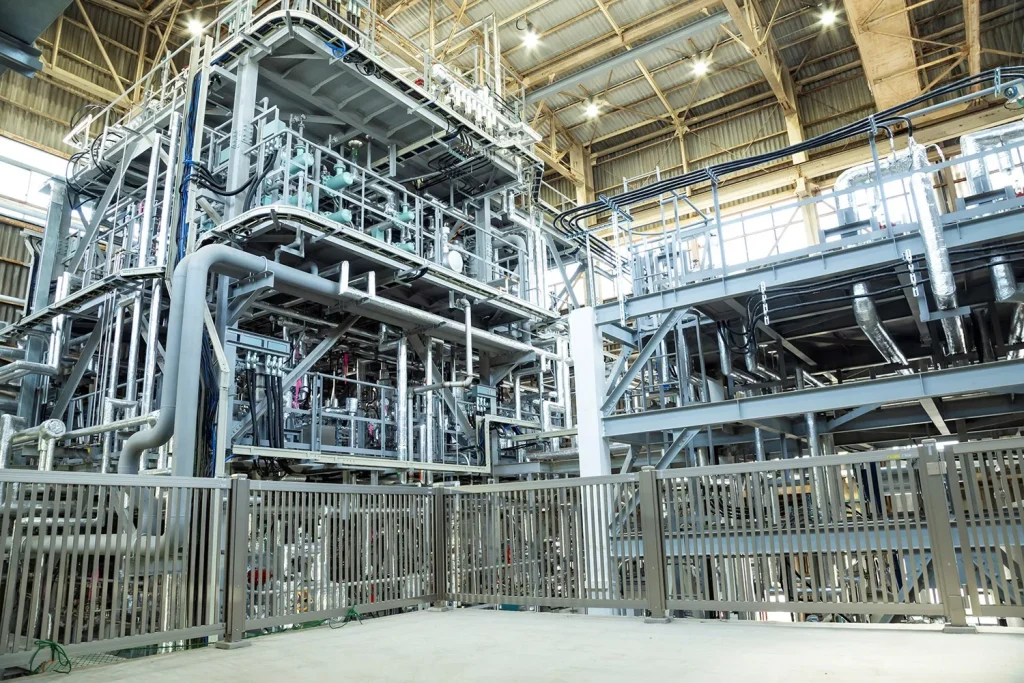
Fez– Japan has taken a new step toward carbon neutrality in the transport sector with the launch of a synthetic fuels demonstration plant designed to produce cleaner fuel using carbon dioxide and hydrogen.
According to Enos Corporation, the project focuses on reducing emissions from aircraft, cars, and other vehicles by developing synthetic fuels made from recycled CO2 and CO2-free hydrogen.
Supported by the Japanese government under the Green Innovation Fund Projects managed by the New Energy and Industrial Technology Development Organization, the plant officially began operations in September 2024.
Built inside a research laboratory, the facility can currently produce one barrel, or around 159 liters, of synthetic fuel per day.
It is considered the first plant of its kind in Japan capable of carrying out the entire production process in one integrated system, starting from raw material supply to the final fuel production stage.
The process begins with the supply of carbon dioxide and the production of CO2-free hydrogen through water electrolysis powered by green energy.
The plant then converts these materials into synthetic gas using the reverse water gas shift reaction before transforming it into synthetic fuel through the Fischer-Tropsch synthesis process and further upgrading stages.
Researchers say another important feature of the project is the planned use of carbon dioxide captured directly from the atmosphere.
The facility is expected to use Direct Air Capture technology developed by Climeworks AG as part of its raw material supply.
The project represents years of gradual technological development.
Long before carbon neutrality became a global priority, researchers had already started studying synthetic fuel production methods using a small experimental system capable of producing only around 30 milliliters per day.
Through repeated testing and engineering improvements, the project expanded from a laboratory-scale setup into a large demonstration plant covering nearly 1,200 square meters.
Researchers aim to use the facility to improve efficiency, solve technical challenges, and develop technologies needed for larger-scale industrial production in the future.
One of the project leaders described the launch of the plant as a major milestone since the project began in 2022.
The official said seeing the first drop of oil produced at the facility was a moment of pride for everyone involved in the research and construction process.
The team now plans to operate the plant continuously while studying production performance and identifying technical issues that still need to be solved before the technology can be commercially implemented.
Researchers also stressed that safety will remain a priority as they continue balancing scientific research with industrial-scale production goals.