Both Thailand and Indonesia have grown into strong, growing tech hubs for tech talents globally. For developers, product managers, designers, and remote workers looking beyond the usual choices, these two Southeast Asian countries keep coming up in conversations with individuals asking which is the better choice for building a tech career.
You see it in places like Bangkok, where co-working spaces, startup meetups, and regional tech offices are becoming part of the city’s everyday rhythm. And then there’s Bali, which has evolved from a tourist hotspot into a magnet for remote workers and indie builders trying to mix work with a different pace of life.
A lot of this growth comes from Government-backed initiatives, and relaxed visa pathways, as well as a steady flow of startup funding, have all played a role in turning both countries into viable options for tech talent.
Here’s how both Asian countries compare in what they offer.
Tech Startup Ecosystem
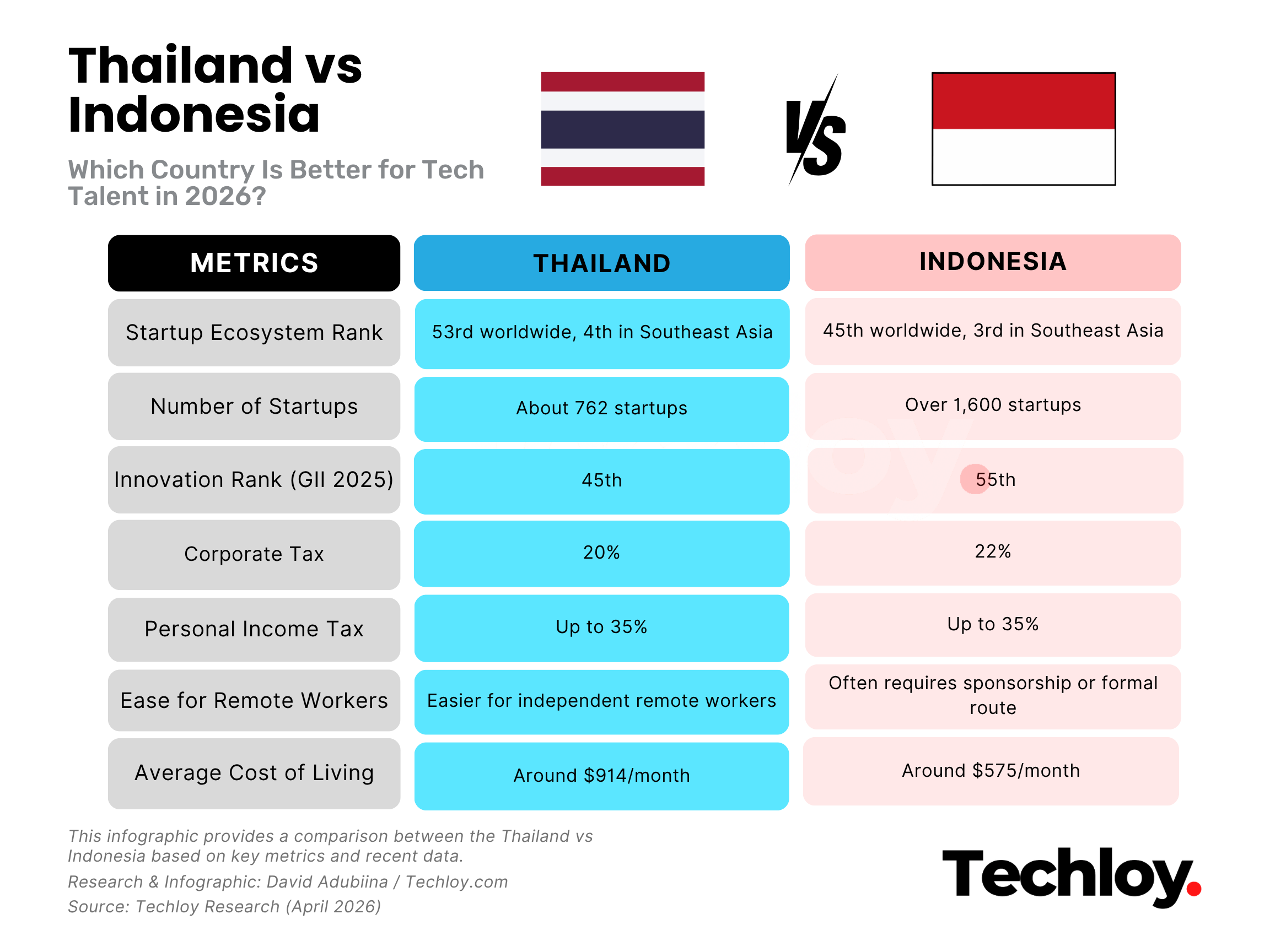
When it comes to the global startup ecosystem, both countries are active startup players. According to StartupBlink, Thailand’s startup ecosystem ranks just behind Indonesia and ahead of Vietnam, coming 53rd worldwide, with around 762 startups. It climbed one spot from the previous year and remains 4th in Southeast Asia, holding steady since 2024.
Indonesia’s startup ecosystem is ranked 45th worldwide, even after falling nine spots from the previous year. It remains 3rd in Southeast Asia and is home to more than 1,600 startups, which reflects Indonesia’s scale and growing digital economy. For tech workers, it can mean more openings across fintech, e-commerce, logistics, and consumer apps.
Thailand’s ecosystem is smaller, but still competitive and increasingly attractive for regional roles and startup growth.
Who’s Winning the Innovation Race?
Based on the Global Innovation Index 2025 rankings, Thailand ranks higher in innovation when compared to Indonesia. It ranks 45th and has largely maintained its position. While this speaks volumes of the growth taking place in Thailand, Indonesia does not seem to be falling behind, even though it is 55th on the ranking
Instead, Indonesia continues to rank among the GII’s “innovation overperformers.” This is the fourth consecutive year it has held that position, which points to steady growth.
Areas like knowledge and technology output are seeing strong growth. That’s usually where you start to see real activity, not just policy or plans, but actual output.
So while Thailand holds the higher spot, Indonesia keeps showing up in the details.
Which offers lower tax?
Both Indonesia and Thailand use progressive personal income tax systems, with top rates reaching 35% in both countries. However, Thailand generally offers lower corporate tax rates at 20%, compared with 22% in Indonesia.
Thailand also has a higher tax-free threshold for personal income, starting at 150,000 THB ($ 4,700).
For tech talent, Thailand can be more favorable for mid-to-high income earners. Its progressive tax system reaches the top 35% rate on income above 5,000,000 THB ($ 156,000).
In Indonesia, income up to IDR 60 million ($3,500) is taxed starting at 5%, while income above IDR 5 billion($292,000) is taxed at 35%.
Looking at the numbers, Thailand can be more tax-efficient for some higher earners, while Indonesia may still work well for those with lower incomes or those benefiting from its lower cost of living.
Cost of living
The average cost of living in Indonesia is around $575, which is about 37% less expensive than Thailand at $914, according to livingcost, which can make a difference for freelancers, remote workers, or early-stage founders trying to stretch income further.
Indonesia’s global rankings also reflect that gap, ranking lower than Thailand on the list of the most expensive countries in the world. Although Thailand may offer more convenience in some areas, overall, Indonesia offers lower monthly costs.
Visa Costs and Accessibility Compared
Comparing accessibility and visa costs between both asian countries, Thailand offers the best of both for many tech professionals. Thailand currently offers a 60-day visa exemption for many Western countries, which makes short-term entry convenient and free.
Its most recognized long-stay option is the Thailand DTV, a five-year multiple-entry visa that allows stays of up to 180 days per entry. Applicants need proof of 500,000 THB in savings, and the application fee is considered relatively accessible.
Indonesia, on the other hand, requires a 500,000 IDR (about $32) Visa on Arrival for 30 days, which can be extended to 60 days.
For longer stays, Indonesia offers several pathways for tech professionals, including the E33G Remote Worker KITAS, which requires showing a minimum annual income of 1billion IDR ($ 60,000) for foreign-employed remote workers.
However, many Indonesian visas that allow work, such as the ITAS for specialists, still require sponsorship from an Indonesian-based entity or registered guarantor.
That means Thailand may feel easier for independent remote workers, while Indonesia can work well for those entering through an employer or formal business route.
China vs. America: Who Is Really Winning the AI Race in 2026?
The gap between the U.S. and China in AI is shrinking.