
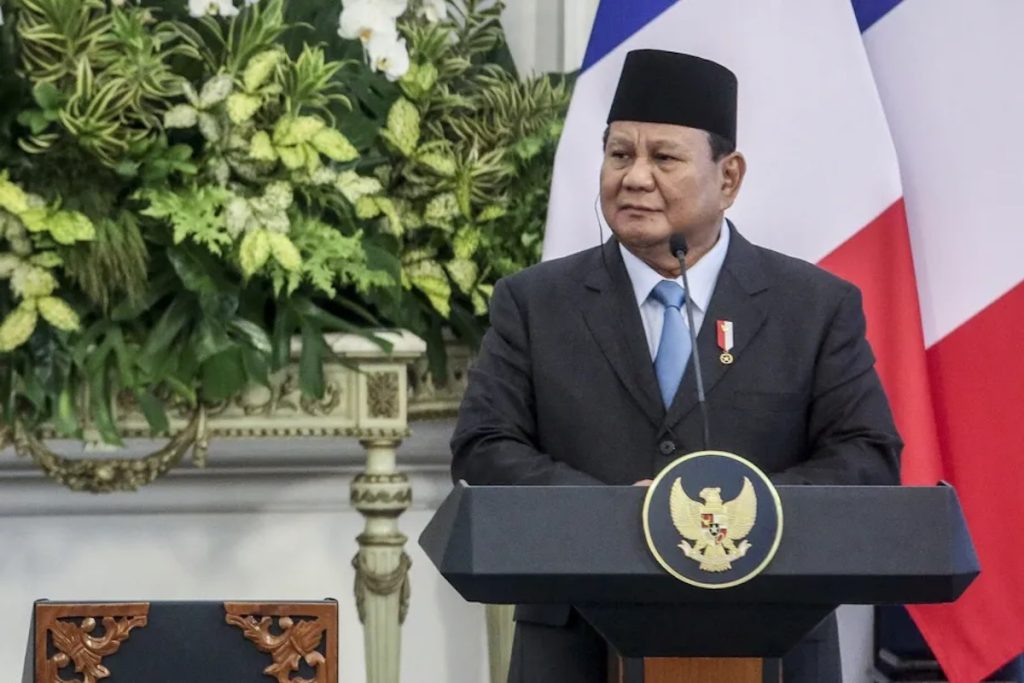
Indonesia’s President Prabowo Subianto has unveiled one of the most consequential
economic interventions since the fall of Suharto: a plan to centralize exports of strategic
commodities — including palm oil, coal and ferroalloys — through a state-controlled
structure linked to the sovereign fund Danantara.
The official justification is seductive. Indonesia, the government says, has lost hundreds of billions of dollars through under-invoicing, transfer pricing and opaque offshore trading schemes.
The problem is real. Commodity exporters across the developing world have long shifted profits to Singapore, Hong Kong or Dubai while reporting artificially low prices at home. Governments lose taxes. Foreign exchange earnings disappear offshore. National wealth leaks outward.
But the cure proposed by Prabowo may prove more dangerous than the disease.
Rather than strengthening Indonesia’s existing institutions — the tax office, customs authority, financial intelligence agencies and anti-corruption bodies — the administration is building an entirely new layer of state control over trade. According to reports, the mechanism will operate through a newly established entity, PT Danantara Sumberdaya Indonesia, registered only shortly before the president’s parliamentary speech.
This is not merely bureaucratic reform. It is a structural shift in how Southeast Asia’s largest economy intends to govern capital, exports and political power.
Prabowo frames the move as economic patriotism. Indonesia, the world’s largest exporter of palm oil and thermal coal, should no longer allow foreign intermediaries to determine prices for its resources. He wants exporters to route transactions through a centralized platform under state supervision.
Yet behind the nationalist rhetoric lies a deeper reality: fiscal pressure.
Indonesia faces mounting budgetary demands from energy subsidies, food programs, industrial policy and ambitious welfare spending. At the same time, the rupiah has weakened sharply against the dollar, prompting authorities to tighten foreign-exchange rules and require export earnings to remain longer in domestic banks.
The export gateway is therefore not just about combating fraud. It is about capturing liquidity, securing state revenue and asserting greater control over strategic commodities at a moment of economic anxiety.
There is also a political logic hiding beneath the economic one.
By controlling export flows, the state gains leverage over domestic supply. Indonesia’s biodiesel expansion program — particularly the push toward B50 fuel blending — requires enormous volumes of crude palm oil. State electricity utility PLN depends heavily on reliable coal supply. A centralized export mechanism gives the government indirect power to prioritize domestic allocation over exports without formally imposing bans.
For companies, the signal is unmistakable: exporting will become more complicated, more political and more dependent on administrative approval.
The transition period reportedly gives firms barely days before implementation begins. In commodity markets, where contracts, shipping schedules and financing are planned months ahead, such abrupt intervention creates uncertainty that investors punish immediately.
And history offers Indonesia a warning.
During the Suharto era, the government created the Clove Support and Trading Board (BPPC), the state-backed clove trading monopoly controlled by Suharto’s son Tommy. The official goal was to stabilize prices and protect farmers. The result was cronyism, distorted markets and widespread suffering among small producers. Political insiders captured rents while farmers lost bargaining power.
Today’s Indonesia is not Suharto’s Indonesia. Its institutions are stronger, its press freer and its economy more integrated globally. But the political temptation remains the same: When states control trade flows, access to power becomes economically priceless.
That is why many businesses fear selective enforcement. Companies with strong political connections or alignment with the administration may face lighter scrutiny and smoother approvals. Others may encounter regulatory bottlenecks, delayed permits or opaque compliance hurdles. Even if no formal favoritism exists, the perception alone damages investor confidence.
Markets do not merely evaluate economic fundamentals. They evaluate predictability.
Indonesia has spent two decades persuading global investors that it is a stable democratic economy governed by rules rather than patronage. This new export regime risks undermining that progress. Reuters reported growing investor concern about policy unpredictability and expanding state intervention, amid capital outflows and pressure on Indonesian assets.
The irony is painful. A policy intended to strengthen the rupiah could weaken it over time.
Currencies depend not only on foreign-exchange reserves but also on trust. Investors need confidence that contracts will be honored, regulations applied fairly and commercial decisions insulated from politics. When governments abruptly centralize commodity trade, investors begin pricing in political risk premiums. Capital becomes more cautious. Financing costs rise.
Most troubling, corruption rarely disappears when states centralize power. It simply relocates.
Under-invoicing by private firms is unquestionably a serious problem. But replacing decentralized opacity with centralized discretion can create something worse: institutionalized rent-seeking inside the state itself. The opportunities for favoritism, hidden commissions and political patronage may expand rather than shrink.
Indonesia deserves better than choosing between private leakage and state monopoly.
The country’s challenge is not a lack of control. It is a lack of institutional credibility. Stronger customs enforcement, digital trade transparency, automatic tax-information exchange and judicial independence would address commodity fraud without concentrating enormous commercial power in politically connected entities.
Prabowo is betting that more state control will produce national strength. But history — in Indonesia and elsewhere — suggests that when governments begin controlling who can sell, who can export and who can access markets, economic nationalism often drifts toward oligarchy.
Once trust erodes, rebuilding it is far harder than tightening control.
Bhima Yudhistira Adhinegara is the executive director of the Center of Economic and Law Studies (CELIOS). Muhammad Zulfikar Rakhmat is the director of the China-Indonesia and MENA-Indonesia desks at CELIOS.