
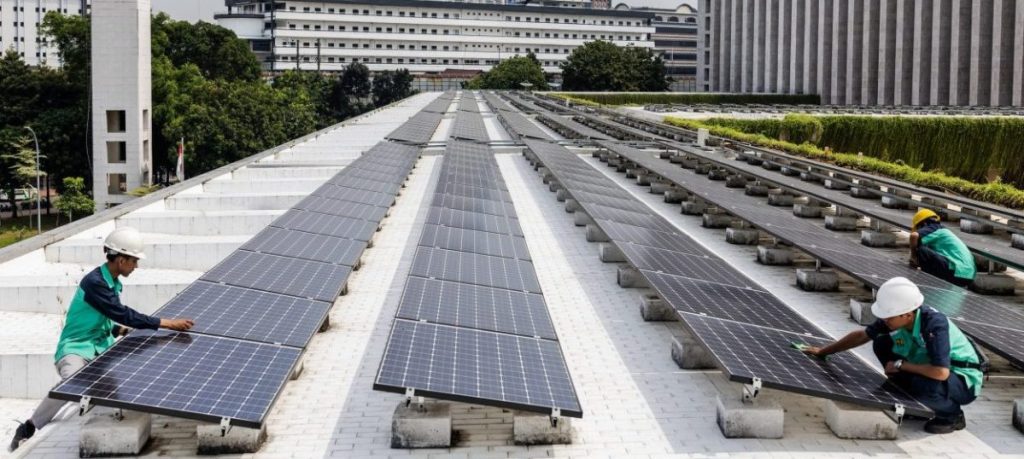
Indonesia’s plan to generate 100 GW of solar energy is laudable. However, there are serious concerns about implementation.
In August 2025, Indonesian President Prabowo Subianto announced an ambitious plan to deploy 100 gigawatts (GW) of solar photovoltaic (PV) capacity within five years — equivalent to 93 per cent of Indonesia’s current power capacity. In response to the energy crisis following the US-led war against Iran, the president compressed the timeline to two years, framing solar-powered electricity as an urgent need amid the current geopolitical landscape. This commitment provides new momentum for Indonesia’s energy transition and decentralisation plans. However, the bolder ambition leaves serious concerns unaddressed: the Prabowo administration is maintaining its strategy to rely on village cooperatives to execute the programme without strengthening their capacity.
The government is currently discussing the initiative, and its implementation details have yet to be decided. According to President Prabowo’s vision, 80 GW of the targeted solar PV capacity will be developed through 1 megawatt (MW) distributed solar plants paired with 4 megawatt-hour (MWh) battery energy storage systems across 80,000 villages and subdistricts, to be managed by the merah putih village/ sub-district cooperatives (KDMPs). A key priority under the Prabowo administration, KDMPs are government-backed, membership-based village enterprises designed to strengthen local economies through collective ownership and mutual assistance. The Prabowo administration initially aimed to have 80,000 KDMPs fully functioning by March 2026. Yet, the target remains out of reach with only 1,061 units currently operational — around 1 per cent of the target. This state of affairs reflects the administration’s rush to deploy programmes at speed despite limited resources and institutional capacity.
Even if the KDMPs can be rapidly established, the underlying capacity deficit will serve as a critical barrier. Although a few KDMPs may meet the necessary conditions, the hard reality is that most villages lack supportive regulatory frameworks, technical expertise, adequate financing, and enabling infrastructure to develop and sustainably manage solar PV infrastructure.
Current regulations only acknowledge Perusahaan Listrik Negara, Indonesia’s primary utility provider, as the sole owner and controller of renewable energy projects, including small village-scale installations. This puts KDMP-led solar PV systems in a grey area.
A recent survey of village officials underscores the lack of capacity among KDMPs, with 78 per cent of respondents identifying capacity-building as an urgent need. This is not surprising, given that many villages lack adequate educational infrastructure. For example, Statistics Indonesia (BPS) reports that senior high schools are available only in 22 per cent of villages; the corresponding figure for vocational schools is 13 per cent. This shortfall could pose a serious problem, as solar-plus-storage infrastructure requires advanced expertise in inverter systems and high-voltage electrical maintenance.
To support KDMPs, the government is providing each of them a state-backed loan of IDR 3 billion (US$175,000) at a 6 per cent interest rate. To prevent default, repayments are secured through direct deductions from the Village Fund and other fiscal transfers (introduced in 2015, the former is a government-funded programme that provides dedicated funding to villages to promote rural development). Yet, the loan is not earmarked primarily for solar infrastructure development. Even if it were allocated to the solar initiative, the amount would still be insufficient to finance the development of 1 MW of solar PV, which is estimated to cost around IDR14.6 billion (US$900,000). As for private financing, individual KDMPs would likely find it challenging to meet banks’ financial and loan requirements for a standalone solar project. At the same time, endemic corruption can undermine project financing. Indonesia’s Corruption Eradication Commission has recorded 900 corruption cases involving village funds since the fund was rolled out in 2015. Ironically, half of those found responsible are village leaders.
Compounding these challenges are land constraints. The installation of 1 MW of solar PV requires 1-2 hectares per village. Some villages and subdistricts do not even have space to host KDMP buildings, let alone 1 MW solar installations.
Ultimately, the success of this vision must be measured not only by the number of panels installed today, but also by their ability to generate power a decade from now.
The above concerns cannot be treated as merely hypothetical. From 2011 to 2015, the Indonesian government built 500 community-scale solar PV systems in rural areas. In 2015, at least 10 per cent of them were in a state of disrepair due to weak governance, poor maintenance, and a lack of financing. Policymakers should learn from these lessons as they embark on the 100 GW solar agenda.
If the new vision falls short, it will add to Indonesia’s litany of failures at meeting energy transition targets. The country recently failed to meet its renewable energy mix goal for 2025. It reached only 15.75 per cent against an original goal of 23 per cent, which was later lowered to 17–19 per cent. The broader consequences of repeated failures should not be underestimated as they will undermine the credibility of Indonesia’s commitment to energy transition. Lack of credible commitment can discourage investment in Indonesia’s energy transition, at a time when Just Energy Transition Partnership (JETP) —a financing mechanism initially expected to catalyse Indonesia’s energy transition — has yet to show significant progress.
To deliver 100 GW of sustainable solar PV capacity, the government must first create enabling conditions and strengthen KDMP capacity. Until the capacity gaps are addressed, the government should not issue a blanket instruction for all 80,000 KDMPs to build and directly manage 1 MW solar PV systems. To promote early engagement of local stakeholders, it could develop pilot projects that facilitate partnerships between KDMPs and experienced entities such as state- or locally-owned enterprises or independent power producers. Different partnership models could be explored, including arrangements in which KDMPs own the solar PV infrastructure while contracting professionals to handle operations and maintenance. This approach would help address the capacity gaps while facilitating knowledge transfer. Prabowo’s 100 GW solar ambition provides a new impetus for Indonesia’s energy transition. However, if the government relies on KDMPs without first ensuring they have adequate capacity, the initiative risks resulting in stranded assets nationwide that are no longer operational or efficient. Ultimately, the success of this vision must be measured not only by the number of panels installed, but also by their ability to generate power a decade from now.
2026/174