
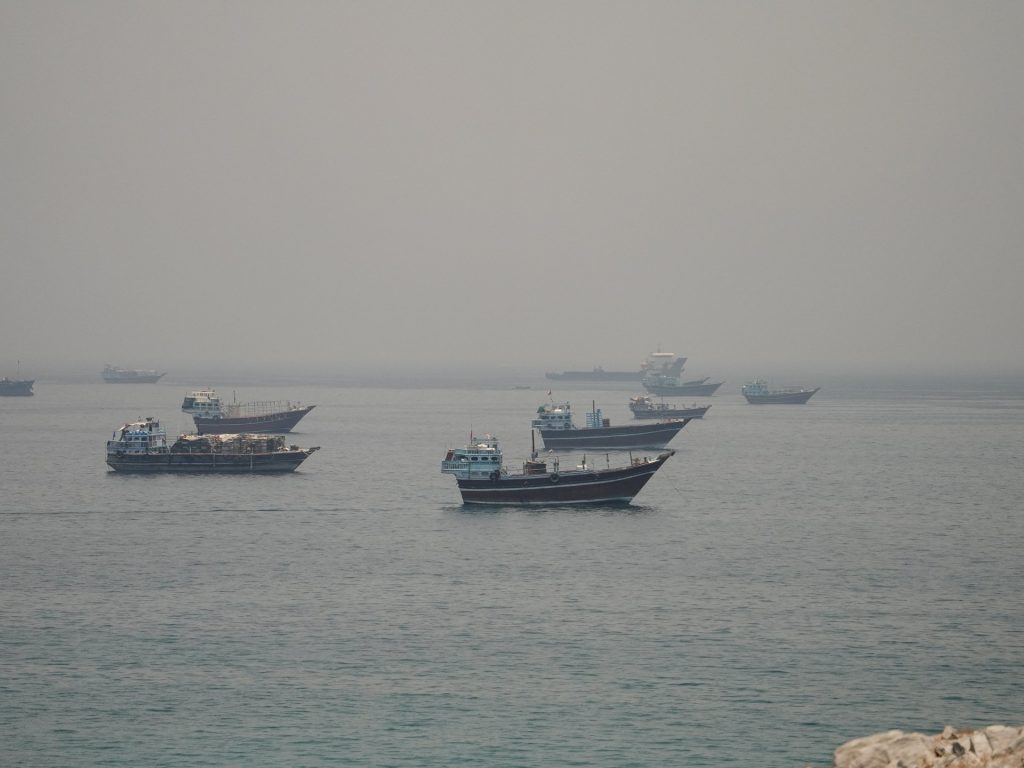
Three Indian sailors have been killed in strikes on at least three commercial ships in the Strait of Hormuz this week, as the United States doubles down on its naval blockade of Iranian ports.
The Indian government on Wednesday summoned a senior US diplomat in New Delhi to demand an explanation after the US military hit a Palau-flagged ship, off Oman’s coast, killing the three Indian sailors. Hours earlier, the US had also bombed another Palau-flagged vessel with 24 Indian sailors on board – also off the coast of Oman.
Recommended Stories
list of 3 itemsend of list
And on Thursday, US Central Command (CENTCOM) said its forces had “disabled” a third tanker in the Gulf of Oman after the vessel “violated the blockade against Iran by attempting to transport Iranian oil”.
By Friday morning, US President Donald Trump and Iranian officials were both speaking optimistically of the prospect of an agreement to at least extend the fragile ceasefire between their countries, brokered first in April by Islamabad. But for thousands of seafarers, stranded on either side of the Strait of Hormuz, peace remains elusive.
The attacks on ships with Indian sailors is also the latest friction point in the relationship between Washington and New Delhi, which has reached new lows during US President Donald Trump’s second term. Trump is expected to meet his Indian counterpart, Narendra Modi, next week at the Group of Seven (G7) summit in France.
So, why are Indian sailors dying in the Strait of Hormuz?
Which ships has the US struck?
In the past four days, the US military has attacked three vessels carrying Indian merchant navy men on board.
On Monday this week, Manoj Yadav, general secretary of the Forward Seamen’s Union of India, said he received frantic calls from Indian crew aboard the Palau-flagged Marivex ship, requesting help.
“We have fire onboard, we have fire onboard. And vessel is sinking,” a crew member on board the ship said in the message. “US Navy attack, the missile on our engine room. We have hole at the bottom … 24 crew. All crew Indian. Please help quickly.”
They were all rescued by the Omani military and taken to an island off Oman’s coast following the distress call.
Later, US CENTCOM confirmed that an F-18 Super Hornet fighter jet from the aircraft carrier USS Abraham Lincoln had “fired a precision munition into the ship’s engineering and steering spaces” to disable the sanctioned ship.
The next day, the US struck the Palau-flagged Settebello, killing three Indian sailors on board. US forces said the vessel had violated the ongoing blockade of Iranian ports. The remaining 21 Indian crew were rescued.
On Thursday, the Indian embassy in Oman said that it was investigating yet another incident involving a vessel off the Shinas port in Oman, which took place in the early hours of the morning.
Yadav said the latest ship to be targeted, MT Jalveer, has 20 Indian crew members. “It is a serious concern. The last three days have erased any little relief that was there after the ceasefire,” he told Al Jazeera.
“Suddenly, the attacks over the last three days show that Indian seafarers are being targeted.”
Yadav argued that the US military could have taken control of the ship rather than firing missiles at it. “They are not warships; they are commercial ships,” he said. “But the US military is not firing a warning shot; they are shooting a bloody missile that will definitely destroy ships and kill the sailors.”
Esmail Baghaei, the spokesperson of Iran’s foreign ministry, condemned the “brutal US attacks” that “stand as clear evidence of America’s ongoing policy of armed robbery and State piracy.”
“The international community must hold the United States accountable for its lawless conduct, which continues to threaten global peace and security while endangering the freedom of navigation,” he added in the statement.
In a statement late Wednesday, Secretary General of the International Maritime Organization (IMO) Arsenio Dominguez said that he “strongly” condemned “any act from any party that endangers the lives of seafarers and the safety of international shipping. This is simply unacceptable”.
Have Indian sailors been hit before?
Yes. Indian seafarers have repeatedly found themselves on the front lines in the Strait of Hormuz, despite Iran having allowed some Indian ships to pass through it at certain times since the US-Israel war on Iran began. Iran closed the strait early into the war, threatening to fire on any ships trying to pass, but has at times allowed ships from nations it deems “friendly” to go through.
The first fatality was reported just days into the war, on March 1. An Indian crew member aboard the Marshall Islands-flagged tanker MKD Vyom was killed when the vessel was struck by an unmanned surface missile off the coast of Oman. No one claimed responsibility for the attack, although US CENTCOM blamed Iranian forces.
The same day, an attack on the Palau-flagged tanker Skylight near Oman’s Musandam Peninsula killed two Indian crew members, while a third was reported missing.
Two Indian vessels were struck in the Strait of Hormuz on April 18. India’s foreign secretary, Vikram Misri, summoned Iran’s ambassador to India, Mohammad Fathali, to convey India’s “deep concern” about the incidents.
On May 8, yet another Indian sailor was killed when a wooden dhow carrying Indian crew members caught fire near the Strait of Hormuz.
These attacks were not immediately attributed by Indian officials, but reportedly originated from Iran.
In all, at least seven Indian sailors have been killed during the war so far.

How has India responded?
New Delhi has lodged diplomatic protests. On Wednesday this week, it summoned Jason Meeks, the US Embassy’s deputy chief of mission in the Indian capital, to convey its “deepest concerns over the ongoing attacks”.
“It is deeply unfortunate to learn of the tragic incident aboard the Palau-flagged MT Settebello,” Sarbananda Sonowal, India’s shipping minister, said in a statement, verifying that the three Indians initially reported missing had been confirmed dead.
On Thursday, Indian Foreign Ministry spokesperson Randhir Jaiswal noted there were US attacks on three ships with Indian crews this week.
“These attacks must cease and end,” he told reporters. “We also call for dialogue and diplomacy so that we can have an early return to peace and stability in the region.”
Jason Chuah, a professor of maritime law at City St George’s, University of London, told Al Jazeera that the fact that Indian sailors have been killed aboard a ship registered in Palau – neither of which are party to the ongoing conflict – is likely to provoke “some serious diplomatic headaches”.
“From Palau’s point of view, it is indeed reasonable to suggest that neutral ships flying non-belligerent flags should be given stronger protection during a blockade,” he said.
“The frustrating part, however, is that even if most think it [the attack] was wrong, actually doing something about it is a whole different story. That’s always been a nightmare with international law. Knowing something’s illegal and actually holding anyone accountable for it are two very different things.”
Is it legal to bomb non-combatant ships?
The Strait of Hormuz passes through the territorial waters of Oman and Iran, with the outer edges of it extending to the territorial waters of the United Arab Emirates (UAE). It is not in international waters. However, international maritime law still applies to any natural strait, such as Hormuz, which is used by international shipping.
According to Article 38 of the United Nations Convention on the Law of the Sea (UNCLOS), all ships and aircraft should “enjoy the right of transit passage”, which cannot be suspended by any country. Article 17 of the convention states that all foreign ships also have the “right of innocent passage” in the territorial waters of any nation, and Article 19 states that passage is considered innocent so long as it is not “prejudicial to the peace, good order or security of the coastal state”.
Furthermore, under international humanitarian law, deliberately targeting non-combatant ships is illegal.
An Indian captain who has served in the merchant navy for decades, and who requested anonymity since he is still serving and not authorised to speak to the media, told Al Jazeera: “It is not OK to bomb non-combatant ships whose crew are neither armed nor pose a threat to the security of the coastal state.”
Chuah said the US strike on civilian cargo ships is “somewhat murky in legal waters”.
“The [US] blockade itself might be fine under the law of war rules – but there is the important question of proportionality. It is certainly arguable that firing on a tanker and killing the crew goes far beyond that which is proportionate,” he said.
Chuah added, however, that there is another view that the threshold of force in enforcing a blockade at times of war is higher than during peacetime.
“This means the actions taken to enforce a blockade can exceed simply intercepting the cargo vessel,” he said. “Capture and destruction might be permissible under narrow circumstances. But it would be intellectual contortion to justify or excuse the killing of civilian merchant seafarers with knowledge and intent.”
So what protections are available to Indian sailors?
According to India’s Directorate General of Shipping, more than 300,000 Indian sailors serve global fleets.
To ensure seafarers’ safety, India’s main maritime law, the Merchant Shipping Act, 1958, provides the framework for grievances and redressals, and protects seafarers’ rights. The law also protects Indian seafarers who are injured at sea.
In cases where an Indian seafarer is injured and dies on a foreign-registered ship while the vessel is at high seas, “it is the jurisdiction of the respective flag administration to conduct investigation into the cause of such accident or criminal incident”, and the government of India will participate as an observer in any such observation, the act states.
Meanwhile, if “any accident including the death or injury to any seafarer of any nationality on board a ship registered in foreign country” takes place when the vessel is near the Indian coast, the case can be investigated by an Indian officer.
The Maritime Union of India provides legal and financial aid to Indian seafarers in crisis in addition to the insurance and compensation that ship owners provide.
There is, however, little protection offered to sailors if their ship chooses to make the passage through blockaded straits, according to the Indian captain in the merchant navy.
He explained that when merchant vessels attempt to pass through blockaded straits, they must ideally persuade the governments of the ship’s respective flag states to initiate collective action through a multinational naval task force, such as the United Nations, in order to ensure that merchant ships are protected during their passage.
“Once the ships decide to make the passage, in order to minimise potential danger, only the bare minimum crew are kept on the bridge [point of navigation] and engine room [where propulsion takes place]. All the other crew stay off the forward part of the ship deck to escape chances of a direct missile or drone hit,” he said.
The latest round of escalation between Iran and the US has, however, left Indian seafarers highly fearful of sailing in Gulf waters, according to Yadav.
“Everyone is living under a big threat, waiting there like sitting ducks,” he said.
“The US military has shown that they do not put any value on Indian lives.”
