
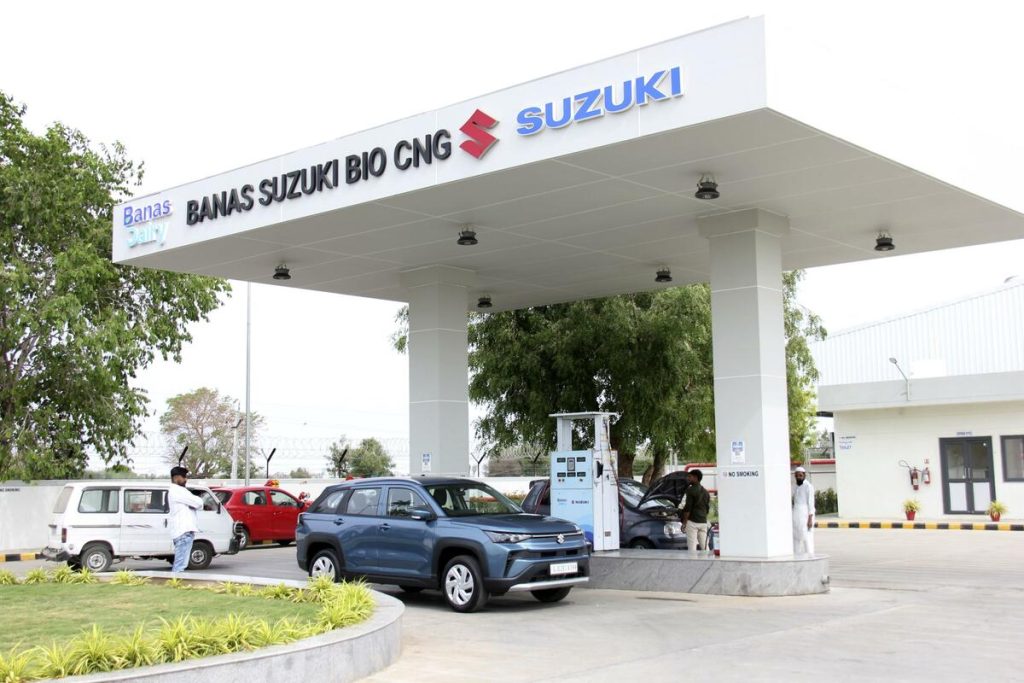
BHUKHALA, India – Japan’s Suzuki Motor Corp. has been producing biogas for use as vehicle fuel from cow dung in India, a key market for its cars, aiming to promote decarbonization while boosting local dairy farmers’ income.
In mid-March, the Japanese automaker unveiled a biogas plant to reporters in Bhukhala in the western Indian state of Gujarat, where cow dung is fermented for about a month in a large tank.
The generated gas is refined into fuel and supplied to nearby residents at a refueling station next to the plant. The leftover residue is sold as organic fertilizer.
Some 300 million cattle, regarded as sacred in Hinduism, are raised in India.
Biogas can be used as fuel for compressed natural gas-powered vehicles, which emit less carbon dioxide than gasoline-powered cars and currently account for around a fifth of India’s auto market.
Using cow dung also helps reduce methane emissions, which are a major cause of global warming. Otherwise, these emissions would be released from the waste.
The plant processes up to 100 tons of cow dung daily, producing around 1.5 tons of biogas — enough to power roughly 850 vehicles for one day.
Suzuki purchases dung from nearby farmers at a rate of one rupee per kilogram, generating an annual income of about 72,000 rupees ($775) for the average household.
The automaker currently operates two biogas plants in India and plans to build seven more. An official said the company aims to expand its operation across the country.