
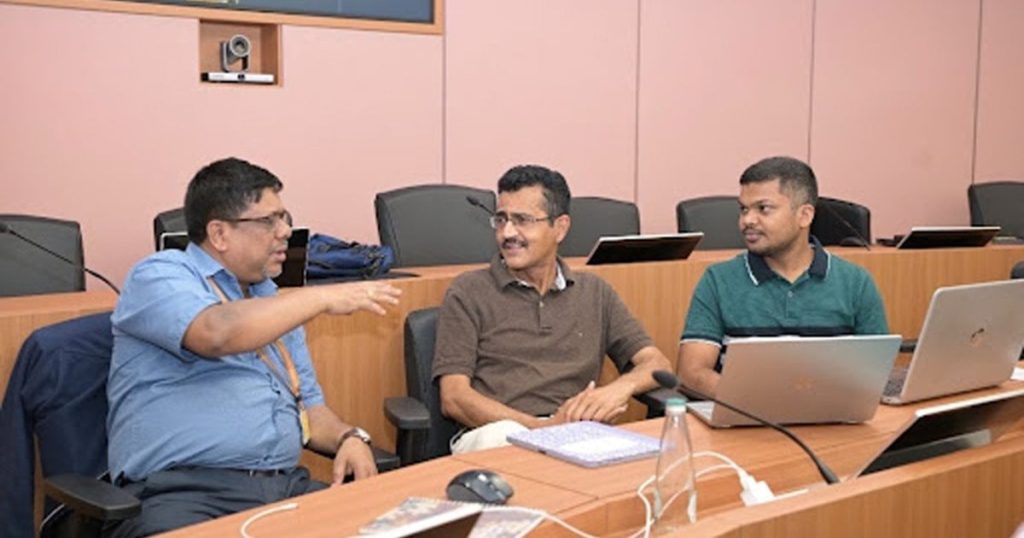
Scientists from NOAA/AOML, the Indian National Center for Ocean Information Services (INCOIS), the India Meteorological Department (IMD), the National Centre for Medium Range Weather Forecasting (NCMRWF), the National Institute of Technology (NIT) Rourkela, the University of Texas (UT) at Austin, and other partner institutions came together to review recent progress and outline the next phase of development for India’s next-generation coupled forecasting system.
A major achievement highlighted during the meeting was the successful implementation of the coupled IOLA system in experimental operational mode at IMD, INCOIS, and NCMRWF.
The system is also being actively used for research and development at NIT Rourkela and UT Austin, creating a seamless pathway between scientific innovation and operational forecasting.
The IOLA system is unique in its ability to provide seamless, multi-scale coupled forecasts ranging from basin-scale ocean-atmosphere interactions to regional severe weather events. By integrating advanced atmosphere, ocean, and land-surface processes within a unified framework, IOLA has become one of the first regional multi-scale coupled forecasting systems designed to support prediction across scales—from tropical cyclones and monsoon depressions to extreme rainfall events and hurricane-strength storms.
The IOLA system represents the evolution of more than a decade of NOAA–MoES collaboration that began with the implementation of NOAA’s Hurricane Weather Research and Forecasting (HWRF) model for tropical cyclone prediction over the Indian Seas. Building on that foundation, IOLA expands forecasting capabilities beyond tropical cyclones to encompass a broad spectrum of high-impact weather events, including monsoon rainfall, severe storms, and air-sea interaction processes across the Indian Ocean region.
Scientists from NIT-Rourkela reported encouraging results from the first-ever application of a moving-nest coupled IOLA configuration for monsoon prediction. In the meantime, scientists at UT Austin also used IOLA to understand the catastrophic rainfall event over North Carolina due to Hurricane Helene using another configuration of IOLA. The computing required for developing the framework was supported by UT Austin.
Originally developed to track and forecast tropical cyclones, the moving-nest framework was adapted to follow evolving monsoon systems and areas of heavy rainfall. Preliminary evaluations demonstrated improved rainfall forecasts compared to conventional approaches, highlighting the potential of scale-aware coupled modeling for forecasting high-impact weather across the region.
Following the meeting, Sundararaman “Gopal” Gopalakrishnan, NOAA’s principal scientist for the IOLA project, visited NIT Rourkela to meet with collaborators and define priorities for the next phase of model development. Discussions focused on strengthening coupled prediction capabilities, advancing AI-enabled forecasting applications, and expanding opportunities for collaborative research and workforce development under the NOAA–MoES partnership.
“The progress achieved through IOLA demonstrates the power of sustained international collaboration. By bringing together operational forecasting centers, academic institutions, and research laboratories, we are building a forecasting system capable of addressing some of the most challenging weather problems affecting the region and will lay the foundation for a unified coupled modeling system across scales,” said Sundararaman Gopalakrishnan, Ph.D., AOML Senior Meteorologist and principal scientist for the IOLA project.
This collaboration provides NOAA with valuable regional forecast verification information, operational feedback, and observational datasets to enhance the evaluation of coupled model performance for tropical cyclones, monsoon systems, and extreme rainfall events, while strengthening research-to-operations activities and the long-standing NOAA–MoES partnership.
As IOLA continues its transition from research to operations, the partnership between NOAA and MoES remains focused on delivering improved forecasts that support disaster preparedness, protect lives and property, and enhance resilience to extreme weather across one of the world’s most densely populated and weather-vulnerable regions.