
It sounded like a straightforward measure but the move to increase female representation in India’s parliament has proved anything but.
The Women’s Reservation Bill, which reserves a third of seats for women, was strongly supported when it was introduced in 2023, but a subsequent attempt to implement it was recently rejected by India’s parliament in 2026.
That’s because the bill can’t be rolled out until parliamentary constituencies are redrawn in line with more recent population data.
And that’s where it gets contentious.
Indian female lawmakers pose outside parliament house before the start of the debate in New Delhi. (AP)
While there’s broad agreement on the need for more women representation, currently around 14 per cent, the redrawing of electoral boundaries is a much tougher sell.
It’s mainly because India’s parliamentary constituency map has not been altered since the 1970s and the population has changed vastly since then.
Experts suggest redrawing India’s electoral map would likely increase the representation of northern states, which account for a much larger share of India’s population — around 40-50 per cent — compared to about 20 per cent in the south.
They say it could shift the balance away from southern states, where opposition parties dominate.
“Southern states are bound to lose a significant number of seats,” said Professor Sanjeer Alam from the Centre for the Study of Developing Societies in Delhi.
“Hence, their voice in parliament will get diluted.”
India’s 2011 census put the national population at 1.21 billion, but the number of elective seats in parliament remains at 543. (AP: Manish Swarup)
The government attempted to pass a series of bills last week around the redrawing of boundaries, also known as a “delimitation” process, which would have then paved the way for the implementation of women’s quotas.
Because a constitutional amendment was involved, a two-thirds majority was required.
The vote unsurprisingly failed.
“The BJP knew very well they did not have the numbers for a two-thirds majority,” Monash University’s Manisha Priyam told the ABC.
“But they wanted to send a message to women voters, ‘We as BJP want to empower you here and now. It’s the opposition that is blocking power coming your way’,” she said.
Burning the ‘black law’
Opposition parties hit out at the government’s move.
“This is not a Women’s Reservation Bill — it has nothing to do with women,” Opposition Leader Rahul Gandhi said.
“This bill is anti-national — against the south, north-east, north-west and small states.”
MPs from Dravida Munnetra Kazhagam (DMK), the ruling party of the southern state of Tamil Nadu, were among those protesting the bill.
They came to parliament dressed in black.
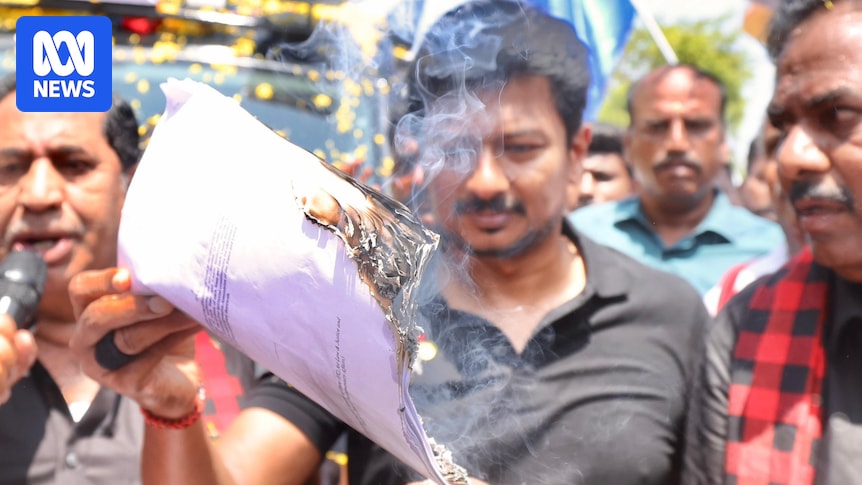
Tamil Nadu Chief Minister MK Stalin described the delimitation bill as “the black law”, calling it “punishment” for southern states and burned a copy.
Tamil Nadu’s chief minister, MK Stalin burning a copy of the bill he refers to as “the black law”. (X: @mkstalin)
“Our concern is with delimitation, which requires careful thought to ensure it is fair, especially for southern states,”
Mr Stalin said.
Leaders in the south say a population-based delimitation exercise punishes areas that have successfully slowed population growth and built strong economies.
Data has shown southern states outperforming other parts of the country in economic and other key factors.
“Since 1971, the southern states have curbed the population growth rate whereas the northern states have allowed their population to grow at a higher rate,” Professor Alam said.
Tamil Nadu’s Deputy Chief Minister Udhayanidhi Stalin burning copies of the bill. (X: @Udhaystalin)
“As a result of this demographic imbalance, southern states’ relative share in overall population has come down.
“Therefore, they are likely to suffer a loss of seats if population remains the basis of fresh allocation of seats across states.”
Modi accuses opposition of female foeticide
India’s government dismissed the opposition’s accusations, calling the outcome “an insult to every woman”.
In a nationally televised address, Mr Modi accused opposition parties of “killing” women’s reservation at inception, likening the defeat to “bhrun hatya”, which translates to abortion or female foeticide.
The Modi government says no state will be discriminated against during delimitation and that it’s about rebalancing parliament.
India’s PM Narendra Modi accused opposition parties of “killing” women’s reservation at inception.
(Reuters: Altaf Hussain)
“This celebration by the opposition is an insult to every woman who has been waiting for her rights for decades. How many times will the Congress and its allies betray women?” India’s Home Affairs Minister Amit Shah said.
“This country must not be fragmented through the narrative of north versus south.”
Mr Shah and India’s Ministry of Home Affairs did not respond to the ABC’s request for comment.
Members of the Tiruppur South Assembly Constituency burn a copy of the bill in protest. (X: @DMKTiruppur)
Professor Priyam said there were still many people who did not understand the process of delimitation.
“Political parties need to educate the people,” she said.