
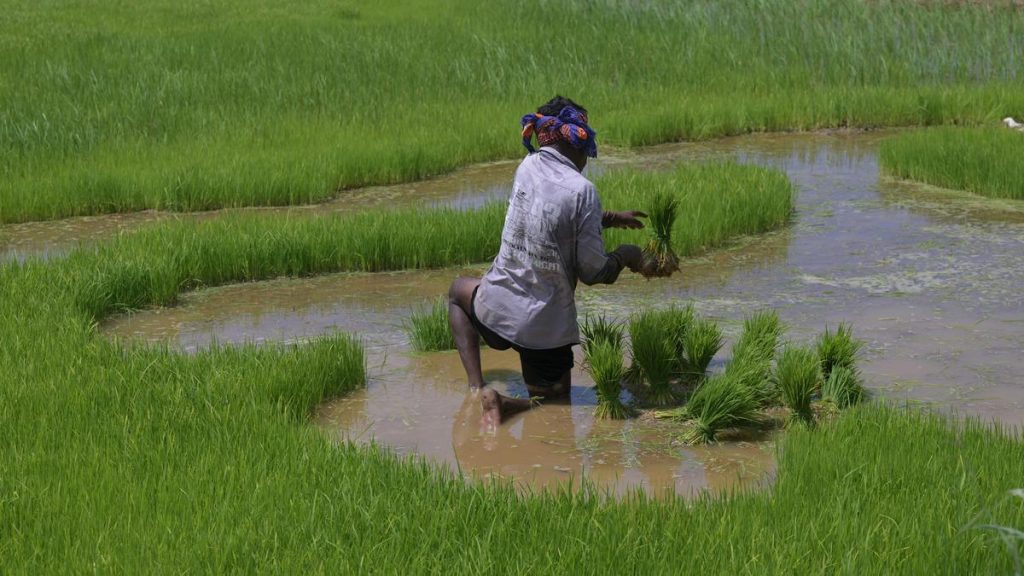
After the first month of this year’s monsoon ended in a massive 40% deficit, the India Meteorological Department has forecast that rainfall in July will also be “below normal” or less than 94% of what is usual for the month. “Below-normal rainfall can pose significant challenges for agriculture, water resources, hydropower generation, ecosystem sustainability, and drinking water availability,” the agency warned. The outlook for July comes on the back of weak rainfall in June.
Data from the IMD showed rainfall in June was 99.5 mm against a long-period average of 165.3 mm, a fall of 39.8% from normal across all four meteorological subdivisions. The outlook comes weeks after Union Agriculture Minister Shivraj Singh Chouhan sounded the alarm, warning about the impact of a potential ‘super’ El Niño. “This could directly affect Kharif crops, particularly in rainfed regions where agriculture is heavily dependent on monsoon rains,” he told reporters on June 23, 2026.

How could a poor monsoon damage India’s economy?
A poor monsoon can damage the economy in three ways: it affects agricultural output, reducing the sector’s contribution to the economy; it hits rural income, denting aggregate demand; and it threatens to push up food prices, causing inflation.
India came into this kharif season from a position of strength — foodgrain output in 2024-25 jumped to 357.73 million metric tonnes (MMT), up 25.43 MMT from the previous year. A weak monsoon now puts that momentum at risk.

In a report, CRISIL notes that while paddy acreage is expected to expand in Punjab, Haryana and Bihar, maize acreage is expected to decline as farmers shift towards more remunerative crops. Farmers might also prefer pulses, because of lower cultivation costs and water requirements, and may choose not to plant vegetables at all. Irrigation, MSP, procurement support and market conditions also factor in the decision-making process.
This could trigger food and beverage inflation. In its June bulletin, the Reserve Bank of India warned: “An adverse south-west monsoon, if materialised, may weigh on the domestic growth-inflation outlook.”
The authors noted that CPI inflation had risen to 3.9% in May 2026, up from 3.5% in April, with broad-based increases across food, fuel, and core components. The report noted that daily price data up to June 18 showed food inflation continued to rise and the prices of edible oils, potatoes, onions and tomatoes edged up.

A weak monsoon, coupled with higher global food prices driven by higher fertiliser, edible oil, and shipping costs, will only push them higher.
Agriculture accounts for only one-fifth of India’s Gross Value Added (GVA) but employs 46% of the workforce and supports nearly 55% of the population. “It will have a direct impact on the lives of people,” said Prof. R. Ramakumar, School of Development Studies, Tata Institute of Social Sciences.
Prof. Bharat Ramaswami, Department of Economics, Ashoka University, believes farm incomes could fall by up to 10%. “The rural non-farm sector consists mostly of non-traded services such as construction. These sectors contract when agriculture is adversely affected. Industries that depend on rural demand will be affected,” he said.

This stress moves into the wider economy. Automobile sales are a reliable early signal, two-wheelers and tractors are among the first sectors to feel the squeeze, followed by real estate in smaller towns and cities. Kotak Mutual Fund, in a blog, has noted that a combined El Niño-plus-drought scenario may shave 20–65 basis points off GDP growth.
Compounding the pressure are pests and fertiliser supply constraints caused by the Iran war. The Union Cabinet approved a ₹41,533 crore Nutrient-Based Subsidy for Phosphatic and Potassic fertilizers for the kharif season, covering 28 grades. If output still falls short, the government will have to release buffer stocks and import commodities, widening the Current Account Deficit and putting pressure on the rupee.
“The danger in 2026 is that the weak monsoon is coinciding with the outcomes of the West Asian conflict,” Prof. Ramakumar said, noting that Prime Minister Modi urged citizens in May to limit gold purchases and foreign travel to ease stress on India’s foreign reserves.
India’s agri-exports face a threat too. “Agriculture exports have clocked a CAGR of 8.2% between fiscals 2020 and 2025, contributing 12% to India’s core exports. That too, faces a threat,” said Dipti Deshpande, Principal Economist, CRISIL.

How did El Niño impact the economy?
Historically, El Niño has posed significant risks. Several of India’s worst droughts fell in El Niño years – 1972, 1982, 2009, and 2015. “In the 11 instances of below-normal or deficient monsoon performance at an all-India level since 2000, six were classified as El Niño years by the IMD. Of these, five saw deficient rainfall,” Ms. Deshpande said.
The 2009 and 2015 failures illustrate the different impact poor monsoons can have on the economy. “Two subsequent years of rainfall stress and all-India average irrigation cover less than 45%, caused agriculture output to suffer – crop GVA contracted 2.5% and 3.2% in fiscals 2009 and 2010, respectively. Inflation was in double digits,” she said.
El Niño conditions moved from weak to strong in 2014 and 2015, and both years saw monsoon disruptions. Crop GVA contracted, but the impact on inflation was different.
Unlike 2009, when food inflation spiked, inflation was rather muted in 2015 due to proactive food management, restrained MSP hikes, and a global commodity price slump, which kept overall prices in check despite the monsoon failure, Ms. Deshpande noted.
The average kharif output losses have fallen from 17% in early El Niño episodes (FY03, FY10) to just 1.4% from FY15 onwards, according to Equirus Securities. But prolonged episodes still take a toll as agri GVA has averaged just 1.3% in El Niño years against 5.5% in normal years, it notes. “A second successive bad weather will be more damaging,” Prof. Ramaswami said.
Can India ‘drought-proof’ the economy?
Agriculture Minister Shivraj Singh Chouhan’s presser raised an important data point: 315 districts are vulnerable to a poor monsoon, of which 111 across 12 states are of primary concern due to poor irrigation facilities. With more than half of India’s cultivated land still rain-fed and groundwater tables declining, a poor monsoon adds pressure to an already stressed system.

India needs to ‘drought-proof’ its economy, said Prof. Ramakumar. He said the country must move from crop insurance to ex-ante risk reduction. “We need to pay attention to policies and interventions that reduce risk itself. That requires public investment, and that’s lacking,” he said. He added that India needs enough drought-resistant, high-yielding crops, and that farmers must have access to them. “We have not invested adequately in any of these, and hence our disaster preparedness is very poor,” he said.
“India does spend a lot of resources on crop insurance. However, we spend no money on evaluating how the benefits reach the farmers. We will not be able to rely only on crop insurance. I expect the government will have to offer drought relief as well,” Prof. Ramaswami said.