
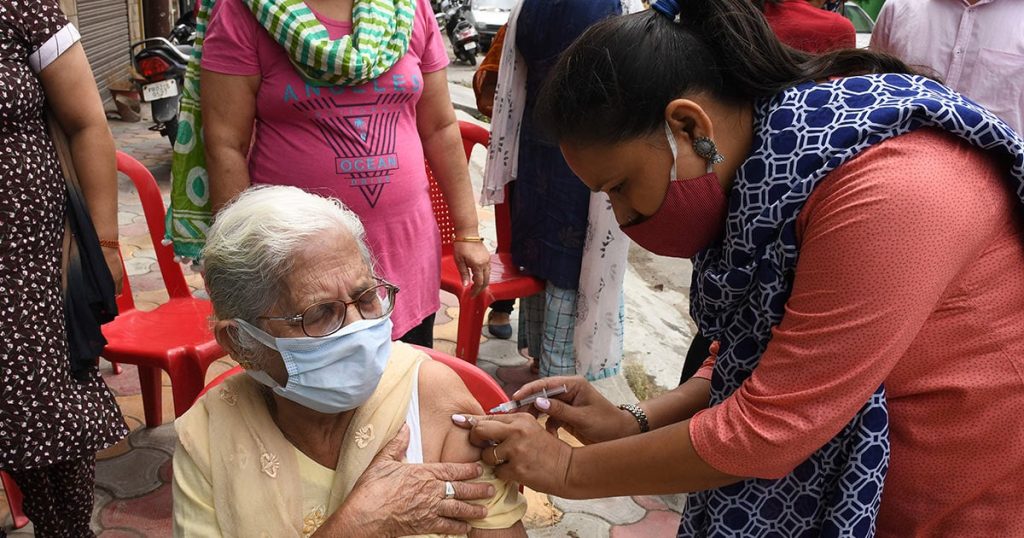

Image Source: Getty Images
Until the National Sample Survey (NSS) 80th Round on health in 2025, the only nationally representative data source on adult vaccination in India was the Longitudinal Ageing Study in India (LASI) Wave 1, conducted in 2017–18. LASI covered adults aged 45 years and above across 35 states and union territories, and its health module asked respondents whether they had ever received any one of five vaccines: influenza, pneumococcal, hepatitis B, typhoid, and diphtheria-tetanus. The resulting coverage figures were stark, with influenza coverage at 1.5 percent and pneumococcal coverage at 0.6 percent among older adults. However, the data had significant structural limitations for policy purposes. The vaccination module recorded only a binary ‘yes’ or ‘no’ response for each vaccine, with no information on when the dose was received, where it was administered, its cost to the household, or how many doses had been administered.
The NSS 80th Round, fielded in 2025 under Schedule 25.0 on health, marks the first time that a large-scale national household survey in India has collected detailed, multidimensional data on adult vaccination across the full adult population. Unlike LASI, the round covers adults of all ages, establishing comparable coverage estimates from age 18 onwards and enabling age-disaggregated analysis at the 50- and 60-year thresholds that matter most for an ageing policy agenda. The result is a dataset that can, for the first time, situate adult vaccination within India’s broader health financing architecture, whether vaccinations are delivered free through the government healthcare system or through the market. It is, in short, the baseline from which any serious adult immunisation programme in India will have to be built. As the immunisation findings were not a part of the initial report of the 80th Round published in April 2026, this article presents a country-level assessment of adult immunisation based on an analysis of the unit-level data.
The NSS 80th Round’s headline figure of 8.14 percent vaccination coverage across all ages (Figure 1) is largely driven by childhood immunisation. However, examining adults separately reveals a very different picture.
Main Findings of the Survey
India’s child immunisation programme is one of the genuine public health achievements of the past three decades: NFHS-6 records full vaccination coverage among children aged 12–23 months at 87.1 percent. The NSS 80th Round’s headline figure of 8.14 percent vaccination coverage across all ages (Figure 1) is largely driven by childhood immunisation. However, examining adults separately reveals a very different picture. Among adults aged 18 and above, coverage is 1.98 percent. Among those aged 50 and above, it falls to 0.43 percent and among those aged 60 and above, to 0.40 percent. The same country that vaccinates nearly 9 in 10 children reaches fewer than one in 200 of its older citizens. These averages describe the sheer absence of a programme rather than low coverage.
Figure 1: Vaccination coverage by age group, India (all ages and adults 18+, 50+, 60+)

Source: NSSO unit-level survey data, analysed using STATA. All estimates are weighted.
The 1.98 percent adult coverage figure conceals more than it reveals. Roughly 95 percent of adult vaccination events in the sample are tetanus-diphtheria (Td) boosters, delivered almost entirely through government antenatal infrastructure to pregnant women. Many other vaccines on the list, including influenza, pneumococcal, and herpes zoster, were received at a government facility by fewer than half of their recipients (Figure 2). These are market-priced products accessed largely through private providers, which explains why their coverage is negligible at the population level. The COVID-19 booster is the only recent exception, with 95.2 percent being administered through government facilities—a product of an exceptional state-led campaign. Remove the handful of vaccines available as a part of government programmes, and adult vaccination in India is, structurally, a private enterprise.
Figure 2: Vaccination coverage among adults aged 18+, by vaccine type: share received at government facility

Source: NSSO unit-level survey data, analysed using STATA. All estimates are weighted.
Counterintuitively, at the 18+ population level, female coverage nationally is 3.57 percent, against male coverage of 0.40 percent, a gap that appears to reflect a women’s health achievement (Figure 3). However, it is the result of Td booster vaccination among pregnant women through antenatal networks, not evidence of women’s access to adult vaccination. A disaggregated analysis of the data makes this plain at older ages: coverage among women aged 50+ falls to 0.31 percent, and among those aged 60+ to 0.26 percent, both below the male rate. Rural women aged 60 and above have a vaccination coverage rate of just 0.12 percent, the lowest in the dataset. Vaccination coverage among urban women at older ages do only marginally better, approaching the male rate because purchasing power provides some access to private-market vaccines. The public system, however, effectively stops reaching women once they are no longer pregnant.
Figure 3: Vaccination coverage by sex, age group, and sector

Source: NSSO unit-level survey data, analysed using STATA. All estimates are weighted.
Scheduled Tribe (ST) adults lead all social groups at 18+, with 2.33 percent coverage against 1.83 percent for the general category. This looks like an equity success until the older age bands are examined, mirroring the gender results. At 60+, ST coverage collapses to 0.10 percent, the lowest of any group, while the general category holds at 0.66 percent. The ST lead at 18+ is entirely a function of focused antenatal Td delivery in tribal geographies through government programmes fighting maternal and child mortality, which inflates female coverage among reproductive-age women. Once that cohort ages out, the public system has no equivalent mechanism to reach them. The general category’s relative advantage at older ages seems to reflect access to private-market vaccines that are effectively out of reach for SC, ST, and OBC elderly adults by both price and geography.
Figure 4: Vaccination coverage by social group across three age bands (18+, 50+, 60+)

Source: NSSO unit-level survey data, analysed using STATA. All estimates are weighted.
Across consumption quintiles, adult coverage at 18+ barely varies, from 1.68 percent in the poorest quintile to 2.16 percent in the richest. At 50+ and 60+, a modest gradient appears, but with a clear anomaly: the fourth quintile (Q4) outperforms the fifth quintile (Q5). Urban Q4 coverage at 50+ reaches 1.03 percent, compared with 0.65 percent for urban Q5. The explanation remains unclear from these data, but the pattern is consistent across age groups and sexes. The more consequential finding is the rural–urban gap: urban coverage at 50+ is 0.65 percent, compared with rural coverage of 0.33 percent—a two-to-one disparity that may reflect limited vaccine availability and the relatively small number of private vaccine providers outside cities.
Figure 5: Vaccination coverage by MPCE quintile across three age groups

Source: NSSO unit-level survey data, analysed using STATA. All estimates are weighted.
The religious disaggregation contains the dataset’s most striking finding. Christian coverage at 50+ is 2.12 percent and at 60+ is 1.92 percent, five to six times the rate for Hinduism and Islam at the same ages. This is not a wealth or urbanisation effect. Rural Christian coverage at 50+ is 2.32 percent, higher than the urban figure of 1.76 percent, reversing the urban premium seen everywhere else. Islam’s 18+ lead of 2.67 percent dissolves on gender disaggregation: the female-to-male ratio is 9.3, identical to Hinduism’s, suggesting it could be a fertility artefact, explained by the reach of the antenatal programmes. At the other end, Jainism, the most affluent religious community in the sample, records 0.05 percent coverage at 50+, the lowest of any group, a clear signal that vaccine hesitancy in India is not simply a problem of poverty.
Figure 6: Vaccination coverage by religion across three age bands (18+, 50+, 60+)

Source: NSSO unit-level survey data, analysed using STATA. All estimates are weighted.
The Way Forward
India has spent decades building the institutional muscle to count what it cares about, and governments do not design survey instruments for phenomena they have no intention of addressing. The NSS 80th Round has now told us, with unusual precision, that adult immunisation in India is not an agenda in need of improvement but one that does not yet exist. It has also told us where the fault lines run, who is being left behind, and what a serious programme would need to correct. From the findings of this preliminary analysis, it is clear that this fascinating dataset can offer actionable policy insights at sub-national levels.
The NSS 80th Round has now told us, with unusual precision, that adult immunisation in India is not an agenda in need of improvement but one that does not yet exist.
A country that is simultaneously the world’s fastest-ageing large democracy and pharmacy of the world has both the epidemiological urgency and the manufacturing capacity to act. The silver dividend that an ageing India aspires to harvest will not materialise without a deliberate investment in keeping that population well. If the latest NSSO health round is any guide, the conversation has already begun. The programme should soon follow.
Oommen C. Kurian is Senior Fellow and Head of the Health Initiative at the Observer Research Foundation.
The author gratefully acknowledges Mr Rakesh Kumar Sinha for his valuable help with data analysis.
The author acknowledges use of Claude for data visualisation for this piece.
The views expressed above belong to the author(s). ORF research and analyses now available on Telegram! Click here to access our curated content — blogs, longforms and interviews.