
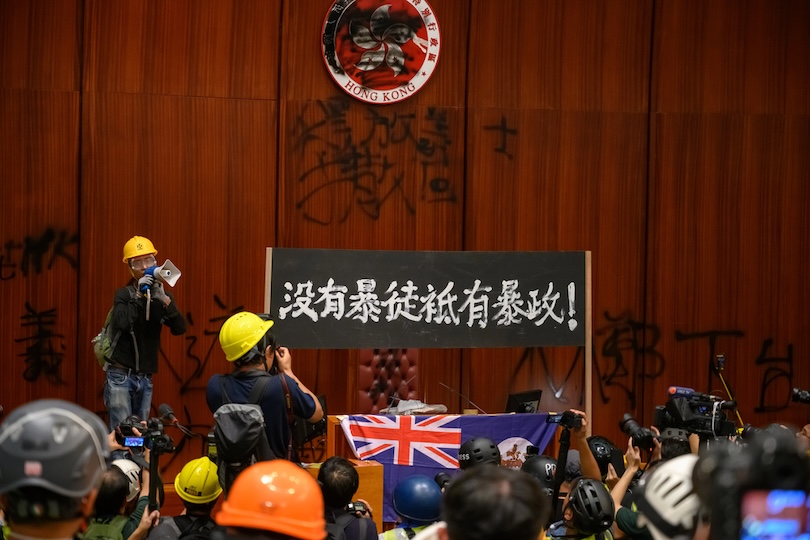
For decades, Hong Kong’s June Fourth commemorations centred on a single demand: 平反六四 — the vindication of June Fourth. The phrase carried meanings beyond remembrance. It implied acknowledgement, rehabilitation, and the restoration of historical truth. Yet after the National Security Law, even public commemoration itself has become politically dangerous within Hong Kong. Previously, I argued that Britain’s selective nationality response after 1989 — granting full citizenship to only 50,000 families through the British Nationality Selection Scheme (BNSS) while leaving most Hongkongers with the more limited BN(O) status — shaped Hong Kong’s later political trajectory in profound ways (Wong 2026). I suggested that the unequal distribution of British citizenship contributed to divergent political incentives and anxieties within Hong Kong society during the post-handover period, culminating in the 2019 Hong Kong protests. This raises a further question: if meaningful historical reckoning can no longer occur openly in Hong Kong, what might a truth and reconciliation process connected to Hong Kong actually look like?
Rehabilitation Without Truth?
In recent years, the Hong Kong government has increasingly adopted the language of “rehabilitation” in response to the social divisions that emerged from the 2019 protests. Special rehabilitation initiatives for young people arrested but not prosecuted, alongside reintegration programmes for convicted offenders, suggest an official recognition that punishment alone cannot fully resolve the political and generational fractures exposed by the unrest.
Yet the concept of rehabilitation raises a deeper question: rehabilitation into what historical narrative? Existing programmes largely frame participants as individuals who were “misled” and who must be reintegrated through national education, mainland exchanges, and renewed identification with the Chinese nation. The underlying assumption is not that multiple interpretations of 2019 may coexist, but that social stability depends upon acceptance of a single authorised account of the crisis (Chan 2026). This differs fundamentally from the logic of truth and reconciliation processes seen elsewhere. In such processes, reconciliation is not achieved through ideological correction alone, but through testimony, acknowledgement, institutional self-examination, and the preservation of contested historical memory (Peacock 2011, 320). The annual Hong Kong demand to 平反六四 historically reflected precisely this impulse: the belief that social healing requires truth before closure.
Ironically, while open commemoration has now become politically restricted in Hong Kong, the emergence of rehabilitation discourse after 2019 may unintentionally reveal the continued absence of a genuine mechanism for historical reckoning. If the authorities themselves recognise that prosecution cannot fully repair the social rupture left by 2019, then the question becomes not merely how to rehabilitate individuals, but whether a broader process of truth recovery remains possible at all.
Selective Citizenship and Hong Kong’s Unresolved Fracture
Previous proposals for reconciliation in Hong Kong, including calls for a Truth and Reconciliation Commission after the 2019 protests, have largely focused on the immediate social and political divisions exposed by the unrest. Discussions often centred on tensions between the “blue” and “yellow” camps, police conduct, or the restoration of public trust (Richburg 2019). Yet such approaches risk addressing only the visible symptoms of Hong Kong’s crisis rather than its deeper historical foundations.
One overlooked dimension lies in Britain’s post-Tiananmen nationality policy. Following the Tiananmen killings, the British government created the British Nationality Selection Scheme, granting full British citizenship to a limited number of Hong Kong families while leaving the wider population with the more restricted BN(O) status, which was not inheritable. Before 2021, this status provided no pathway to full British citizenship for its holders or their descendants. In doing so, the policy fostered a perception that some Hongkongers were regarded as more worthy of British citizenship than others (Jowett, Findlay, and Li 1995, 245).
The long-term significance of this selective citizenship structure was not simply legal, but political and psychological. As I have argued elsewhere, for a small elite, full British citizenship offered a secure exit option should conditions in Hong Kong deteriorate (Wong 2025b). For the wider population, however, no comparable guarantee existed. In the decades that followed, the governing elite increasingly aligned themselves with Beijing’s political order, leading some British political figures to compare them to Vidkun Quisling, the Norwegian politician who collaborated with Nazi Germany during the Second World War. Protected by British or other foreign citizenship while administering the erosion of Hong Kong’s freedoms, these governing elites came to symbolise a class that had accommodated itself to the enemy force at the expense of the society it governed. The resulting asymmetry contributed to a society divided between the British who possessed a secure political future, and the British whose status remained conditional and constrained.
This does not mean that full British citizenship mechanically determined traitorous behaviour. Individuals responded in very different ways. Jimmy Lai, despite being a British citizen and the ability to leave Hong Kong, chose instead to remain and publicly resist Beijing’s encroachment, ultimately facing severe legal consequences for his continued advocacy of liberal-democratic values in Hong Kong. In contrast, figures within the post-handover governing elite, for instance Carrie Lam, engaged with and adapted to the institutional framework of the new political order, prioritising administrative stability under Beijing’s claimed territorial sovereignty over Hong Kong. The contrast illustrates that British citizenship alone cannot determine loyalty or betrayal.
Nevertheless, the BNSS shaped the broader environment within which such choices were made. By distributing British citizenship unevenly after 1989, Britain unintentionally contributed to a political landscape in which questions of loyalty, resistance, compromise, and survival became increasingly fractured. The wider Hong Kong population and later generations, despite largely being denied full British citizenship, continued to uphold liberal values associated with Britain. Meanwhile, those of the governing class, previously loyal to the mother country, now served in political roles within a Communist regime that has violated the Sino-British Joint Declaration (Peck, Meulbroek, and Anguelov 2024, 1085).
As I have argued previously, Carrie Lam’s case illustrates an important point: that of survival (Wong, 2025a). I wish to expand on this argument by examining how Carrie Lam’s quisling-like collaboration with the occupying regime reshaped the political conditions experienced by Hong Kong’s subaltern population. Tuck and Yang (2012, 4) describe the Chinese Communist Party (CCP) as a form of settler empire, illustrating this through Chinese rule in Tibet. Drawing on this framework, Lee and Law (2016, 91) argue that colonialism not only dispossesses the colonised of their identity, traditions, and self-representation, but also assimilates local elites into the ideological framework of the coloniser. Once empowered, these elites often reproduce the governing logic of the dominant power, enforcing assimilation while marginalising those who resist incorporation. This concept of internal colonialism can be applied to post-handover Hong Kong, where the governing elite aligned themselves with the political priorities and discursive practices of the CCP. Regina Ip’s assertion that democracy was never promised in the Sino-British Joint Declaration personifies this dynamic. Ip advances a deeply distorted political discourse that transforms civic virtue into culpability, recasting democratic conviction as a form of moral and legal transgression. Beijing’s authority is maintained through what Tuck and Yang (2012, 5) describe as “particularized modes of control,” manifested in Hong Kong through the National Security Law, policing, and the restructuring of the education system.
Yet, as Lee and Law (2016, 90) note, colonised peoples frequently resist by reconnecting with suppressed identities and forming solidarities with other subordinated subjects. In Hong Kong, this resistance contributed to the emergence of a distinct local consciousness and intensified struggles over identity and belonging (Lecours & Dupré 2018, 11). However, the implementation of the National Security Law severely constrained civil society and dissent, leaving diasporic communities abroad as some of the few remaining spaces through which Hongkongers can continue to advocate for their political freedoms. In light of Chinese state narratives that impose a singular and politically enforced categorisation of Hong Kong identity as inherently “Chinese,” any reconciliation must examine not only the events of 2019, but also the deeper historical processes through which alternative identities have been delegitimised and subsumed under totalitarian state-defined categories. This trajectory was shaped in part by the BNSS, which, by granting full citizenship only to a limited number of families, reproduced a hierarchy of belonging that left the majority of Hongkongers in a structurally precarious position and embedded a long-term asymmetry in political agency and security.
What Would a UK-Based Hong Kong Truth Commission Look Like? A Policy Proposal
I have argued in my doctoral thesis that a Hong Kong Truth and Reconciliation Commission (HKTRC) should be established in the United Kingdom, functioning as an independent, non-judicial body tasked with constructing a structured historical record of Hong Kong’s political transformation across multiple overlapping periods of crisis. Its purpose would not be adjudication or political determination, but the systematic collection, preservation, and organisation of testimony relating to the long-term consequences of key constitutional, legal, and nationality policy decisions affecting Hong Kong.
At its core, the Commission would respond to the absence of an agreed or openly contestable framework through which the post-1989 and post-2019 political developments can be collectively understood. Rather than replacing existing narratives, it would create an institutional space in which competing accounts of the past can be recorded and preserved within a coherent archival structure, ensuring that political memory is not reduced to fragmented or restricted sources. The Commission would operate on the basis of truth-seeking, respect for human dignity, inclusivity of testimony, and transparency of archival process. It would not possess judicial authority, nor would it determine legal liability or assign criminal responsibility. Its function would instead be historical and documentary: to assemble a record that spans multiple jurisdictions and generations, and that is otherwise dispersed across diasporic communities, institutional archives, and constrained informational environments.
Participation could be organised across three interrelated layers. The first would consist of direct historical witnesses, including individuals involved in or directly affected by the 1989 Tiananmen Square Massacre, participants in the 2019 Hong Kong protests, and journalists directly engaged in political junctures during these periods. Their testimony would provide primary accounts of lived experience, institutional action, and political decision-making at the moment of crisis.
The second layer would include institutional actors, such as former British officials, diplomats, civil servants, legal advisers, and policy architects in both British and Hong Kong governance structures. Their contributions would be essential for reconstructing how nationality arrangements, constitutional assumptions, and administrative decisions were formulated, justified, and implemented over time, and how these decisions shaped the evolving political relationship between Hong Kong, the United Kingdom, and the People’s Republic of China.
The third layer would consist of post-event and inheritance-generation participants, including members of the Hong Kong diaspora, BN(O) status holders, and younger generations whose political identities have been shaped by the long-term consequences of earlier historical developments. Their testimony would not function as eyewitness reconstruction, but as reflection on inherited conditions of political life, including legal precarity, memory transmission, and the evolving meaning of citizenship and belonging in the post-2019 context. This inclusion ensures that the Commission does not treat historical truth as confined to direct observation alone, but situates it within a broader framework of consequence and continuity.
The Commission would examine the period from 1989 to the present, beginning with the aftermath of the Tiananmen Square Massacre and the introduction of the BNSS, and extending through the 1997 handover, the development of the BN(O) citizenship pathway, and the Chinese-imposed National Security Law in 2020. Within this arc, attention would be given to how assumptions about sovereignty, political continuity, and institutional stability shaped British policy decisions, and how these decisions contributed to the formation of divergent political identities within Hong Kong society.
The Commission would produce a series of thematic interim reports alongside a final comprehensive report intended for academic, policy, and public historical use. Its outputs would therefore function not only as documentation but also as a structured public archive capable of supporting historical education and future policy reflection. In this sense, the HKTRC would aim to reconstruct a fragmented historical record while providing an institutional mechanism for clarifying the long-term consequences of political and nationality decisions affecting Hong Kong.
A potential critique of a UK-based Hong Kong Truth and Reconciliation Commission is that it risks privileging diaspora voices or excluding those unable to participate due to geographical, financial, or political constraints. This limitation reflects the broader difficulty of conducting open historical inquiry under conditions where political space for testimony is unevenly distributed. However, rather than undermining the Commission, this constraint reshapes its mode of operation. Participation could therefore not be limited to physical presence, but could include written submissions, recorded testimony, and archival documentation, allowing the Commission to function as a distributed mechanism of historical reconstruction rather than a territorially bounded forum of hearings.
To illustrate how a Hong Kong Truth and Reconciliation Commission might operate in practice, the following is a proposed opening statement, adapted from my thesis. It signals the Commission’s commitment to truth, recognition of historical harms, and the pursuit of reconciliation:
The Government of the United Kingdom of Great Britain and Northern Ireland sincerely apologises for the policies and arrangements, including the British Nationality Selection Scheme (BNSS), which, in the years leading up to and following the 1997 handover, contributed to divisions within Hong Kong society and constrained the political agency of its people. We recognise the pain, anxiety, and structural pressures imposed on Hong Kong citizens navigating these circumstances. We acknowledge in particular the collective trauma experienced during the 2019 Hong Kong protests and the imposition of the National Security Law, which led to widespread arrests and incarceration of civic voices. For these consequences, and the enduring impact on Hong Kong society, we say sorry. This apology forms the opening of the Hong Kong Truth and Reconciliation Commission (HKTRC), which seeks to examine the historical record, acknowledge the consequences of policy choices, and explore avenues for understanding and reconciliation.
By linking past policy decisions to the contemporary BN(O) citizenship pathway, the HKTRC can frame the latter as a corrective mechanism, reinforcing the continuity of civic agency and the preservation of Hong Kong’s liberal-democratic identity. In the context of the proposed Hong Kong Crown Dependency, this process not only documents historical injustice but also establishes the institutional foundation for a diaspora-led, exit-based model of political resistance and governance outside the direct control of the People’s Republic of China, thereby helping to fulfil the promises of the Sino–British Joint Declaration.
Conclusion
The demand to “vindicate June Fourth” (平反六四) has never been solely about the past. It has expressed a broader insistence that political reconciliation requires historical truth rather than enforced forgetting. Yet in the contemporary Hong Kong context, where public commemoration has become increasingly constrained and official responses to political unrest have taken the form of rehabilitation rather than open historical inquiry, the possibility of such truth-seeking has become structurally limited. In this light, a UK-based Hong Kong Truth and Reconciliation Commission is not proposed as a mechanism for adjudicating political blame, nor as a substitute for domestic political change, but as an attempt to preserve and organise a fragmented historical record shaped by colonial transition, selective citizenship, and post-2019 political rupture. Its significance lies less in resolving contested histories than in ensuring that they remain publicly knowable, collectively accessible, and open to future interpretation.
Further Reading on E-International Relations