
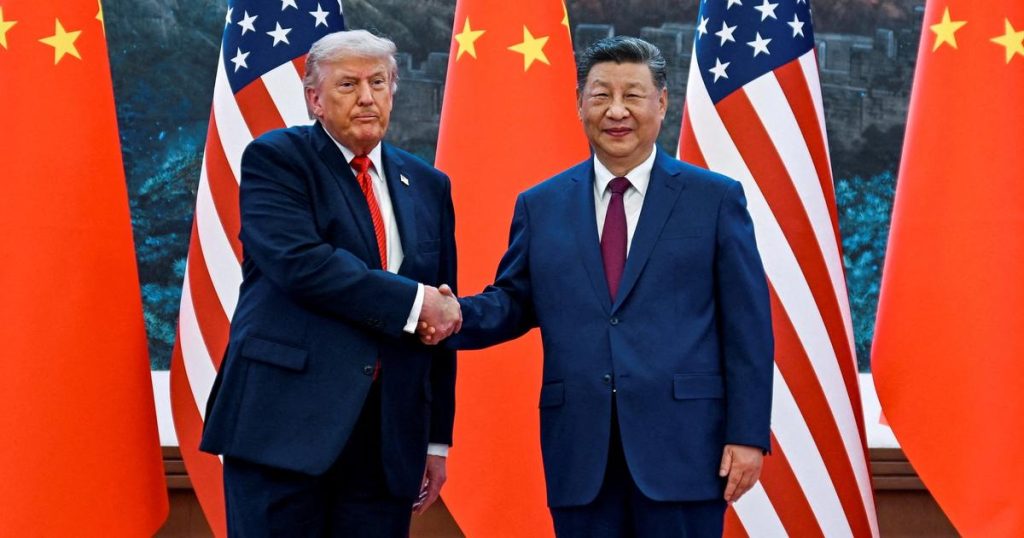
Farewell “win-win cooperation.” For more than a decade, Beijing’s nonstop intoning of the happy-sounding catchphrase — the foundational tenet of Chinese leader Xi Jinping’s foreign policy — caused eyes to roll in Washington. American business executives complained that what it really meant was that China wins twice.
At his meeting with US President Donald Trump last week, Xi debuted a solemn new line: “Constructive strategic stability.”
In Chinese diplomacy, words matter. Indeed, Beijing’s desire to order relations by using carefully constructed phrases is as old as its civilization. Confucius believed that if language didn’t align with reality, social order would collapse. Mao borrowed from that tradition when he labeled the US a “Paper Tiger,” an assessment that gave him confidence to confront the US in Korea, where his People’s Liberation Army troops fought the Americans to a standstill.
After the summit, the Chinese embassy in Washington, DC, posted that Xi’s new formula is “not a slogan.” Indeed, his revised language signals the ground has shifted under US-China relations once again, and Washington’s friends and allies around the region should be concerned about what comes next.
Beijing’s new framing appears intended to send both a message of reassurance — China seeks good relations with the US — and a warning: Don’t cross our red lines.
In effect, Xi was laying down conditions for all the deals Trump sought on his first-in-a-decade presidential visit to Beijing, namely sales of beef, Boeing planes, and soybeans; greater access to the Chinese market for US businesses; and cooperation on issues like fentanyl, AI safety, and financial stability.
Taiwan will be the first major test of Xi’s new mantra. Trump is sitting on a decision over whether to deliver a $14 billion arms package to the island, having greenlit an $11 billion sale last year.
For Xi, that would be a deal-breaker, and although it’s anybody’s guess how Trump will ultimately decide, it appears that Xi got to him in Beijing. Asked by Fox News at the end of the trip whether he had made a decision on the sale, Trump replied: “No, I’m holding that in abeyance and it depends on China.” Then he added that Taiwan would be a “very good negotiating chip for us,” undermining written commitments dating back to the Reagan administration that Washington wouldn’t discuss arms sales with Beijing.
“Trump’s visible sympathy for Xi’s framing on Taiwan will embolden Beijing to increase pressure on Taipei,” Ryan Hass of the Brookings Institution wrote. “This will elevate — not lower — the risk of confrontation,” he added.
Part of the thinking behind Beijing’s new emphasis on “constructive strategic stability” is that China needs time to prepare for the coming showdown by addressing its economic problems, including high debt, soaring rates of youth unemployment, and a real estate slump. Trump, too, needs breathing room. His urgent priority is to break China’s chokehold on rare earths, which gives Beijing the ability to turn America’s factories dark.
The summit reflected all these tensions. It featured pomp and ceremony and grand gestures — Xi ushered Trump into Zhongnanhai, the secretive heart of Chinese Communist Party power in central Beijing — but also telling detail: Before boarding Air Force One to fly back to Washington, the US delegation, reporters and CEOs were no exception, had to dump everything they’d be given in China into garbage bins, including credentials, badges, burner phones, and souvenirs.
The new “constructive strategic stability” is, in fact, a delicate equilibrium.