
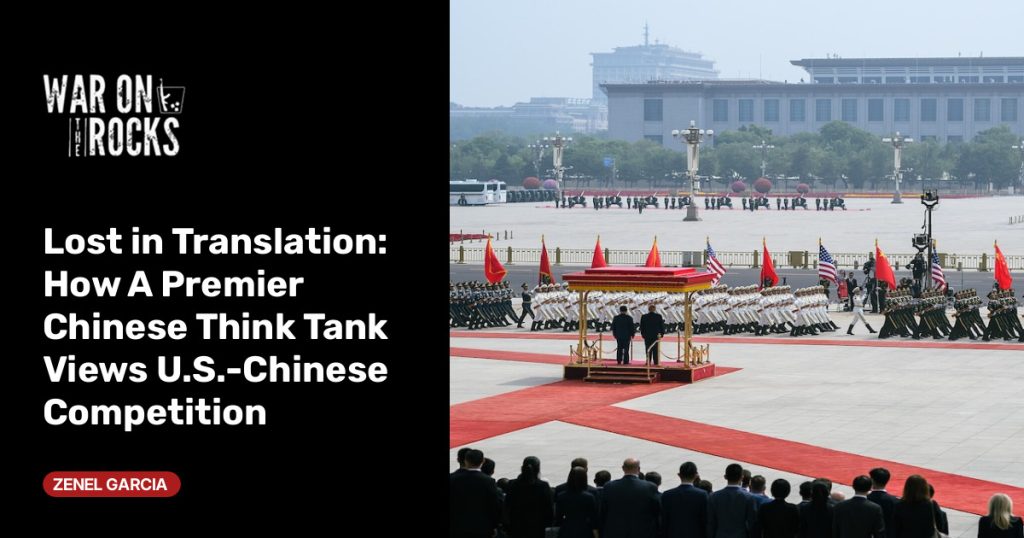
On May 13, 2026, Air Force One landed in Beijing for President Donald Trump’s first state visit to China in nearly a decade. That same morning, the China Institutes of Contemporary International Relations published a report titled The Evolving World and the Right Way to China-US Coexistence. The summit dominated global media coverage for two days. The report received almost none.
The Beijing summit produced familiar imagery: honor guards, a state banquet in the Great Hall of the People, and carefully choreographed warmth. Chinese leader Xi Jinping announced that both sides had agreed to “strategic stability” as a framework for the next three years, and both leaders praised the collegial atmosphere.
Beneath the pageantry, China’s premier foreign policy think tank had published its own assessment of the state of bilateral relations. Read against Mao Zedong’s original theory of protracted struggle, its report describes the current moment not as a step toward partnership but as the product of a strategy in which struggle precedes and produces cooperation on terms favorable to Beijing. Treating that stabilization as evidence of strategic convergence, rather than as a single stage within a longer competition, would be a misreading worth correcting.
Who Is Writing, and for Whom
The China Institutes of Contemporary International Relations is not a conventional foreign policy think tank. It functions as a research and analysis arm of China’s Ministry of State Security, and its principal customers are the Central Foreign Affairs Commission of the Chinese Communist Party Central Committee, the body that sets the country’s strategic direction at the highest level. When it publishes something, it is either articulating existing leadership thinking back to the policy apparatus or feeding analysis upward to those who act on it. The institutional provenance is not incidental — it transforms the document from a scholarly exercise into something closer to an official strategic situation assessment.
The report’s central analytical concept is “strategic stalemate.” It is the precise vocabulary that the founder of the People’s Republic of China Mao Zedong used in On Protracted War, his 1938 lectures at Yan’an, to designate the second of three phases in a long-duration geopolitical competition between a weaker rising power and a stronger incumbent. For any Chinese policy reader, the term has a single unambiguous referent: Mao’s second phase of protracted war. Its use in the report was not accidental.
The Phases of Protracted War
Mao’s protracted war phases are explicit. The first phase, “strategic defensive,” describes the period when the stronger adversary is on the offensive and the weaker side must preserve its forces, avoid annihilation, and resist without seeking decisive engagement. The second phase, “strategic stalemate,” describes the equilibrium in which neither side can deliver a decisive blow, and the weaker side uses the pause to build strength, exhaust the adversary, and shift the underlying balance of forces. The third phase, “strategic counteroffensive,” arrives when the balance has shifted sufficiently for the formerly weaker side to go on the offensive and secure final victory.
The Institute’s report maps this framework directly onto U.S.-Chinese competition. Phase One corresponds to the post-Cold War era of American unipolar dominance, a period that begins with the Soviet collapse, shifts with the perceived erosion of U.S. primacy after the 2008 global financial crisis, and sharpens into open strategic competition as Washington’s posture toward Beijing hardens from the Obama administration onward. Throughout this period, China absorbed American pressure on issues ranging from market access, tariffs, and sanctions to what it saw as an increasingly assertive U.S. military containment strategy, abetted by Washington’s regional allies and partners, all while building and safeguarding its own economic and military capacity.
The current moment is explicitly named Phase Two. The report advances beyond simply identifying the stalemate — it describes the present stage as a deepening of the equilibrium reached during the first U.S.-Chinese trade dispute of the late 2010s, marking the shift with the formulation from initial stalemate to comprehensive stalemate. It attributes that deepening to three compounding factors: a shift in composite national strength across the economic, scientific, and defense domains; economic resilience capable of mitigating American economic coercion; and resistance to what Beijing characterizes as a broader containment effort by Washington. Taken together, the report argues, these conditions mean the balance of forces has shifted further in China’s favor than it had during the earlier stalemate. Phase Three is implied but deliberately unnamed. Taiwan’s reunification with mainland China is described as inevitable, leaving only the exact timing in question.
The report appeared on the morning of the summit, providing the Central Foreign Affairs Commission with a strategic baseline as the summit began. The Chinese leader’s announcement that both sides had agreed to “strategic stability” as their governing framework for the next three years maps precisely onto what the Protracted War framework prescribes for Phase Two: stabilize the relationship with the stronger adversary, prevent escalation to a direct confrontation, and use the resulting equilibrium to continue accumulating position.
Lost in Translation
The three-phase framework identified above is not simply a structural parallel imposed from outside. The clearest evidence that it reflects a deliberate analytical choice rather than an artifact of translation lies in what the report’s Mandarin text says that its English counterpart does not. The two versions are not equivalent, and the gap is widest in the second section, where the authors explain why China’s resistance to America’s pressure campaign produced a deeper, comprehensive stalemate. This is the passage where the Maoist vocabulary is most densely concentrated, where the English translation most consistently flattens what the Chinese asserts, and where the gap between what a Western reader receives and what a Chinese policy reader understands is widest.
The most structurally consequential formulation appears earlier in the document and is the one the translation handles best: from initial stalemate to comprehensive stalemate. This is the report’s central empirical claim. China has not merely entered Phase Two of competition with the United States but has advanced within it. In other words, the balance of forces has shifted further over the past decade — something a reader of either version can grasp at this point. What the English version obscures is the three formulations in the second section that explain how that advance was achieved and what it requires going forward.
First, the English renders the formula as “struggle as a tool for cooperation and stability,” but the Chinese is “seeking cooperation through struggle, seeking stability through struggle.” The translation loses the precision, given that in Maoist dialectics, this formula means that struggle is not abandoned during the cooperative phase; it is the method by which cooperation is extracted on acceptable terms. Put differently, cooperation is a conditional outcome of principled struggle, not a substitute for it.
Second, where the English describes China as having “stood united as one, dared to fight and was skilled in fighting, and met U.S. containment and suppression,” the Mandarin is doing something the translation cannot fully carry: It deploys vocabulary that echoes Mao’s insistence on combining the will and the capacity for principled resistance in language with a specific Maoist ideological address. These are not interchangeable virtues in the Maoist tradition — they are the paired conditions for Phase Two success. The English reader gets a description of China’s response to U.S. pressure. The Chinese reader receives something closer to a doctrinal checklist: a formula that signals, in the vocabulary of Maoist political tradition, that China has demonstrated both the will and the method needed to succeed in the stalemate phase.
Third, historical initiative is a Xi-era formulation that takes Mao’s operational concept of initiative — the weaker side’s capacity to control the terms of engagement and deny the stronger adversary a decisive battle on his own terms — and extends it into something larger: a claim that China’s advance is not merely the product of the right strategy but of structural historical forces that make the outcome inevitable.
As a whole, these formulations constitute the report’s explanation of Phase Two mechanics: China advanced within the strategic stalemate because it understood the correct relationship between struggle and cooperation, applied both will and skill, exercised initiative, and moved from an initial equilibrium to a comprehensive one. The English translation conveys the conclusion. The Chinese text explains the theory behind it.
Notably, official Chinese statements have not repeated the “strategic stalemate” framing in the weeks since the summit. The term has not surfaced in Ministry of Foreign Affairs readouts or the Chinese leader’s own public remarks. That silence is not evidence against the framework, so much as a reminder of where it originated. The Ministry of Foreign Affairs speaks for public diplomacy and calibrates its language accordingly. The China Institutes of Contemporary International Relations answers to the security and intelligence apparatus and operates under different incentives. A formulation surfacing in the latter and not the former is precisely the kind of signal that merits attention because it locates the strategic stalemate framing’s origin in the security and intelligence apparatus rather than the diplomatic corps, suggesting an internal analytic paradigm rather than a phrase chosen for any particular audience.
Clarity Without Alarm
None of this requires an alarmist conclusion. China’s preference for stability today is probably genuine. The costs of direct military confrontation between two nuclear-armed powers would be catastrophic. Nor is the point here to adjudicate whether Beijing’s self-assessment is correct or to forecast when or whether a third phase might arrive — those are separate questions that deserve their own treatment. The aim is narrower: to flag that an institution occupying a unique position in China’s foreign policy apparatus chose this vocabulary, on this day, and that the choice is worth Washington’s attention regardless of how the larger debate over Chinese intentions is ultimately resolved. The summit’s practical outcomes, including a proposed AI protocol, the Chinese leader’s stated commitment to not provide military equipment to Iran, and the reopening of agricultural trade, have real value independent of the strategic framework behind them. Working channels between Washington and Beijing serve American interests too. U.S. Trade Representative Jamieson Greer described the visit as having restored communication channels whose absence he called “a dangerous situation” between the two countries. In his view, the Trump-Xi meeting advanced several of those restored channels, from the AI protocol to the agricultural purchase agreement described above, to broader issues on trade.
What the report provides, however, is something Washington rarely gets: a window into how Beijing’s intelligence establishment assesses the state of the competition, written for the officials who set China’s strategic direction. That assessment should be read carefully. In Beijing’s telling, years of American pressure campaigns and competitive measures have not destabilized China’s position. On the contrary, they have strengthened it. China’s combination of principled resistance and strategic stabilization moved the relationship from initial stalemate to comprehensive stalemate on terms Beijing regards as favorable. Whether that self-assessment is accurate is a separate question. What matters for Washington is that it is the official assessment and that it produces a specific expectation about how the current period should be managed and what it is meant to produce.
This distinction matters for how Washington interprets the current moment. The cooperative signals coming out of Beijing are real, and engaging them in good faith is appropriate. But they are the output of a strategy in which struggle precedes and produces cooperation, not a sign that the underlying competitive logic has been revised. Any American tendency to treat stabilization as convergence, rather than as the product of a theory, China’s intelligence community believes it has already confirmed, would be a misreading with consequences that compound over time.
The document explaining Beijing’s position was published on the day of Trump’s arrival, in both languages, by an institution that answers to the Ministry of State Security and writes for the body that sets China’s strategic direction. Washington should read it the way Beijing wrote it: as an assessment of where the competition stands, how it is being managed, and what comes next.
Zenel Garcia is associate dean and associate professor at the U.S. Army War College, where he holds the Henry L. Stimson Chair of International and Military Studies. His research focuses on the intersection of international relations theory, security, and geopolitics in the Indo-Pacific and Eurasia. The views expressed are the author’s alone and do not reflect the official policy or position of the Department of the Army, the Department of Defense, or the U.S. government.
Image: The White House via Wikimedia Commons