
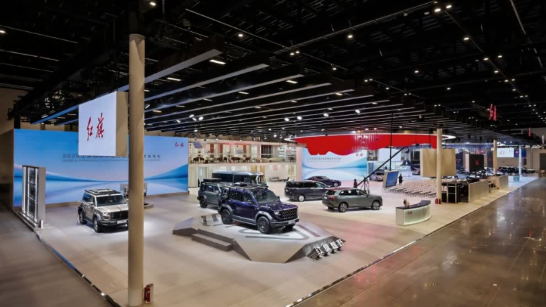
Gasgoo Munich-At the 2026 Beijing International Auto Show, Hongqi presented a lineup of 27 vehicles. It officially showcased its latest achievements under the “Quality Improvement & Renewal” strategy.
Unlike previous years, Hongqi did not focus its narrative on a single flagship model. Instead, it systematically displayed three sub-brands—Hongqi, Hongqi Tiangong, and Hongqi Jin Kuihua—covering mainstream luxury, cutting-edge technology, and top-tier customization.
This clarified brand architecture signals a shift for Hongqi. The brand is moving from reliance on single products to a matrix-driven, systemic approach to full-spectrum competition.
Accelerating Product Rollouts: Three New Models Target Second Half; Tech Specs Receive Major Upgrade
The spotlight at this year’s show fell on three all-new models slated for launch in the second half of 2026. These include the next-generation Hongqi H9, the next-generation Hongqi H7, and the brand’s first luxury rugged off-road SUV—the production version of the Hongqi Off-roader.
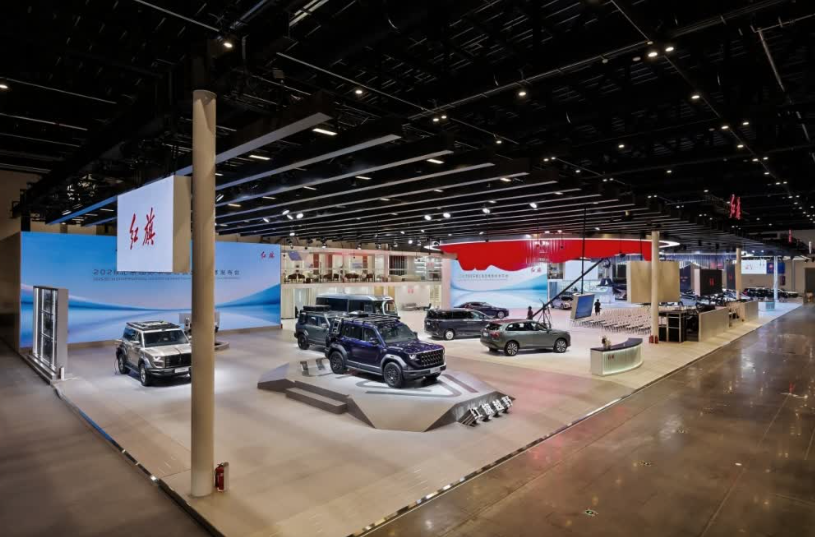
Image Source: FAW Hongqi
Positioned as a C+ class intelligent luxury flagship sedan, the next-generation H9 represents Hongqi’s deep collaboration with Huawei.
According to official specifications, it is among the first models to feature Huawei’s Qiankun Intelligent Driving ADS 5. It is equipped with the world’s highest specification mass-production 896-line dual-optical-path image-grade LiDAR and carries 40 high-sensing sensors. The system can reportedly detect objects just 14 centimeters high from 120 meters away while traveling at 120 km/h. It maintains stable perception even in low light, heavy rain, or fog.
The H9 also features the HarmonySpace cockpit and utilizes Hongqi’s self-developed 2.0T longitudinal two-speed hybrid system. Paired with chassis technologies like rear-wheel steering, the car aims to strike a new balance between intelligence and driving dynamics.
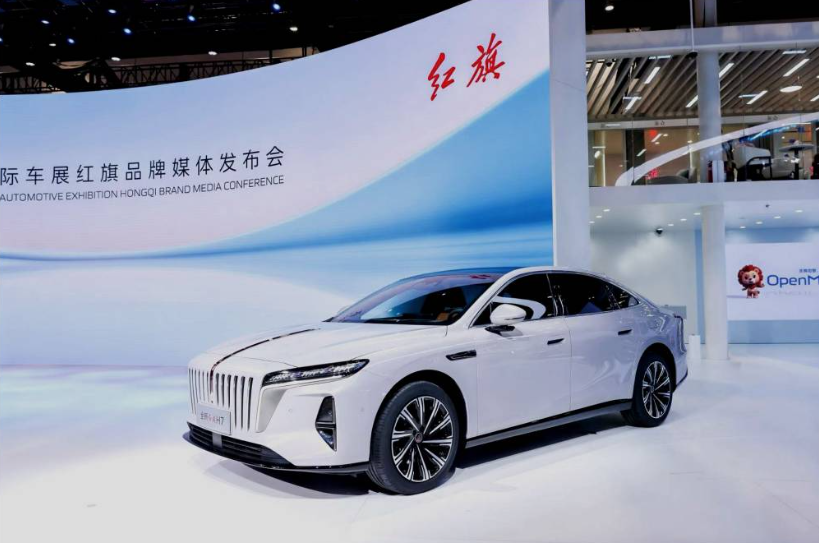
Image Source: FAW Hongqi
The next-generation H7 is a C-class luxury hybrid sedan debuting with Hongqi’s Sinan combined driver assistance system. It supports functions such as left turns at unsignaled intersections, navigating complex roundabouts, full-scenario parking assist, 120-meter trail reversing, and 2-kilometer memory parking. Its Lingxi Cockpit 5.0 incorporates a 100-billion-parameter AI large model, enabling over 600 functions, including automatic HUD adjustment and trip planning.
On the safety front, the H7 adopts an “integrated double door ring” structure and “hexahedral fortress protection” battery technology. Official data indicates the battery’s crush resistance is 1.5 times the national standard. Bottom impact resistance is double, and waterproofing is 240 times the standard.
The production Hongqi Off-roader marks the brand’s first mass-market foray into rugged off-roading. It features a body-on-frame design, with high-strength and ultra-high-strength steel accounting for over 90% of the structure. This achieves a torsional stiffness of 9,500 Nm/deg.
Power comes from a vector-controlled four-motor setup with three differential locks, delivering a wheel-end torque of 18,500 Nm. Official test data shows the vehicle has accumulated over 7.7 million kilometers of testing across extreme environments. These include Turpan, the Pamir Plateau, freezing snowfields, and scorching deserts. Additionally, Hongqi Off-road has launched an “Eco-Creation Plan,” with over 500 partners already on board in areas like modification and outdoor equipment.
Overhauling the Tech Ecosystem: From Smart Driving to Manufacturing, Hongqi’s “Invisible” Upgrades
Beyond the dense rollout of new products, the more significant story at this year’s show is Hongqi’s systematic upgrade of its technical architecture.
Over the past five years, Hongqi has mastered over 1,500 core technologies, building three proprietary platforms: Tiangong for EVs, Honghu for hybrids, and Jiuzhang for intelligence. These underlying capabilities are gradually translating into tangible competitive advantages for its products.
Regarding intelligent driving, Hongqi is pursuing a dual-track strategy. The H9 and H7 feature distinct systems—Huawei’s Qiankun and Hongqi’s Sinan, respectively. Sinan is self-developed for volume models, while the H9 incorporates Huawei’s high-end solution to create a differentiated configuration. This parallel “self-developed + partnership” approach is a pragmatic move in the current industry climate.
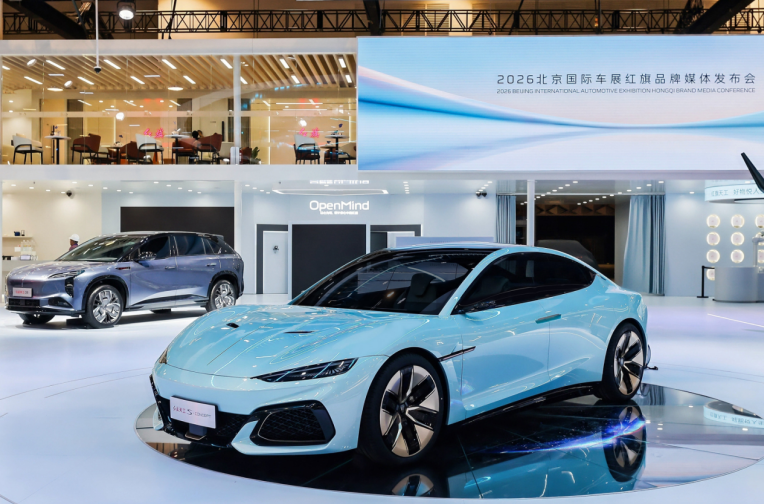
Image Source: FAW Hongqi
On the manufacturing front, the “S-concept” from the Hongqi Tiangong sub-brand introduces China’s first automotive “unboxing process.” Breaking away from the traditional assembly line model and integrated with die-casting technology, it claims to halve the production cycle.
Although still a concept, the manufacturing paradigm shift it represents warrants close attention.
Hongqi also showcased its green manufacturing and future technology roadmap. For instance, its “Zero-Carbon Factory” reduces carbon emissions by 0.4 tons per vehicle produced. Next year, the brand plans to launch a demonstration of solid-state hydrogen storage technology, debuting in the Hongqi Guoyue hydrogen fuel model.
In more cutting-edge domains, the “Tianjian No. 1” flying car has completed its maiden flight, with an airworthy model expected in 2027. Additionally, Hongqi’s self-developed embodied AI robot will be deployed in its smart factory this year.
Summary
Judging by the displays at this year’s Beijing Auto Show, Hongqi is moving past the stage of “lone breakthroughs.” It is moving toward a multi-dimensional synergy involving brand matrices, technology platforms, and manufacturing systems.
The division of labor among the three sub-brands is clear, the product cadence is precise, and the technology path is pragmatic. The deep collaboration with Huawei for the H9, the specific safety and efficiency data for the H7, and the accumulated extreme-environment testing for the Off-roader all point to substantial progress. This progress is evident in Hongqi’s product definition and technology execution.
The ultimate market performance of these products and technologies will depend on subsequent user experience, supply chain stability, and the supporting capacity of the service system. For Hongqi, the Beijing Auto Show served as a systematic display of achievements.