
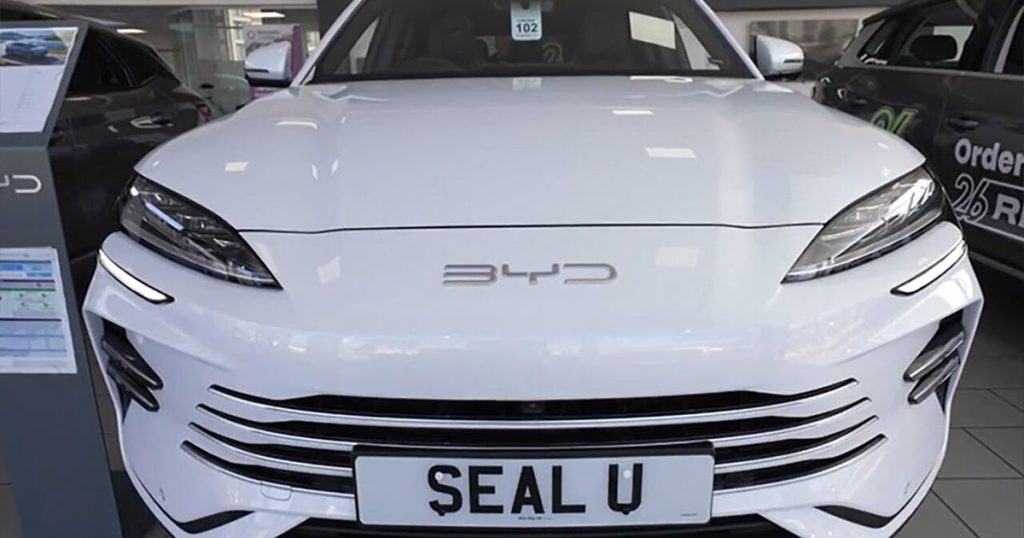
“The ride, the drive, the suspension, the comfort, the level of technology is far superior than anything I’ve had before,” said Justin Watson. This sort of pitch is typical at a car dealership, except Watson is a customer.
He’s trading in his Lexus for a BYD, which stands for “Build Your Dreams.” It’s a Chinese car company you won’t really find in the U.S., but which overtook Tesla last year as the world’s top seller of fully-electric vehicles. [While Tesla is ahead in early 2026, BYD still leads when including hybrids.}
Watson said the “taboo” of buying a Chinese car is gone: “I think long are the days where you bought cheap from China and it didn’t last long. They’re putting a lot of emphasis in quality.”
BYD 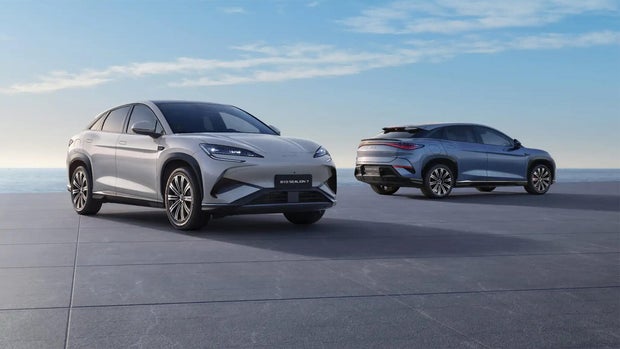
Paul Tanner, the managing director of Alan Day Motor Group in London, says sales are excellent. The company has been in business for more than 50 years, primarily selling Volkswagens. He said he never thought he’d be selling Chinese cars: “But when you see the growth and the quality of the product, it’s phenomenal,” he said.
BYD tailors some of its marketing to social media, pitching (at the high end) vehicles that can go in water, turn 360-degrees in place, have longer battery life, and claim, soon, a five-minute charge.
“China is miles ahead of the rest of the world,” said Ben Nelmes, executive director of New Automotive, a U.K. think tank. He says China’s long-term investments in innovation are paying off. By some estimates, BYD can make cars for 25 percent less than competitors in the West. “BYD has been so successful because it started life as a battery company, so it owns the whole supply chain before the car,” Nelmes said. “It’s able to produce batteries very cheaply, and it’s been exporting them all over the world.”
But you won’t find many BYD cars on the road in the United States. In 2024, President Biden slapped China with 100 percent tariffs on its electric vehicles, or EVs. “I’m determined that the future of electric vehicles be made in America by union workers. Period,” he said.
The tariff doubles the cost of the car. “It makes it impossible” to sell in the States, said Nelmes. “It effectively closes the market to the import of those vehicles.”
President Trump kept those tariffs. He also relaxed auto emissions standards, and removed tax incentives to buy EVs.
Tariffs in the U.S. and Europe are much lower. In Norway, 97 percent of new cars sold are electric. China is the world’s largest market, where about half of new car sales are EVs, compared to less than 10 percent in the U.S.
CBS News 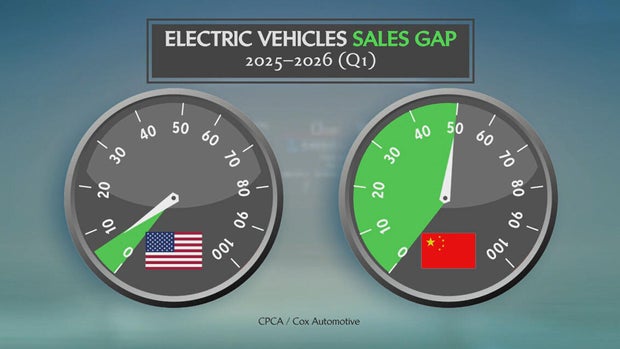
How important is the tariff on Chinese EVs to American automakers? “I think they see it as very important,” said Nelmes, “but whether or not it’s the best thing for them, I think, is arguable. If you stifle innovation and if you stifle competition and you stop there from being a free and open market, then actually markets stop delivering what they should do, which is good products at good cost to consumers.”
Is the tariff saving jobs in the U.S., at least for now? Nelmes said, “Well, it might be temporarily, but I suppose in the longer term, that’s a lot less certain. If the future of all car-making is electric car manufacturing, then you might simply be preventing American carmakers from making that journey, and then at some point in the future they will eventually be exposed to that competitive pressure.”
That pressure could be building, as gas prices soar due to the war in Iran. But Justin Watson is expecting big savings from his Chinese car. “I’ve got family in America,” he said. “They’re actually jealous!”
For more info:
Story produced by Mikaela Bufano. Editor: Brian Robbins.
See more: