
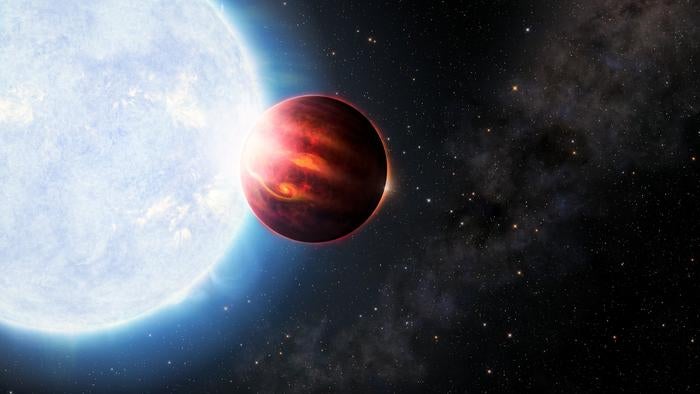
Far beyond the reach of any spacecraft, a distant world glows with heat so intense that rock itself turns to vapor. In that extreme environment, scientists have uncovered a rare clue about how planets are born. For the first time, astronomers have directly measured key rock-forming elements in an exoplanet’s atmosphere and found that its chemical makeup closely mirrors that of its parent star.
The discovery centers on WASP-189b, a giant planet located about 320 light-years away in the constellation Libra. This world belongs to a class known as ultra-hot Jupiters, where temperatures climb high enough to vaporize elements like magnesium, silicon, and iron. Those conditions give scientists a unique opportunity to study materials that usually remain locked inside solid rock.
An international team led by Jorge Antonio Sanchez, a graduate student at Arizona State University, used the Gemini South telescope in Chile to make the breakthrough observation. The findings provide the first direct evidence for a long-standing assumption in planetary science, that planets inherit their basic chemical structure from the stars they orbit.
“These discoveries show Gemini’s ability to help us understand the characteristics of the remarkable zoo of exoplanets in our solar neighborhood,” says Chris Davis, NSF Program Director for NOIRLab. “Such discoveries are only possible because of Gemini’s cutting-edge instruments.”
Reading the Chemical Fingerprints of a Distant World
Astronomers often describe their work as reading light. By splitting starlight into its component colors, they can identify the presence of specific elements. This method, called spectroscopy, acts like a chemical fingerprinting tool.
In the case of WASP-189b, the team used a high-resolution instrument called the Immersion GRating INfrared Spectrograph, or IGRINS. This device allowed them to measure magnesium and silicon in the planet’s atmosphere at the same time. That simultaneous measurement had never been achieved before.
The results showed something striking. The ratio of magnesium to silicon in the planet’s atmosphere closely matches the ratio found in its host star. This connection confirms a theory that has guided research for decades but lacked direct proof beyond our solar system.
“WASP-189b gives us a much-needed observational anchor in our understanding of terrestrial planet formation since it offers a measurable quantity that validates the presumed resemblance of stellar composition and the proportion of rocky material around host stars used to form planets,” says Sanchez.
This finding does more than confirm a theory. It strengthens a link between stars and the planets that form around them, suggesting that both emerge from the same shared material.
Why Extreme Heat Reveals Hidden Clues
Most planets keep their rocky elements locked deep inside their interiors. That makes them nearly impossible to measure directly. WASP-189b is different.
Its extreme heat, reaching levels high enough to vaporize rock-forming elements, lifts these materials into the atmosphere. In this gaseous state, magnesium and silicon become visible through spectroscopy.
This rare window allows scientists to study the building blocks of planets in a way that is not possible on cooler worlds. It turns a hostile environment into a powerful laboratory for understanding planetary origins.
Hot giant planets like this one form within swirling disks of gas and dust around young stars. These disks, known as protoplanetary disks, contain the raw ingredients for planet formation. Scientists have long assumed that the ratio of key elements in these disks matches that of the host star.
Until now, that assumption relied mainly on observations within our own solar system. The new findings extend that relationship to a distant planetary system, offering the first direct confirmation beyond our cosmic neighborhood.
A Key Step For Understanding Planet Formation
Element ratios such as magnesium to silicon play a crucial role in shaping planets. These ratios influence the types of minerals that form, the structure of a planet’s interior, and even how its surface behaves over time.
On Earth, rock-forming elements contribute to the processes that make the planet habitable. They help drive plate tectonics, support the magnetic field, and regulate the release of chemicals into the atmosphere and oceans.
By linking a planet’s composition to its star, scientists gain a powerful tool. They can study a star’s chemical makeup and use that information to estimate what its planets might be like, even if those planets remain too distant to observe directly.
This connection is especially important in astrobiology, the study of life beyond Earth. Understanding the availability of key elements can help researchers identify which worlds may have conditions suitable for life.
The study also highlights how advanced instruments on ground-based telescopes are opening new doors. High-resolution spectroscopy allows scientists to detect subtle signals that were once out of reach.
“Our study demonstrates the capability of ground-based, high-resolution spectrographs to constrain critical species like magnesium and silicon, which are two elemental building blocks from which rocky planets form,” says study co-author Michael Line, Associate Professor at ASU. “This advancing capability opens an entirely new dimension in our study of exoplanet atmospheres.”
Expanding the Map of Alien Worlds
WASP-189b is only one example, but it represents a turning point. By confirming that planets can share key chemical ratios with their stars, the study gives researchers a stronger foundation for exploring other systems.
Future observations will aim to measure additional elements and study more planets across different environments. Scientists hope to build a broader picture of how planetary systems form and evolve over time.
Multi-wavelength studies, which examine light across different parts of the spectrum, will help reveal a more complete chemical inventory of distant worlds. These efforts could uncover patterns that link planetary composition to factors like distance from the star or formation history.
Each new measurement adds detail to a growing map of planetary diversity. It also brings researchers closer to understanding how common Earth-like conditions might be across the galaxy.
Practical Implications of the Research
This discovery gives scientists a reliable way to estimate the composition of distant planets using their host stars. That approach can guide future searches for habitable worlds by identifying systems with favorable chemical conditions.
The findings also strengthen models of planetary formation. By confirming that key element ratios remain consistent between stars and planets, researchers can refine simulations that predict how planets develop over time.
For astrobiology, the work provides a foundation for studying environments that could support life. Knowing the distribution of rock-forming elements helps scientists assess whether a planet might sustain processes like tectonic activity or magnetic field generation.
In the long term, these insights can shape how future missions target and study exoplanets. By focusing on systems with known chemical signatures, researchers can improve the chances of finding worlds with Earth-like properties.