
The Burj Al Arab hotel, built on a man-made island jutting into the Persian Gulf, is famous around the world for being designed like a billowing sail on one of the traditional local dhow boats.
But today, the butlers, chauffeurs, cooks and cleaners who catered to the whims of wealthy visitors paying tens of thousands of pounds a night for a suite – with a choice of 17 pillows – are being sent home.
Bentleys and Lamborghinis no longer line up outside. The rooftop helipad is deserted. And when I attempted to visit the world’s most famous hotel this week, I was turned away by a polite security guard informing me the entire premises had been closed.
This opulent building – a longstanding symbol of Dubai’s success – has been shuttered, along with at least three other palatial hotels owned by the ruling sheikh. When I called the booking office, I was told the hotels were shutting down for a year for ‘renovations’. The agent admitted when pressed, however, that fighting with Iran was also a factor.
Burj Al Arab has long stood as a symbol of this extraordinary city-statelet. But now it looms as a monument to hubris.
Dubai has become collateral damage in a foolish war launched by Donald Trump and Israel’s Benjamin Netanyahu against Iran, which lies just 75 miles across the glistening blue waters of the Gulf.
In response to the attacks of Operation Epic Fury, which started on February 28, Iran has been striking America’s allies in the region – especially the United Arab Emirates – by hitting sensitive targets such as data centres, desalination units and hotels.
Even the famed Burj was in flames at one point – officially blamed on ‘shrapnel’ from an intercepted drone, although open-source data suggests a more serious incident.

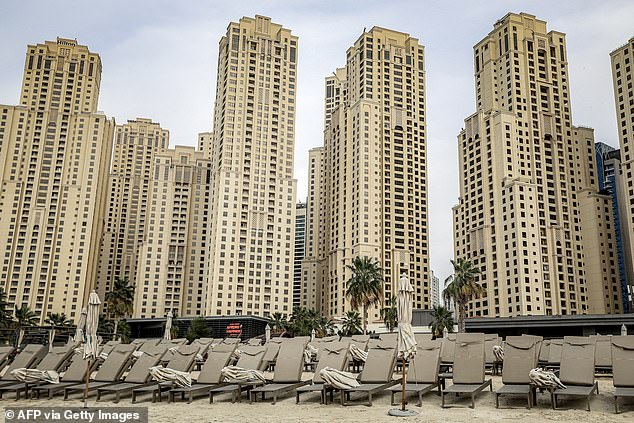
Empty sun loungers line a beach at Jumeirah Beach Residence, formerly a tourism hotspot

Most chairs at the Al Seef Cafe are empty as tourism grinds to a near-complete halt amid the Iran war
I saw the consequences of the war for myself this week, staying in Dubai’s spectacular but near-deserted hotels and strolling around shops filled with bored staff scrolling on their phones. One jeweller in the emirate’s biggest mall told me I was her first potential customer of the day – at 1.30pm. A taxi driver admitted his trade was 90 per cent down. Hotel staff whispered of sackings.
‘There has been serious harm done, anyone who tells you otherwise is speaking nonsense,’ said one property developer, flogging penthouse flats with plunge pools and air-conditioned balconies that cost close to £5million.
And while the country’s air-defence systems are claimed to have shot down 537 ballistic missiles, 26 cruise missiles and 2,256 drones over five weeks of war, at least 13 people have died – and Dubai’s reputation has been devastated.
Multiple Iranian drones have successfully struck its buildings, foreigners have fled and tourists have cancelled bookings.
Last week, there were reports that a locally based 25-year-old flight attendant had joined the dozens of Britons recently detained, often for sharing images of strikes. This young employee of a local airline merely asked colleagues on a private WhatsApp group if it was safe to walk through the airport.
Such incidents remind the world that while Dubai relies on millions of foreigners – including about 240,000 Britons – who have made this tax haven their home, it is run by a ruthless Islamic monarchy that does not tolerate dissent.
The real power is held by an Emirati population comprising less than 10 per cent of residents – while the legal system can be weaponised against foreigners or women who fall from favour.
One driver, who claimed to have seen an oil plant burning after a strike, said many foreigners had been arrested. ‘You must be very careful here,’ he warned.
The arrests, as well as the demands for residents to inform on anyone sharing videos of strikes, clamping down on free expression and trying to conceal attacks all serve as sharp reminders that Dubai is essentially afeudal dictatorship.
‘The laws are so broadly framed that a tweet, private message or shared content can be interpreted as a criminal act if authorities decide it damages the country’s reputation or public order,’ said Radha Stirling, founder of Detained in Dubai.
All this pierces the glitzy picture pushed by thousands of online influencers who prattle aboutliving in ‘the safest city in the world’ while ignoring its lack of democracy, flagrant disregard for human rights, intense cyber-surveillance and systemic abuse of low-paid migrants.
Hypocritically, the regime treats adultery and homosexuality as crimes – yet the emirate has a blatant and thriving sex trade, with an estimated 80,000 prostitutes catering to a population of 4million, 70 per cent of whom are male.
Dubai is notorious, too, for the dirty money that helps fund its success. Soiled cash embezzled by corrupt politicians, mobsters and warlords routinely passes through this city; it was even a haven for Iranian money-laundering and stolen assets. It is no coincidence that the billionaire Kinahan brothers – leaders of an Irish cocaine-running cartel described by Washington as one of the most dangerous gangs in the world – have lived lavishly in the city.
Meanwhile, this pivotal Western ally is reputedly a key backer of rebels in Sudan’s horrific civil war that has displaced millions of people – and also of the Libyan militia chief who controls the key smuggling routes feeding Europe’s migration crisis. One thing is certain. This wealthy petrostate, which has transformed itself from a fishing port into a futuristic metropolis, is now suffering badly.
Schools have shifted back to Covid-style online classes, with one Briton telling me that many expat teachers flew to the beaches of Thailand to make the most of the opportunity. Banks such as Goldman Sachs and Standard Chartered have ordered staff to work from home.
One mall beneath a cluster of skyscrapers in the financial district – where shops selling Islamic attire sit beside a modern art gallery and a clinic offering trendy ‘cryotherapy’ – felt like a morgue after the exodus of office workers and tourists.
A manager at this property told me only one-third of their flats remained occupied, highlighted by the lack of lights at night and the drop-off in deliveries.
‘Many people have left or given up leases. The business model here is being destroyed. I fear long-term damage,’ they said.
Such concerns spark fears Dubai’s property bubble – fuelled by foreign speculators and money launderers, as openly admitted to me by one agent – is going to burst again. Prices are being slashed amid rumours that firms are in financial distress.
I was shown around a four-bedroom flat in a prestigious new skyscraper in ‘Dubai Internet City’. The 18.5million dirham (£3.75million) price was advertised as ‘negotiable’, having already seen one million dirhams slashed from its listing, despite being put on the market earlier this year.

Burj Al Arab has long stood as a symbol of this extraordinary city-statelet. But now it looms as a monument to hubris, writes Ian Birrell

The opulent building has been shuttered, along with at least three other palatial hotels owned by the ruling sheikh
The affable Kashmiri estate agent said the Indian owners were looking for a quick sale and had offered to halve his commission. ‘I’ve been in the business since 2007, but this has been the worst – I’ve never seen anything like it.’
He pointed out a television by the bath, showed me the moveable lights for any owner’s art collection, then took me to see the building’s outdoor cinema along with its separate male and female jacuzzies. ‘No, you can’t share one with your wife,’ he stated firmly.
A British agent showing me a smaller apartment confessed it was ‘a buyers’ market’ and that I was his first foreign client for three weeks. Yet he sought to downplay the impact of war. ‘Most people will forget about it in five minutes,’ he claimed.
Perhaps. But the sheikh’s closure of four top hotels nevertheless shows how tourism has been hit hard. Dubai attracted almost 20million international visitors last year after putting huge effort into luring shoppers, sun worshippers and business folk to its 160,000 hotel rooms.
Many are ultra-lavish – but rates have plummeted and the first room I stayed in cost only £150 per night, roughly the same as a budget hotel in central London. ‘We never normally have prices like this,’ said a worker at the five-star Park Hyatt resort, as he showed me to my swish room overlooking a marina filled with yachts. Another staff member said many migrant workers were losing their jobs.
‘Maybe after six months they will be able to come back, but it’s a terrible time,’ they said.
The sprawling Park Hyatt sits beside a golf course and boasts 223 rooms, two fake lagoons and a swimming pool. But it felt ghostly.
At midday, I counted just five adults and one child on the sun-loungers – with twice as many staff in attendance.
On Kite Beach, surfers took advantage of blustery conditions, but I saw no families.
I watched as one Russian influencer in a bikini posed on some rocks, ignoring a sign asking people not to stand there, while her friend took pictures.
Although some prominent influencers among Dubai’s 50,000 ‘content creators’ have joined the exodus, many have stayed to praise their adopted country’s ‘strong leadership’, faithfully peddling its claims of safety.
Often, the blizzard of posts by these people have been strangely similar – including their attacks on foreign media for spreading ‘misinformation’, demonstrations of normality despite the drones and denials they are being paid to push propaganda.
My second hotel was a typically extravagant Dubai edifice: pyramid-shaped, styled after ancient Egypt and run by the famous Raffles brand.
It had 242 rooms, fine food, charming staff – yet as I worked for several hours one afternoon, I saw no one swimming in the pool beneath my window.
An Uber driver pleaded with me to pay cash to avoid the tech company’s commission. He told me: ‘Life is very difficult: Many people left and few people coming. Hopefully, this war is just a small thing, inshallah, since Dubai is a very nice place.’
Natasha Sideris, owner of a restaurant chain with 14 outlets, told the BBC she had seen revenues fall by half, forcing her to cut salaries for 1,000 staff including her own by 30 per cent.
‘The current situation is brutal,’ she said bluntly.
Other restaurant chains have been hit even harder, with one group admitting footfall had collapsed to less than one-fifth of normal, forcing it to place more than half its staff on unpaid leave.
Dubai’s government is spending millions to help the hospitality sector. But analysts predict up to 38 million fewer people might now visit the Middle East region due to the conflict.
The shadow of war is, of course, ever present and endlessly debated. On Tuesday, after Donald Trump made his grotesque threat to slaughter ‘a whole civilisation’ in Iran, Arsenal fans discussed their fears nuclear war might break out when I joined them in a bar watching their team’s Champions League match.

Smoke rises from a fire near Dubai International Airport on March 16 after a ‘drone-related’ incident
There was relief the next morning when everyone awoke to a ‘ceasefire’, albeit one strained by fresh attacks. ‘I was really stressed last night,’ one British expat told me. ‘It would have been such a disaster if they had escalated.’
At Deep Dive Dubai, a 200-foot hole dug into the desert for scuba and free divers, there is ‘a sunken city’ to explore. There are 56 underwater cameras enabling visitors to post videos afterwards on social media. The dive at this oyster-shaped facility was fun. The set-up professional.
When alerts sounded on our phones about another impending missile strike, the situation was handled calmly, with everyone ushered into a secure room.
Just like the ski resort, replete with penguins, inside a shopping mall where temperatures outside can hit 50C, the ‘world’s deepest pool’ exemplifies Dubai’s ambition to tout itself as a unique destination. Yet like so much in this shiny city built on sand, it is utterly artificial – perfect for Instagram or TikTok.
‘Yes, it was a crazy place, crazy laws, the sheikh,’ said one Frenchman. ‘But it worked. We never priced into the equation there could be a war, missiles, attacks. Now people are thinking: OK, maybe I’d better go back to Europe and pay taxes.
‘I was in London ten days ago – it feels so gloomy, I think it’s doomed. But lots of people will move to Milan or Madrid.
‘If I go to Madrid, I don’t pay tax for six years.’
This is the issue that scares Dubai: that the rich people who have been key to its astonishing success might now be diverted to other destinations, especially with the Iranian regime surviving and still in control of the critical Strait of Hormuz.
The danger for this soulless place is that its fakery and hypocrisy have now been exposed. Dubai has been a towering success, as shown by Burj Al Arab. But only time will tell what the full impact on its image has been and the depth of the wounds it has suffered in this unwanted war.