
- Ancillary revenue drives growth
- Utility-like stock appeal
- Traffic recovery expected
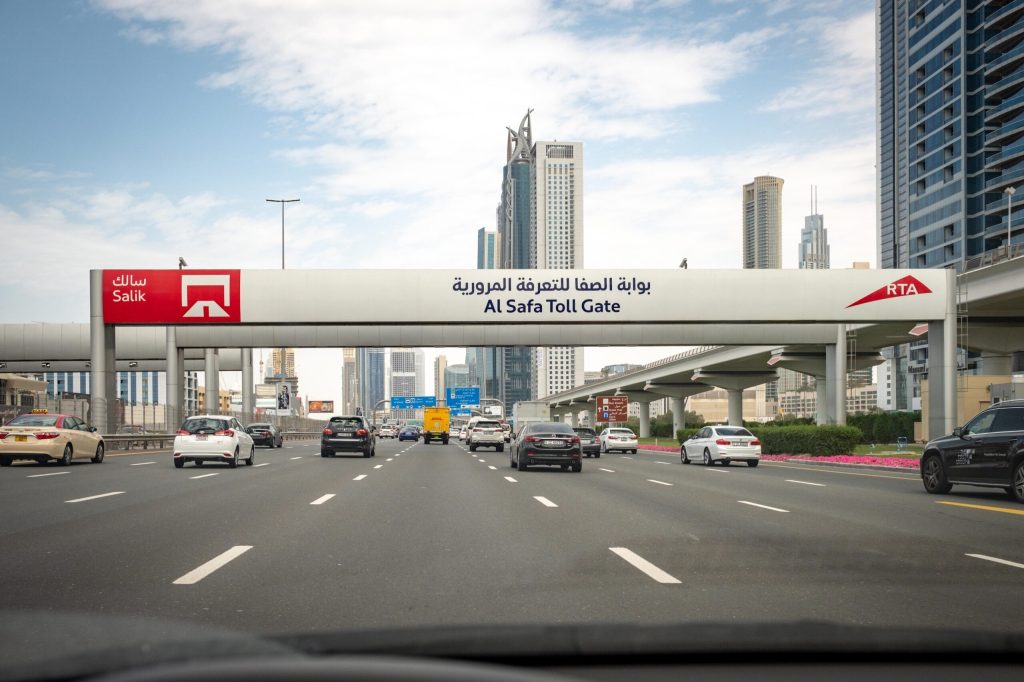
Dubai road toll operator Salik has shrugged off lower traffic on the emirate’s highways since the outbreak of the US-Israeli war on Iran, reinforcing its reputation as a utility-like stock.
But with no control over toll pricing or network expansion, ancillary revenue remains Salik’s clearest path to growth, analysts said.
Salik, majority owned by the Dubai Roads and Transport Authority (RTA), operates 10 toll gates in the emirate. In the second quarter, vehicles passing through these gates dropped 13 percent — or 26 million — year on year to 187 million as Iranian attacks caused disruption.
Second-quarter net profit fell 16 percent to AED335 million, in line with financial services company EFG Hermes’ forecast.
Ahmed Hazem Maher, managing director and head of energy, transport & industrials research at EFG Hermes in Cairo, attributed the declines to reduced tourism and more people working from home.
Stable revenue from fines supported quarterly earnings, said Ali Afifi, a director at Dubai’s Arqaam Capital.
“Salik is a proxy for Dubai population growth rather than the wider economy, which has many more moving parts,” he said.
Maher expects third-quarter earnings to be similar to the second quarter, with the summer travel lull usually making it Salik’s weakest period.
Further reading:
“It’s too early to be certain because of the highly fluid geopolitical situation,” he said.
Indarpreet Singh, assistant vice president for research at Bahrain’s Sico Bank, was more bullish.
“Salik’s improving performance should extend into Q3,” he said. “It’s a service that Dubai car users cannot avoid — it’s like a utility.”
Afifi said the academic year starting August 31 should help traffic levels return to 80-85 percent of pre-war levels by about September or October.
Business model
Salik’s half-year Ebitda and net profit margins were almost unchanged at 69 and 49 percent respectively. Its biggest cost is a concession fee it pays to the government, calculated as a percentage of toll fees.
The RTA sets toll fees and decides when and where to build new gates. Salik cannot control traffic volumes, so the factors that most shape its performance lie beyond its control.
“Salik’s business is extremely safe, but it has limited upside on its core business,” said Afifi. “Toll fees are inflation-linked, which provides a hedge against inflation but also limits growth.”
With traffic levels still below pre-war levels, new toll gates seem unlikely in the short term, he said.
Beyond tolls
Afifi described Salik’s app as Dubai’s most widely used homegrown app, reaching nearly every Dubai vehicle owner. The company is monetising that audience by partnering with insurance companies and other businesses to sell products through the platform.
Ancillary revenue, which also includes Salik’s exclusive agreement to manage parking at Dubai Mall, helps diversify its income and bring more of its earnings under its direct control.
“Most of these ancillary revenue streams have very high margins, so most income flows straight through to the bottom line,” said Maher.
Valuation
Salik sold 25 percent of its stock at AED2 per share in a September 2022 initial public offering that raised AED3.7 billion ($1 billion).
The stock hit an all-time high of about AED6.90 in August 2025, a rally Afifi attributes to the introduction of dynamic toll pricing in January 2025 and the opening of two new toll gates the preceding November.
Its stock ended Wednesday at AED5.26, down 18 percent since the start of the Iran war. Its price-to-earnings ratio is 27 and its dividend yield is 4.2 percent. That compares with a P/E ratio of 13 for UAE stock markets combined, financial website Simply Wall St estimates.
Arqaam and EFG Hermes consider the shares fairly valued. Salik’s relative equity price premium is justified, said Afifi, pointing to its free cash flow margin of about 90 percent.
“[It] pays out all its profits in dividends and is a very low-risk business,” he added.