
In anticipation of its International Lunar Research Station (ILRS), China intends to usher in the new era of space by sending robot dogs, man’s new and improved “best friend,” to the Moon to conduct research and even help us move there.
We would have to build new communication and navigation systems from scratch before that dream could become a reality, according to SCMP, but it seems we’re already on our way.
China intends to integrate these new systems into its future space station, that they intend to complete in 2035.
It almost sounds like a scene from a Pixar movie: a robot dog, complete with a cute cartoon voice, strapped into a spacecraft seat, innocently marveling at the powerful launch it takes for the rocket to get to space.
After all, one of the dog’s functions would be to support astronauts emotionally and psychologically…as life on the Moon can take its toll, even if we are hellbent on moving there. I suppose we’d get used to it.
Chinese robot dogs heading to space
Just published in the Chinese Space Science and Technology journal, South China Morning Post reports that the authors painted a visceral picture of life on the future Moon… of robot dogs serving as leaders and guardians, patrolling research stations, and assisting astronauts in conducting scientific research.
Man and dog will live and work side by side. Robot dog will even guard the lunar research station. Against whom, though? They will patrol the stations, with bemused astronauts. I guess you never know.
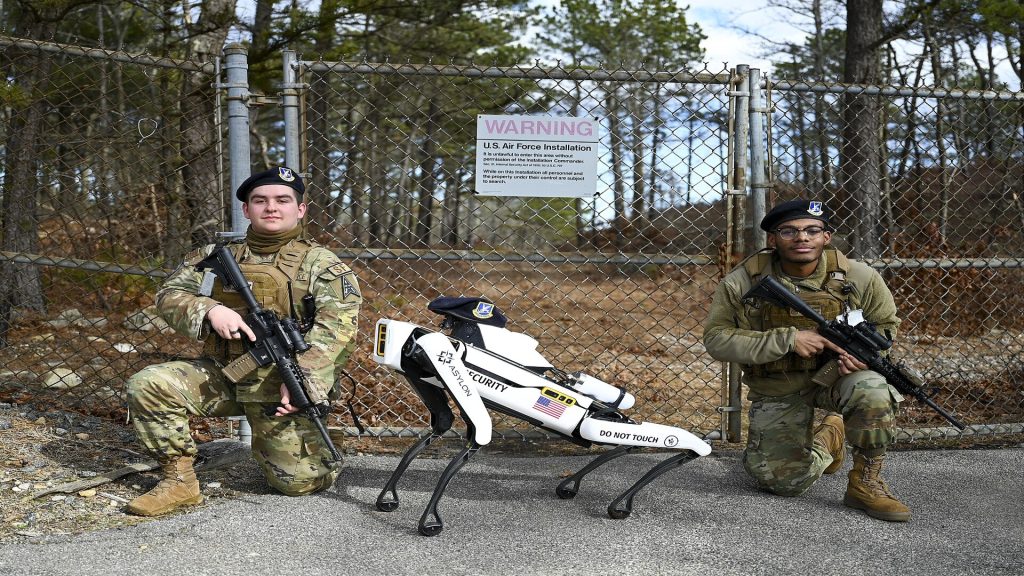
Playfulness aside, as dogs inspire it, patrols and inspections are evidently carried out daily. Robot dogs could provide welcome support. They already are, on land, at the Cape Cod Space Force Station.
It’s just that, typically, a man accompanies dogs on their walks, but they might eventually be able to operate autonomously. As of 2023, at Cape Cod, they were “semi-autonomous.”
Picturing an adorable robot, eagerly seeking to be of use, even designed to wag a mechanical tail, to riff off the idea, the proposal doesn’t sound that far-fetched, but rather a development of what already exists.
Beyond keeping space safe, man’s best friend will be at the forefront of future moon research. Man will call the command. Dogs will carry out the work. Or, they will do it together.
In total, this idea shows how three machines could aid three astronauts in performing different tasks: exploring the landscape, collecting rock samples, and carrying out detailed work.
Even in our efforts to colonize the moon, robot dogs could “prepare the Moon for long-term human settlement” by “harvesting water ice and mining minerals…and building with local materials,” according to SCMP.
Furthermore, they would regulate air and temperature, clean living spaces, tend to plants, and even prepare meals. They might even be able to talk to astronauts to alleviate any strain they might be under in these conditions.
And these conditions will pose challenges to the technology that will fuel man’s best friend in space because AI on Earth relies on data that doesn’t exactly exist on the Moon. So it will be a learning curve for all life forms, digital and natural.
China is building a lunar base
Upon completion of its first base on the Moon in 2035, China will move ahead and extend its footprint by constructing a larger orbiting complex by 2045.
Later this August, 2026, China is launching a mission to extract water ice at the lunar South Pole to help astronauts live at the base, SCMP reports.
And robot dogs just might – with their lit-up noses in the air – be standing next to their human counterpart.