
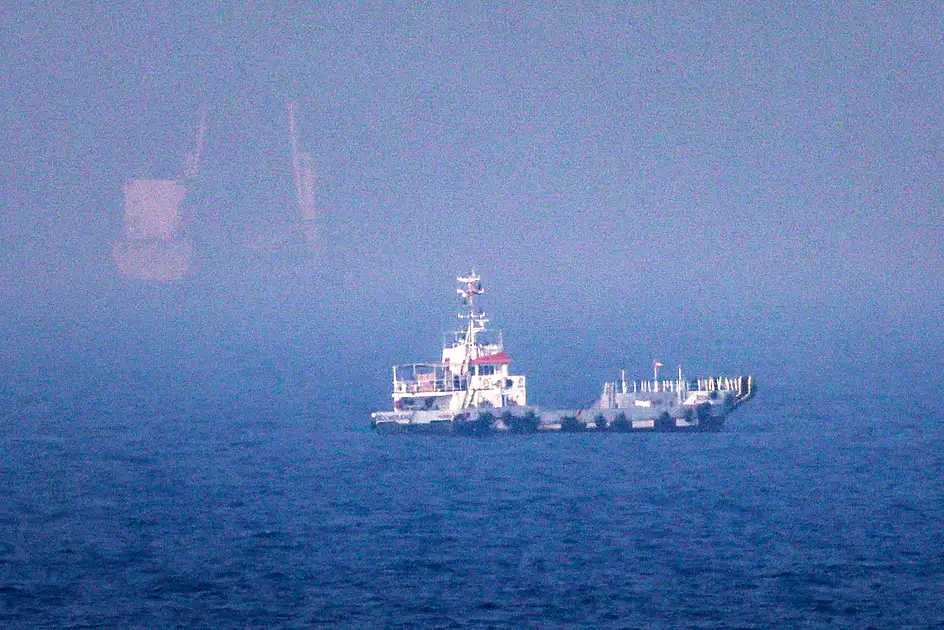
The UAE has expressed grave concerns over Iranian attacks on commercial shipping and closure of the Strait of Hormuz.
Speaking at the 2026 BRICS Trade Ministers Meeting (TMM), Dr Thani bin Ahmed Al Zeyoudi, UAE Minister of Foreign Trade, underscored the UAE’s grave concerns over Iran’s attacks on commercial shipping and the continued closure of the Strait of Hormuz, and reiterated the UAE’s call for its immediate and unconditional reopening and the protection of freedom of navigation and international shipping, in accordance with international law.
On Friday, UAE’s energy giant Adnoc said it continues to be “significantly impacted by unprovoked attacks on its assets and employees.”
“Since the beginning of the conflict, 15 of our vessels have been attacked by missiles and drones while transiting the Strait of Hormuz, including three vessels this week alone. Tragically, these attacks have resulted in one fatality and 20 injuries to crew members,” Adnoc said in a statement.
Since the start of the regional conflict between the US, Israel and Iran, Tehran has targeted energy and other assets many times in the Gulf region.

“Freedom of navigation and the safe, uninterrupted passage of commercial shipping through international waterways must be respected and protected without threat, harassment or attack,” Adnoc said.
A statement issued by the Ministry of Foreign Trade said that the broader discussions covered key priorities for BRICS economic cooperation, including trade resilience, market connectivity and emerging challenges affecting global commerce. Trade ministers were unable to reach consensus on a joint declaration at the conclusion of the meeting.
“At a time of heightened uncertainty in global trade, cooperation between emerging markets and developing economies is more important than ever. The UAE views BRICS as an important platform for strengthening economic cooperation and supporting an open and predictable trading environment. Our engagement in Jaipur reinforced the strength of the UAE’s economic relationships with fellow BRICS members, and we are committed to translating these discussions into tangible outcomes for businesses and communities,” said Al Zeyoudi at the 2026 BRICS Trade Ministers Meeting (TMM) held in Jaipur, India.
$312 billion non-oil trade
Trade between the UAE and BRICS nations continues to record strong growth.
In 2025, bilateral non-oil foreign trade between the UAE and BRICS member nations surpassed $312 billion, a 28.5 per cent increase compared to $243 billion in 2024. BRICS nations accounted for approximately 31 per cent of the UAE’s total non-oil foreign trade in 2025. They were also the source of 34 per cent of the UAE’s imports, the destination for 23 per cent of its non-oil exports, and accounted for 28 per cent of its re-exports during the same period.
Al Zeyoudi also discussed with India’s Minister of Commerce and Industry Piyush Goyal expanding cooperation in services trade, digital commerce, logistics, and food security.
India remains one of the UAE’s largest trading partners globally, with bilateral non-oil trade reaching $76.2 billion in 2025, a 17.3 per cent increase on the previous year.
The BRICS community expanded from five to nine member nations in 2024, with Indonesia joining as its tenth member in 2025. It comprises Brazil, Russia, India, China, South Africa, Indonesia, Ethiopia, Egypt, Iran, and the UAE. Together, these nations represent approximately 40 per cent of the world’s population and around 25 per cent of global GDP.
The UAE’s participation in the BRICS TMM complements its broader trade agenda, anchored by the Comprehensive Economic Partnership Agreement (CEPA) program, which aims to increase non-oil foreign trade to $1.1 trillion by 2031. Since its launch in September 2021, 38 agreements have been concluded with economies across Asia, Africa, Europe, and the Americas, with 18 in force – including agreements with fellow BRICS members India and Indonesia.
