
Close Menu
Simply Invest Asia
  • Home
  • About us
  • Explore industries/sectors
    • Automobile
    • Aviation
    • Banking
    • Biotechnology
    • Chemical & Fertilizer
    • Entertainment and Media
    • Food Processing
    • Healthcare
    • Iron and Steel
    • Leather
    • Mining
    • Oil and Gas
    • Pharmaceutical
  • Explore by countries
    • China
    • Dubai / UAE
    • Hong Kong
    • India
    • Indonesia
    • Japan
    • Malaysia
  • Explore cities
    • Bangkok
    • Beijing
    • Chongqing
    • Delhi
    • Dubai
    • Guangzhou
    • Jakarta
    • Kuala Lumpur
  • Why Asia
Facebook X (Twitter) Instagram Threads
Trending:
  • Man arrested as mainland Chinese dental centres in Hong Kong come under scrutiny
  • Is Dubai’s property market unstoppable? A look at 2026’s record-breaking figures
  • Why India’s Hockey Teams Swapped Iconic Blue for Saffron Jerseys at the 2026 FIH World Cup
  • Indonesia strengthens villages against human trafficking
  • Manufacturing pivot to green steel could unlock billions in regional investment, CEF says
  • China’s Top 10 GDP Cities at Midyear: Guangzhou and Shenzhen Lead Growth, Chongqing Lags, as Hard Tech Reshapes Urban Rankings — BigGo Finance
  • China denies report of planned shipment of missile launchers to Iran, calls it ‘not factual at all’
  • Shetland Heroes Awards 2026: Focus on Healthcare and Emergency Service Hero category
  • Death toll from earthquake in southwestern Japan rises to 30
  • Australian rendering industry symposium
  • Emirates accepts crypto payments for UAE residents
  • Jorn again: Hong Kong set for Fifa Asean Cup reunion with old boss after Myanmar draw
  • China pushes back against EU Beijing duck dumping probe
  • Can Nine Entertainment (ASX:NEC) Reshape The Media Conversation?
  • Hyatt Place Debuts in Vithalapur, India’s Thriving Industrial Destination
  • The chemical blind spot in ballast water treatment
  • Bangkok Post – Drones and blackouts inflict tense summer on Crimea
  • Central banks slashed their gold purchases in early 2026 – Financial Times
Thursday, July 30
Facebook X (Twitter) Instagram
Simply Invest Asia
  • Home
  • About us
  • Explore industries/sectors
    • Automobile
    • Aviation
    • Banking
    • Biotechnology
    • Chemical & Fertilizer
    • Entertainment and Media
    • Food Processing
    • Healthcare
    • Iron and Steel
    • Leather
    • Mining
    • Oil and Gas
    • Pharmaceutical
  • Explore by countries
    • China
    • Dubai / UAE
    • Hong Kong
    • India
    • Indonesia
    • Japan
    • Malaysia
  • Explore cities
    • Bangkok
    • Beijing
    • Chongqing
    • Delhi
    • Dubai
    • Guangzhou
    • Jakarta
    • Kuala Lumpur
  • Why Asia
Simply Invest Asia
Home»Explore industries/sectors»Chemical & Fertilizer»The chemical blind spot in ballast water treatment
Chemical & Fertilizer

The chemical blind spot in ballast water treatment

By IslaJuly 30, 20264 Mins Read
Share
Facebook Twitter Pinterest Threads Bluesky Copy Link


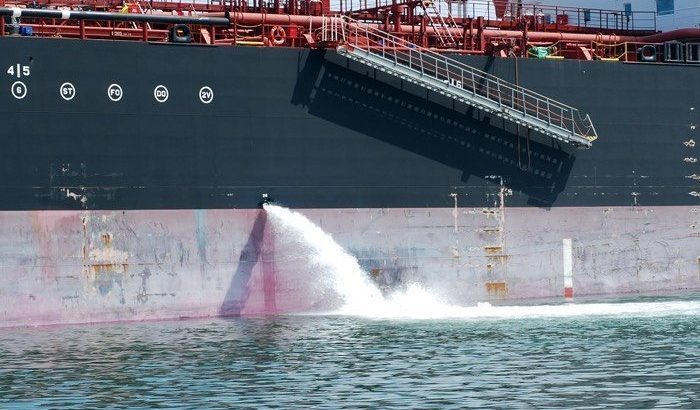
Ballast systems are judged on whether they kill invasive organisms, not on what their oxidant chemistry leaves behind. With billions of tonnes discharged each year, ports still have little idea how much bromoform and other by-products are accumulating in their waters. Captain Alex Byelyavtsev reports.

Ballast water treatment was built for one problem: ships were carrying live organisms from one sea to another, and some of those organisms took hold where they did not belong. The Ballast Water Management Convention deals with that directly. A system is approved if it kills what is in the tank, and a discharge is legal if it meets a concentration limit on the way out. Nobody asks what happens to the chemistry that made the kill possible once it is in the harbour. 

Not every system creates that chemistry. Ultraviolet treatment adds no chemical to the water. The systems that do are oxidant-based, mainly electrochlorination, which generates chlorine inside the ballast tank from seawater. The chlorine kills the organisms, but in seawater it does not stay chlorine. It reacts with bromide and organic matter to form bromoform, bromate, chlorate and a family of brominated acids. Chemists call them disinfection by-products. The International Maritime Organization knows they exist. Its scientific advisory group, GESAMP, keeps a list of them. Manufacturers have to test for them under IMO’s Procedure (G9) before a system is approved. That risk assessment is not run against a real port. It is run against what GESAMP itself calls a Model Harbour, a standardised, hypothetical stand-in. Discharge limits apply to the leftover chlorine. What is not tracked is the cumulative load once systems are in commercial use.

Scale is where the picture breaks. Concentrations are measured in micrograms per litre, to check whether one ship’s discharge crossed a line. Ballast water itself is measured in tonnes, and only a few places count it. Around Singapore, cargo-based modelling has put annual ballast discharge at something closer to 190m cu m. Ships are not required to report where they deballast. IMO’s own guidance puts the global transfer at 3bn to 5bntonnes a year in one place and at 10bn tonnes in another, within the same document. There is no agreed way to measure ballast volumes, let alone the by-products inside them.

Once concentration sits next to a real annual discharge, the arithmetic changes. A 2022 review in Water Research measured disinfection by-products in treated ballast water directly. It found bromoform averaging around 247 micrograms per litre, roughly 10 times the concentration the same researchers measured in cooling water or desalination effluent. A ballast tank holds its chlorine dose longer, and with less dilution, than either. On that basis the review estimated that ballast water treatment worldwide releases something like 860 tonnes of bromoform into the sea every year. Modelling for Singapore and the Pearl River Delta, published in Ocean Science and using ocean-current data from the EU’s Copernicus Marine Service, put the regional bromine input from ballast-derived bromoform at roughly eight to 63 tonnes a year.

Bromoform evaporates, and in open water much of it leaves the sea surface for the atmosphere. The Singapore modelling found that most of the bromoform produced there does exactly that. In slow harbours, exchange is what removes it. The Gulf of Fos and the Persian Gulf already show what happens when the same chemistry enters semi-enclosed water from industrial outfalls: bromoform concentrated near discharge points, related compounds building up in marine tissue at concentrations many thousands of times higher than in the surrounding water. Ballast water has not been added to that count in those regions, or in most of the world.

In 2019, Australia’s Bureau of Agricultural and Resource Economics and Sciences ran the same risk-assessment method against real ports instead of the Model Harbour. At Port Hedland, dibromoacetonitrile exceeded its safe environmental threshold even under a plausible scenario. In Melbourne, monochloroacetic acid exceeded its threshold at every dock modelled, and dibromoacetic acid at Appleton Dock. The report recommended physical sampling. As far as the public record shows, nobody has.

This is not an argument for stopping oxidant-based treatment. The convention solved the problem it was built for. GESAMP reviews the chemistry at approval, and discharge limits on residual oxidant are real. For most ports, the other side of the picture is still missing: how much oxidant-treated ballast they receive each year, how slowly their water exchanges with the open sea, and what that adds up to after a decade of discharges. Singapore has one model. Australia has one. Most harbours do not.


Source link

Related Posts

Flexible DNA Transforms Protein Crystallization | News

July 29, 2026

Shandong Port yard breaks into chemical tankers

July 28, 2026

Lancashire chemicals plant linked to PFAS contamination announces closure – News

July 27, 2026
Add A Comment
Leave A Reply Cancel Reply

Top Posts

China Scraps 12,000 Degrees in Biggest Academic Overhaul in Years

June 14, 2026

Chinese Wall may stem India tech flows for electronics and automobile

June 1, 2026

Abandoned malls, whispers of nuclear war and young foreigners detained. This is what’s REALLY going on in Dubai… and the chilling warning one taxi driver gave to the Mail’s IAN BIRRELL

April 11, 2026
Don't Miss

Man arrested as mainland Chinese dental centres in Hong Kong come under scrutiny

By IslaJuly 30, 2026

Poll shows dentists in the city must treat about four patients per month for complications…

Is Dubai’s property market unstoppable? A look at 2026’s record-breaking figures

July 30, 2026

Why India’s Hockey Teams Swapped Iconic Blue for Saffron Jerseys at the 2026 FIH World Cup

July 30, 2026

Indonesia strengthens villages against human trafficking

July 30, 2026
SUBSCRIBE TO OUR NEWSLETTER

Get our latest downloads and information first. Complete the form below to subscribe to our weekly newsletter.


I consent to being contacted via telephone and/or email and I consent to my data being stored in accordance with European GDPR regulations and agree to the terms of use and privacy policy.

Stay In Touch
  • Facebook
  • YouTube
  • TikTok
  • WhatsApp
  • Twitter
  • Instagram
Top Trending

China pushes back against EU Beijing duck dumping probe

By IslaJuly 30, 2026

Can Nine Entertainment (ASX:NEC) Reshape The Media Conversation?

By IslaJuly 30, 2026

Hyatt Place Debuts in Vithalapur, India’s Thriving Industrial Destination

By IslaJuly 30, 2026
Most Popular

Spring silkworm cocoon harvesting season arrives in Qianjiang, China’s Chongqing-Xinhua

June 21, 2026

South Korea, Indonesia rein in derivatives trading to defend currencies

June 15, 2026

India regains favor as investors seek shelter from AI-driven market swings By Investing.com

July 5, 2026
Our Picks

India-US trade deal: Delhi set for crucial four-day talks – Asia News Network

June 3, 2026

Police raid Bangkok steroid lab, seize 1.3 million tablets

July 1, 2026

Iran war latest: Araghchi claims Iran will have sole custody of Hormuz after night of strikes

June 29, 2026
SUBSCRIBE TO OUR NEWSLETTER

Get our latest downloads and information first. Complete the form below to subscribe to our weekly newsletter.


I consent to being contacted via telephone and/or email and I consent to my data being stored in accordance with European GDPR regulations and agree to the terms of use and privacy policy.

© 2026 Simply Invest Asia.
  • Get In Touch
  • Cookie Policy
  • Privacy policy
  • Terms & Conditions

Type above and press Enter to search. Press Esc to cancel.

SUBSCRIBE TO OUR NEWSLETTER

Get our latest downloads and information first.

Complete the form below to subscribe to our weekly newsletter.


I consent to being contacted via telephone and/or email and I consent to my data being stored in accordance with European GDPR regulations and agree to the terms of use and privacy policy.