
On July 19, India’s Minister for Culture Gajendra Singh Shekhawat, speaking in Cholpon-Ata, Kyrgyzstan, at the meeting of culture ministers from the member states of the Shanghai Cooperation Organization (SCO), framed culture as a “powerful force for dialogue, trust and sustainable development.” He reaffirmed India’s commitment to preserving the “shared civilizational heritage” and strengthening cooperation among the members of the group. The meeting ended with a gala concert and a guided tour of the Rukh-Ordo cultural complex, which serves as an exhibition venue to showcase Kyrgyzstan’s cultural heritage, history, and traditions. There was also a proposal for an SCO international theater festival.
Earlier, in April, the defense ministers of the SCO countries met in Bishkek. Next will be the foreign ministers meeting in Cholpon-Ata on July 23-24. Minister of State for External Affairs Kirti Vardhan Singh will represent India at the meeting, which will prepare the ground for the SCO Leadership Summit, scheduled to be held in Bishkek from August 31 to September 1. The foreign ministers will review progress in key areas of SCO cooperation and exchange views on matters of regional and international significance. On September 1, Kyrgyzstan will pass the chairmanship of the organization to Pakistan.
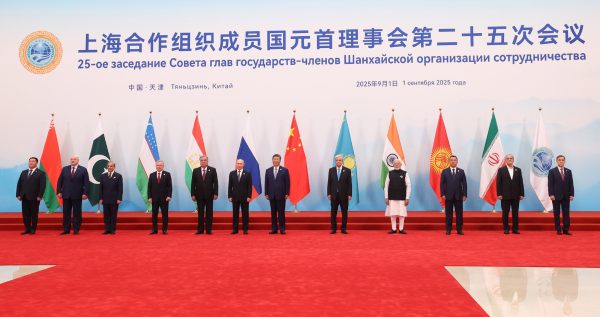
The SCO just marked its 25th anniversary. It was originally founded in June 2001 when the “Shanghai Five” – China, Russia, Kazakhstan, Kyrgyzstan, and Tajikistan – were joined by Uzbekistan and the name was changed to the Shanghai Cooperation Organization. The SCO was meant to catalyze collaborative efforts on regional, geopolitical, and geostrategic challenges. It has over the years added four more member states – India, Pakistan, Iran, and Belarus – bringing the total to 10. As a result, the organization is now the largest pan-Eurasian regional grouping. Not surprisingly, meetings of the SCO, especially those of the heads of states, continue to attract immense attention in the region and beyond.
Nevertheless, beyond media headlines, the SCO’s actual performance and delivery potential on its 10 identified “goals and tasks” has remained suboptimal. Saddled with internal contradictions, divergent world views, and competing geoeconomic and security interests, the SCO has remained mostly a talk shop providing photo opportunities, diplomatic signaling, and at times hedging.
On July 20, I spoke with Kirti Vardhan Singh, the minister who will represent India at the upcoming foreign ministers meeting, to probe where SCO figures in India’s strategic calculus. “India considers SCO as a structured multilateral forum as advantageous to India, in enhancing outreach with Central Asian nations to expand our presence and visibility in SCO geography at large,” Singh said.
To that end, he added, “India continues to maintain its focus on areas of common interest and resolutely defends any move against India’s core interests that may emanate from certain SCO geographies.”
Still, the fact remains that SCO mirrors most of the deficiencies that plague any large multilateral grouping. The lack of unanimity on key goals such as “joint[ly] combating terrorism” and “jointly searching for solutions to the problems that would arise in the 21st century” makes the SCO long on rhetoric but short on delivery.
In particular, the India-Pakistan differences repeatedly cast a long shadow on the SCO’s workings, as do China-India disagreements concerning the China-Pakistan Economic Corridor (CPEC). During the defense ministers’ meeting in Bishkek, India’s Defense Minister Rajnath Singh spoke about “fractured world views” of “inward-looking countries,” but also about how India “demonstrated its firm resolve that terrorism epicenters are no longer immune to justifiable punishment” – indirectly hinting at Pakistan.
On July 17, India participated in the 12th Meeting of the Heads of Border Services of SCO member states, hosted in Islamabad under Pakistan’s chairmanship. The meeting was meant to exchange assessments on border security and finalize plans for the SCO’s joint border operation, “Solidarity 2026.” New Delhi’s long-standing apprehension that the SCO remains a forum for China-Pakistan nexus vis-à-vis India is bound to grow once the baton of SCO leadership passes over to Islamabad for the next year.
Further, the wars in Ukraine and Iran have obligated the SCO to take a position on conflicts that have affected the economies of the world. This is in sync with the SCO’s identified goal of “cooperating in the prevention of international conflicts and their peaceful settlement.” However, having parties to these conflicts like Russia and Iran as members hasn’t led to much progress.
It could be argued that such a state is hardly unique to SCO. Similar challenges afflict other such large groupings where members fail to balance collective goals against individual national interests. Multilateralism around the world has come under increasing strain and is mostly faltering.
Existing global forums hardly reflect the economic and power realities of the changing world order. There is no agreement among nations over existential global issues, no agreement on fair trade rules, and no qualms about using violence to settle differences. Global institutions don’t have the funds to address the dire needs of the Global South in areas like health, education, and climate, even as billions are poured into military spending and ceaseless wars that serve only to secure the short-term interests of great powers.
Can regional organizations be an alternative to the downward trend of multilateralism? The SCO is surely facing a litmus test on this count.
There have been calls in Indian strategic circles for India to withdraw from the SCO and form its own regional organization. The reason why New Delhi has ignored such opinions isn’t merely due to its trust in the potential of the grouping but due to the advantages the SCO provides. Singh told me that India’s participation “enhances New Delhi’s outreach with Central Asian nations to expand its presence and visibility in SCO geography at large.” This allows India to loop in Afghanistan as a bridge into regional trade and connectivity projects to help the economic stabilization of the country.
Moreover, the SCO’s avowed priorities against terrorism, separatism, extremism, and radicalization through the Regional Anti-Terrorist Structure (RATS) have helped mainstream India’s approaches on these matters, a matter of substantive national interest, even when the organization’s ability to take a common stand is a rarity.
Within the SCO framework, India continually advocates for robust mechanisms to tackle transborder terrorism and extremism, as well as for fair trade, secure supply chains, and regional connectivity. India also pushes to make English an official SCO language to broaden global representation, while reaffirming its commitment to shared civilizational heritage. This needs to be contextualized within New Delhi’s substantial investment in regional forums for a rules-based regional as well as global order. India has advocated for open, inclusive and transparent connectivity projects such as the International North South Transport Corridor (INSTC), which potentially provides leeway to regional countries to choose their preferred connectivity projects.
What’s true for India also holds true for the other SCO members. Each has tried to leverage the organization to amplify its interests and used the forum to advance bilateral as well as minilateral interests. It is this advantage that keeps the SCO going. Twenty-five years on, the SCO endures because of these quiet calculations of individual national gain. Now, it is time for this pan-Eurasian organization to step up to the plate and address the needs of the region collectively.