
Welcome to Foreign Policy’s Southeast Asia Brief.
The highlights this week: Five Southeast Asian countries are represented in China’s new AI organization, Bangladesh wants to build a fence along its border with Myanmar, and a Thai civil service exam cheating scandal leads to arrests.
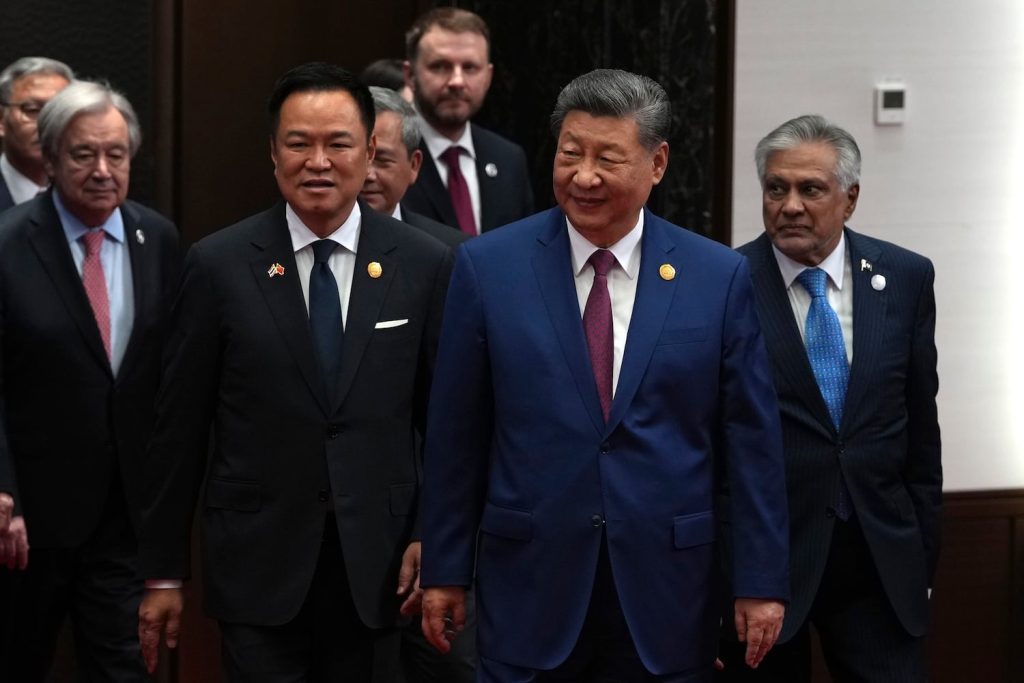
Last Thursday saw China launch its World Artificial Intelligence Cooperation Organization (WAICO) in Shanghai, followed by a four-day conference on the matter. Government representatives from a number of Southeast Asian countries attended, including Thai Prime Minister Anutin Charnvirakul on his first official visit to China since taking office.
Speaking at the conference, Chinese President Xi Jinping called for international cooperation on AI. China tech watcher Kyle Chan read the speech as Xi implicitly contrasting China’s open-source models with the United States’ closed models, rendering China a global goods provider and the United States a selfish tech hoarder.
But what does Southeast Asia make of this pitch? Of the 29 founding members of WAICO, five were from Southeast Asia: Cambodia, Indonesia, Laos, Malaysia, and Myanmar.
How much significant is this? Cambodia, Laos, and Myanmar are all to varying degrees seen as China-leaning in how they conduct their affairs, but they are peripheral to AI developments.
Indonesia is a regional heavyweight but under the current government has a habit of joining every international organization that it can. Malaysia plays an important role in semiconductor supply chains, but didn’t release an official statement after the conference, which makes its goals hard to parse. It maintains an independent foreign policy, though some think it tilts toward China.
Notably, Singapore did not join. Its preference for open-source AI aligns with China. But it is always wary of drawing too close to the superpower.
Despite being a guest of honor, Anutin also didn’t sign on to WAICO. In his speech at the conference, he laid out his own vision of AI governance—one that did not simply echo China’s stance, Thai political analyst Ken Lohatepanont observed.
Anutin’s three key principles were protection, potential, and prosperity. While stressing the need to not overregulate AI and its potential boons, Anutin seemed to be most preoccupied with the first point. Protection took up the biggest chunk of the speech, with a focus on AI risks with regard to fake news and scams.
Even though he didn’t join WAICO, Anutin stressed Thailand’s closeness with China. “China and Thailand are one family,” he declared in a Facebook post about the conference, showing himself and Xi alongside top officials from both countries.
For Anutin, there was a lot more than just AI on the agenda. First of all, there were the ongoing tensions with Cambodia—whose prime minister, Hun Manet, also met with Xi.
Xi urged the two countries to settle their dispute and told Anutin that China was prepared to facilitate talks. According to Anutin’s official Facebook fan club (called “FC Anutin”), Xi also assured him that Chinese tanks sent to Cambodia will not be used against Thailand.
China could play a constructive role here, having already helped broker the cease-fire finalized in December after the second round of fighting between Thailand and Cambodia. It’s a shame that Hun Manet and Anutin did not meet on the sidelines like they did at May’s summit of the Association of Southeast Asian Nations.
The trip to Shanghai also saw Thailand and China agree to set up a 2+2 dialogue co-chaired by their foreign affairs ministers and defense ministers. They also pledged to cooperate on a laundry list of other issues, from scams to the Thailand-China railroad—all much the same scope as under Thailand’s previous prime minister.
The prospect of tighter Thai-Chinese coordination on security may worry some, not least Bai Zhaodong, a dissident Chinese journalist. China has requested his extradition from Thailand, where he has now been detained for several months.
Hun Manet’s meeting with Xi also seemed to focus on the ongoing border dispute with Thailand. But the meeting came at a cost. Taipei ended Cambodia’s visa-free status after Hun Manet reiterated his support for China’s Taiwan stance at the meeting.
What We’re Watching
Bangladesh wants to build the wall. Bangladesh wants to build a fence along its border with Myanmar to limit cross-border flows of people and weapons. The idea was first made public in June, but new details have now emerged. The proposed barrier would stretch for 108 kilometers (about 67 miles), covering nearly 40 percent of the border.
Since the 2021 coup in Myanmar, the insurgent Arakan Army (AA) has consolidated its control of the state of Rakhine, previously the site of the Myanmar military’s genocide of Rohingya. The AA has also been implicated in atrocities against the Rohingya.
In interviews with Nikkei Asia published last week, officials from Bangladesh’s Border Guard said that traditional border management mechanisms are no longer working after the AA took control of the region in 2024.
The main area of focus is the Chittagong Hill Tracts, according to retired Maj. Gen. Shahidul Haque, a former defense attaché at the Bangladesh Embassy in Myanmar, who also spoke to Nikkei. This area sees a two-way flow of recruits leaving to join the AA and drugs and weapons being smuggled out of Myanmar along this route. The AA’s kidnapping and ransoming of Bangladeshis plus cross-border violence are also problems.
Some analysts argue that a border fence alone will not fix the problem. Instead, they say a wider strategy to address poverty and other drivers of instability along the frontier is needed.
Israeli tech incubator panic. Network School, a self-described “frontier community,” or co-living space for tech nerds, has sparked a panic in Malaysia over allegations that it included Israeli citizens.
Situated in Forest City—a massive, Chinese-led property development in a city long reputed as a ghost town—on the coast of Johor, the group was led by American tech/crypto entrepreneur Balaji Srinivasan.
The brouhaha started earlier this month when activist group Malaysian Protest 4 Palestine claimed in an Instagram post that it was a “gathering place for Israeli entrepreneurs.” Malaysia does not recognize Israel diplomatically. Israeli citizens are banned from entering except with special permission from the Home Ministry, but dual citizens can use a second passport to circumvent this.
Public outcry has taken on a paranoid edge. Critics raise the specter that this is somehow the thin end of the wedge for Israeli influence or subversion of Malaysia’s sovereignty. Srinivasan’s own writing about “network states,” where online communities cooperate to develop independent micronations, has not helped. (Such libertarian utopianism is common in tech communities, and it has run them into trouble elsewhere, too.)
Malaysian Prime Minister Anwar Ibrahim has said any Israelis present should be expelled. But so far, immigration inspections have revealed none.
Srinivasan, who has said that the claims are false, has asked to meet with Anwar—but also paused investment and threatened to relocate.
On Tuesday, Johor ordered the school to close over an alleged breach of local regulations on business licenses.
Civil servant exam cheats. On Wednesday, the Thai government announced that nearly 6,000 civil servants could be suspended over an exam cheating scandal.
The scandal first broke in February, when local outlet Next News reported an audio recording that seemed to show officials and politicians discussing altering results from Local Administration Department exams in return for payments of up to 800,000 baht (around $24,000).
On June 23, the National Anti-Corruption Commission announced arrests in relation to the scandal. The ministry is now reviewing some 800,000 exam papers.
Further arrests have followed. Police recently confirmed the arrest of three suspected ringleaders: a university employee, his sister, and retired civil servant. They will face charges alongside 11 civil servants.
Anutin has been outspoken about the scandal, calling it “a betrayal of the nation.” His words may reflect his potential vulnerability on this topic. As well as being prime minister, he holds the position of interior minister, so he oversees the Local Administration Department.
A committee of inquiry is due to provide a full accounting of the scandal in early August. And there are already plans for reforms to prevent a repeat.

This photo taken and released by Vietnam News Agency shows rescue workers addressing the aftermath of flash floods in Muong Than Commune, Lai Chau province, in northern Vietnam on July 17.Vietnam News Agency (VNA) / AFP via Getty Images
Three-quarters. That’s the share of countries that had a more positive view of China than the United States, according to a survey published by Pew Research Center on July 15. The survey measured attitudes in 36 countries.
Southeast Asia stands out as broadly very pro-China. Malaysia has the second-biggest China lean of all surveyed, after Pakistan. Indonesia comes fourth, Singapore fifth, and Thailand sixth. What’s notable is not only the strong majorities that like China but also the United States’ deep unpopularity.
The only exception is the Philippines. Filipinos still favor the United States, but by a narrower margin than one might expect. The survey showed that 56 percent of respondents from the country had a favorable view of the United States, and 40 percent of respondents had a favorable view of China.
In Focus: The Rohingya’s Continued Tragedy
A grim report published by the U.N. migration agency last week stated more than 500 Rohingya refugees were feared to have drowned at sea. Two boats—reportedly carrying roughly 250 and 280 people apiece—set sail from Myanmar’s Rakhine state in late June. Contact was later lost with them. Passengers were reportedly majority Rohingya, including some who had traveled from refugee camps in Cox’s Bazar, Bangladesh.
The start of the genocide against the Rohingya in 2016 created Southeast Asia’s most profound refugee crisis. Some three-quarters of the more than 1.9 million Rohingyas on the continent now live as refugees or internally displaced persons.
The camps at Cox’s Bazar hold the majority, nearly 1.2 million, making it one of the world’s largest long-term refugee encampments. But a steady stream of refugees have left the camps or Rakhine itself for other countries, mainly Thailand, Malaysia, and Indonesia.
The situation is worsening. Rohingyas continue to flee Myanmar, facing violence not just from the junta but also the Arakan Army, which now controls most of Rakhine. Conditions in the camps have deteriorated too, partly a result of U.S. aid cuts. This has pushed more and more people to make perilous sea journeys, mostly to Malaysia or Indonesia.
In November 2025, a boat carrying about 70 Rohingya refugees sunk off the coast of Malaysia, with 27 reported fatalities. In 2024, 176 drowned in one incident off the coast of Myanmar.
Meanwhile, across Southeast Asia, initial sympathy is giving way to aggressive anti-Rohingya sentiment. In Malaysia in 2016, there was a good deal of sympathy for fellow Muslims facing persecution. But in early June this year, half a million people in Malaysia signed an online petition calling for the “removal” of the Rohingya, amid viciously dehumanizing rhetoric.
In Aceh, Indonesia—a landing point for many Rohingya—locals have gone from rescuing them at sea to trying to push them back into the ocean as the pace of arrival picked up.
In Thailand, Rohingya refugees can also face deportation after long detention in overcrowded immigration centers. Though, in a positive move, the Thai government launched ID cards for refugees from Myanmar in June, which will let them register for basic services.