
Published on
July 21, 2026

Image generated with Ai
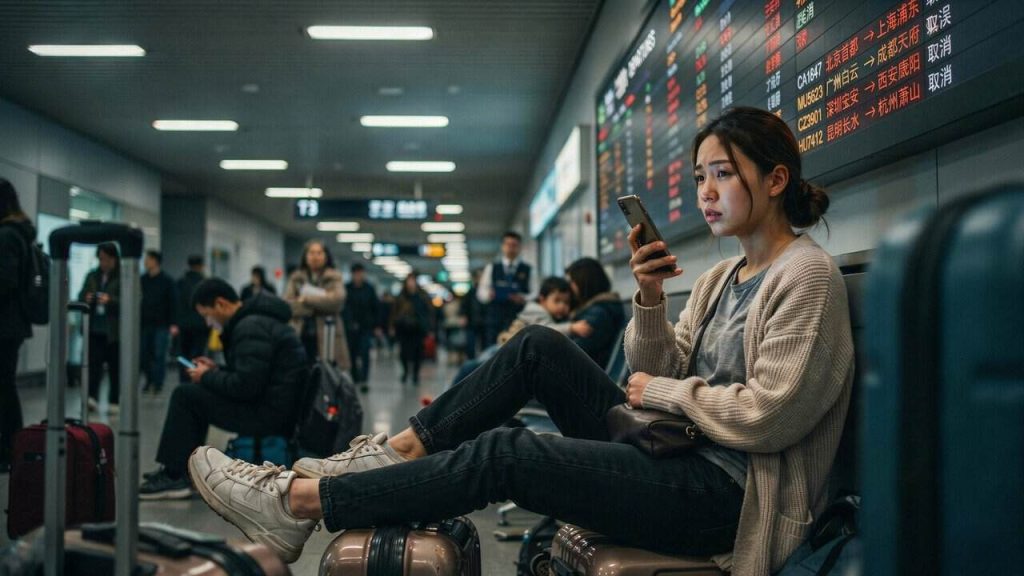
Travelers across China are facing massive disruptions today. Unfavorable summer weather and tight airspace restrictions have combined to paralyze key aviation hubs. As a result, operations have virtually ground to a halt in major cities like Beijing, Shanghai, and Guangzhou. According to recent aviation data, severe gridlock has left thousands of passengers completely stranded at their gates. Statistics show that 6,734 delays and 227 cancellations are actively impacting schedules nationwide. Because these hubs are choked, regional networks are feeling the ripple effects. Consequently, major carriers are bearing the brunt of the chaos. Flights are being canceled rapidly by frontline airlines. Travelers booked via China Eastern, Tianjin Airlines, and Spring Airlines are experiencing the worst of the infrastructure slowdown. More airlines are expected to adjust their schedules as air traffic control manages the backlog. Passengers should check their flight status immediately before heading to the airport.
Analysis of Affected Infrastructure, Municipalities, and Carriers
The footprint of today’s disruptions spans the entirety of mainland China and extends into its key special administrative regions, heavily weighting the operational burden onto the nation’s primary industrial and economic corridors.
Regional and Municipal Airport Impact
The visual and operational epicenter of the crisis sits firmly within the capital. Beijing’s dual-hub system has borne the absolute worst of the cancellations. Beijing Daxing International Airport topped the country’s disruption list with 33 scrubbed flights and 652 delayed departures. Not far behind, Beijing Capital International Airport reported 32 cancellations alongside a staggering 670 delays. Together, the capital’s airspace accounted for nearly 30% of all canceled operations nationwide.
Looking south, the manufacturing and commercial centers faced a similar, delay-heavy bottleneck. Guangzhou Baiyun International Airport registered the highest singular delay count in the country at 864 delayed flights, though it remarkably managed to limit outright cancellations to just 7. In Shanghai, the pain was split across its two main gates: Shanghai Hongqiao International reported 16 cancellations and 360 delays, while the massive international gateway at Shanghai Pudong International logged 15 cancellations and 589 delays.
Advertisement
Advertisement
Other notable disruptions rippled through key regional hubs. Tianjin Binhai International handled 12 cancellations and 208 delays, while Changchun Longjia International in the northeast also saw 12 cancellations paired with 64 delays. Western gateways were not immune, with Chongqing Jiangbei International tracking 10 cancellations and 292 delays, and Xi’an Xianyang International reporting 6 cancellations and 273 delays. Even the coastal and island holiday destinations felt the squeeze, as Xiamen Gaoqi International registered 7 cancellations (231 delays) and Haikou Meilan International saw 5 cancellations (204 delays). Further down the line, airports like Shijiazhuang Zhengding (8 cancellations, 140 delays), Ningbo Lishe (8 cancellations, 128 delays), Taiyuan Wusu (6 cancellations, 99 delays), Nanchang Changbei (6 cancellations, 70 delays), Hangzhou Xiaoshan (4 cancellations, 383 delays), Lanzhou Zhongchuan (4 cancellations, 174 delays), and Shenyang Taoxian (4 cancellations, 125 delays) faced compounding scheduling backlogs. Relatively minor disruptions were recorded at Huizhou Pingtan (3 cancellations, 21 delays), Chengdu Tianfu (2 cancellations, 159 delays), Kunming Changshui (2 cancellations, 147 delays), Hong Kong International (2 cancellations, 129 delays), Urumqi Diwopu (2 cancellations, 105 delays), Dalian Zhoushuizi (2 cancellations, 72 delays), and Hohhot Baita (2 cancellations, 66 delays).
Airline Performance Breakdown
A closer look at the carrier data reveals that China’s “Big Three” state-owned airlines absorbed the brunt of the operational failures, though the impact was felt unevenly across their networks.
Advertisement
Advertisement
China Eastern emerged as the most heavily impacted carrier, reporting a staggering 44 cancellations alongside 908 delayed flights. Air China followed closely behind with 35 cancellations and 682 delays, heavily tied to the grounding of its primary hub operations in Beijing. Interestingly, China Southern Airlines recorded the absolute highest number of individual flight delays at 1,059, reflecting the massive gridlock at its Guangzhou stronghold, though it successfully protected its schedule by holding cancellations down to 17.
Beyond the major three carriers, regional and budget airlines faced severe friction relative to their fleet sizes. Tianjin Airlines recorded a notable 19 cancellations and 157 delays, while low-cost giant Spring Airlines saw 13 cancellations and 175 delays. Mainline operator Hainan Airlines tracked 8 cancellations and 297 delays. Smaller regional operations were similarly bogged down by systemic network issues: China Express Airlines marked 4 cancellations and 122 delays, China United Airlines logged 3 cancellations and 152 delays, Shanghai Airlines registered 2 cancellations and 132 delays, and Okay Airways counted 2 cancellations and 46 delays. Rounding out the carrier impact, Shenzhen Airlines logged just 1 cancellation but a massive 404 delays, while Mandarin reported 1 cancellation and 46 delays, and Qingdao Airlines saw 1 cancellation alongside 16 delays.
Advertisement
Advertisement
Next Steps for Affected Passengers
For travelers caught in the middle of this nationwide gridlock, immediate and proactive action is required to secure alternative transport or compensation.
Step-by-Step Recovery Protocol
- Verify Flight Status Digitally: Before departing for the airport—or if currently stuck in a terminal—passengers should use carrier mobile applications to check the real-time status of their booking. Do not rely solely on airport departure boards, which can lag behind rapid schedule updates.
- Utilize Self-Service Rebooking Tools: With phone hotlines and airport customer service desks facing massive queues, the fastest way to secure a seat on a later flight is through the airline’s official app or WeChat mini-programs. Most Chinese carriers allow free itinerary modifications during major disruptions.
- Secure Official Disruption Certificates: If a flight has been officially delayed or canceled, passengers must request a “Flight Disruption Certificate” (Hangban Wanzheng Zhengming) via the airline’s app or at the gate. This document is legally required in China to process tax refunds, unconditional ticket redemptions, or travel insurance claims.
- Arrange Alternate Ground Transport: For travelers moving between nearby major cities—such as the Beijing-Tianjin corridor or the Shanghai-Hangzhou-Ningbo region—switching to China’s high-speed rail network is highly recommended. The rail system remains unaffected by the factors grounding the aviation sector and offers a reliable alternative to waiting out triple-digit airport delays.
Data Verification Notice
The Data is extensively curated by me with figures derived from Flightaware dated 20 July 2026, 4:47 pm ET USA
Primary Source: Real-time data aggregated via FlightAware.
Verification Protocol: Statistics are cross-checked by our human editorial desk. Timestamped logs and feed snapshots are securely archived internally to maintain historical accuracy.
Note: Real-time tracking figures represent active airspace data and may experience minor variances from local airport terminal gates.
Travelers are advised to check respective airline and airports for more latest information and updates
Advertisement
Advertisement
