
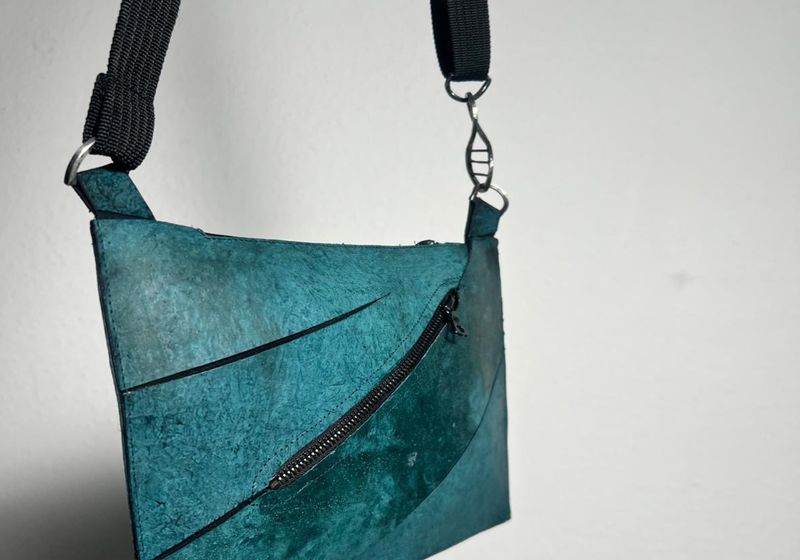
Move over Louis Vuitton and Prada, an even more exclusive handbag has entered the fashion zeitgeist: a Tyrannosaurus rex leather purse.
In a feat of bioengineering that began approximately 68 million years ago, researchers created a teal-colored handbag out of leather made from reconstructed T. rex collagen. Scientists from The Organoid Company and Lab-Grown Leather Ltd. collaborated with the marketing firm VML to bring the product to life.

The T. rex leather purse is currently on auction for €300,000-500,000 in Paris.
Lab-Grown Leather Ltd.
The motivation behind creating dinosaur leather wasn’t just to create a unique fashion item; the team wanted to popularize more sustainable leather materials. There is a “pressing need in the materials and fashion area for alternatives to leather that don’t involve plastics,” said Che Connon, a tissue engineering researcher and the chief executive officer of Lab-Grown Leather Ltd. “Unfortunately [for] sustainability, although everyone recognizes it as a critical thing, [people] don’t really want to approach it from a commercial perspective,” he said.
To improve sustainability from a different angle, Connon and his colleagues wondered, why not look to animals of the past, which might lead to leather with different characteristics? “It was really to get us on the map and to demonstrate the underpinning technology and the ability to create different forms of leather,” he said.
Mary Schweitzer, an emeritus molecular paleontology researcher at North Carolina State University who was not involved in the handbag’s creation, was part of the team that sequenced the first collagen peptides from a T. rex.1 “They took the collagen sequences that we reported and subsequent collagen sequences that others have reported, which is really kind of neat,” she said. “But, in my opinion, they don’t have T. rex leather. In fact, I’m not even really sure they have T. rex proteins.”
Reconstructing T. rex Collagen
Collagen is everywhere. Found in most animals on Earth, it is a common structural protein in skin, bone, cartilage, muscles, and more. “It is an extremely durable protein because of the way it’s constructed,” explained Schweitzer. Collagen forms a triple helix secondary structure, which contains three polypeptide chains wrapped around each other.2 They arrange themselves in this structure by following the repeated amino acid sequence of glycine (Gly)-X-Y, where X and Y are other amino acids. Additional modifications can occur to this structure. For example, in the skin, collagen type 1 forms crosslinks with the help of lysyl oxidase enzymes to create strong fibers.3
In a pair of papers published in Science in 2007, Schweitzer and her team reported the presence of collagen type 1 in T. rex fossilized bones and used mass spectrometry to sequence the collagen protein fragments.1,4 “In dinosaurs, we’d never studied the molecular aspect because everybody said it couldn’t preserve,” she said. “But when you start looking and they’re there, who knows what you can learn.”
To start their journey of creating T. rex leather, scientists at The Organoid Company began with Schweitzer and other scientists’ T. rex collagen type 1 peptide sequences that were present in the UniProt database, according to their preprint.5 To fill in the gaps in these T. rex sequences, the team turned to a protein large language model. They gave the model a number of constraints: It had to use the related chicken collagen type 1 gene as a template, place a glycine in the first position of the Gly-X-Y triplet sequence, and lock the known residues of the T. rex collagen sequence in place.
With those requirements, the protein language model gave the team five potential T. rex collagen type 1 protein sequences. “Our LLM has essentially generated a highly accurate digital facsimile of T. rex collagen,” Connon wrote in a follow up email. “Until paleoproteomics advances to a point where overlapping fossil fragments map out the entire sequence piece-by-piece, our AI’s sequence remains a brilliant approximation of prehistoric biology rather than an exact historical match.”
To their surprise, the researchers noticed that one of these sequences contained a high proportion of lysine residues. “[The] lysine [content was] much higher than any found in any existing modern collagen type 1 sequence,” said Connon.

The researchers at Lab-Grown Leather used their reconstructed T. rex collagen sequence to synthesize T. rex dermis, shown here in a scanning electron microscope image.
Lab-Grown Leather Ltd.
This sequence result was interesting for two reasons, Connon explained. First, since collagen type 1 is so well conserved, it was intriguing to see that increasing the lysine content still resulted in a functional collagen protein. While there may have been no evolutionary pressure to change its sequence, that didn’t mean change wasn’t possible. Second, lysine readily forms crosslinks in collagen fibers, which Connon hypothesized perhaps could have been beneficial for dinosaurs living 68 million years ago.
“But in practical terms for us, it means that we’re generating a dermis which has a higher lysine content and a higher structural capacity or strength than using bovine,” he said. This result also showed that “the T. rex isn’t just a gimmick. Actually, the material has some structural features which are beneficial and beyond traditional leather due to the changes in the collagen sequence,” he said.
Creating a T. rex Leather Handbag
The typical process of creating leather involves stripping animal skin of fat, cells, glands, and other components to reveal the underlying dermis, which is primarily made up of collagen. It is the dermis that undergoes the tanning process to become leather.
When Connon and his collaborators first announced their T. rex leather, many people expressed confusion, saying that it’s not possible to make dinosaur skin, and Connon agreed. They didn’t make skin—they made dermis. “It’s a bit like saying, ‘Where are the leaves in this wooden table?’” he explained. “There are no leaves in a wooden table because it’s not a tree. You’ve processed a living tree and created something from it.”

A researcher from Lab-Grown Leather Ltd. holds up a piece of T. rex dermis that the team created.
Lab-Grown Leather Ltd.
To create T. rex dermis, the Lab-Grown Leather Ltd. researchers transfected mammalian cells with their reconstructed T. rex collagen type 1 DNA sequence, which they derived from the protein sequence they found. They then placed the cells in their proprietary Advanced Tissue Engineering Platform, which uses external environmental cues to direct the cells to produce collagen and form a dermis without the need of a scaffold to provide support.
“We’re able to create an external environment which makes the cells think they’re more inside the body and behave more like that,” he said. Under these conditions the cells start producing extracellular matrix components normally found in the dermis, including collagen, elastin, and glycosaminoglycans, he added.
With the T. rex dermis complete, it then underwent the typical tanning process, and finally, after a rapid nine months of work, Connon and his team of just eight people finally held T. rex leather in their hands. “It took us a few days for it to sink in that it actually worked,” Connon said.

The final dyed T. rex leather has a pitted, tactile structure. The team didn’t add any smoothing agents so that the leather would have a more natural finish.
Lab-Grown Leather Ltd.
The final leather product has a tactile pitted structure. Connon explained that in the typical process of creating leather, producers will add fillers to make the leather look smoother, but they didn’t add anything, wanting to keep the texture as honest as possible.
To create the teal T. rex leather handbag currently on auction, the team collaborated with the techwear fashion brand, Enfin Levé, which designed the accessory.
Connon sees T. rex leather as just the starting point for engineering new biomaterials. “It directs us to look even further into different proteins that may add structural elements into leather or any other function actually,” he said.
Beyond a Dinosaur Purse
The Paris auction house Auctioneers Giquello currently lists the value of this T. rex leather bag between €300,000 and €500,000. However, since bids for the purse failed to top €150,000 at the auction, according to The Brussels Times, it remains unsold.
“This is a cranky old lady talking here, but if you’re going to spend $350,000 on a novelty item…[that money could] help support field seasons where more fossils can be recovered or develop new methodologies to study organics preserved in dinosaurs,” said Schweitzer.
However, she added, “If you can generate interest in what can we do with ancient molecules like this—besides try to regrow dinosaurs into Jurassic Park—what are the real science questions that we can ask that might actually benefit [us]?”
For example, Schweitzer explained, is there something special about T. rex collagen that allowed it to persist in bone for 68 million years? Does it have additional binding sites that help it complex with bone, she hypothesized. “Plaque deposits in atherosclerosis are basically bone depositing on the inside of your vessels, and bone consists of collagen,” she said. “Could we find a way to block those binding sites for minerals so that our vessels stay healthy? We do have blood vessels from dinosaurs, and they’re happy, healthy blood vessels that are really pretty flexible.”
Looking beyond collagen, dinosaurs are a treasure trove of unique biology, Schweitzer said. They evolved and dominated the landscape during a time when the atmosphere contained 10 times as much carbon dioxide as it does now, and many of them thrived as 80-ton herbivores while today the largest herbivores on the planet are cows.
“It’s a million things when you sit down and daydream for about 10 minutes,” she said, referring to molecular paleontology’s many open questions. “From that standpoint, the purse is a great idea because it’s starting a conversation that not too many people are paying attention to.”