
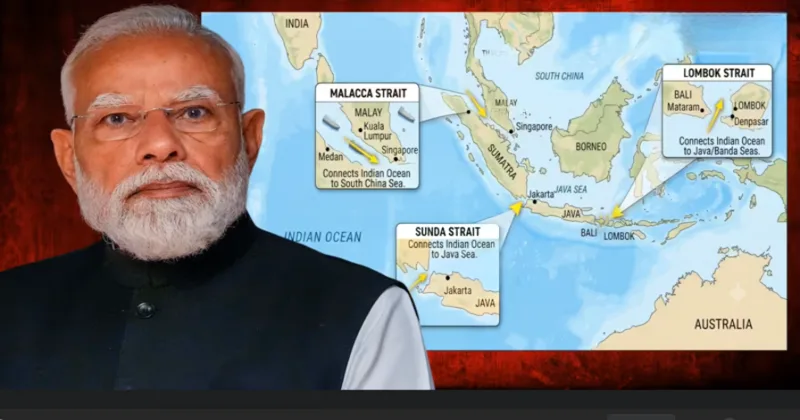
When Prime Minister Narendra Modi touched down in Jakarta on July 6 for a three-day visit, the headlines that followed spoke of trade figures, cultural ties and the usual diplomatic pleasantries that accompany any high-level state visit. But tucked inside the joint statements and the string of agreements signed at the Merdeka Palace was something far more consequential than routine bilateral bonhomie. India and Indonesia have quietly agreed to jointly develop Sabang Port on Weh Island, off the northern tip of Sumatra, a decision that, when read alongside India’s own Great Nicobar project barely 150 kilometres away, amounts to nothing less than a pincer movement around the northern mouth of the Strait of Malacca.
For those unfamiliar with the geography, the Strait of Malacca is the narrow, 800-kilometre channel between the Malay Peninsula and the Indonesian island of Sumatra through which an extraordinary volume of global trade passes every single day. More than a hundred thousand vessels transited the strait in 2025 alone. It is the shortest sea route linking the Indian Ocean to the Pacific and for China in particular, it is the umbilical cord through which the bulk of its energy imports flow. Chinese strategists have had a name for this vulnerability for two decades now the “Malacca dilemma”, a phrase that gained currency during Hu Jintao’s presidency and has haunted Beijing’s naval planners ever since.
India appears to have decided that the time has come to press on that vulnerability and it is doing so with a deliberate, two-pronged approach rather than a single grand gesture.
Two ports, One chokepoint
On the Indian side of the equation sits the Great Nicobar project, anchored by the Galathea Bay International Container Transhipment Terminal, along with a dual-use airport, a power plant and an entirely new township. The project cleared the National Green Tribunal in February this year and carries a price tag estimated at close to $9 billion. Its first phase is slated for completion by 2028. This is not a modest outpost; it is a full-fledged commercial and military foothold at the western gateway of the strait, built to capture a share of the container traffic that currently bypasses Indian shores entirely.
On the Indonesian side sits Sabang, a free port with a curious history of missed opportunities. Declared a free trade zone under Dutch colonial administration in 1896 and revived twice more by independent Indonesia in 1963 and again in 2000, Sabang has repeatedly failed to attract the shipping and investment that its extraordinary location would seem to guarantee.
That location is precisely what makes it valuable to New Delhi now: Sabang lies roughly seven hundred kilometres from India’s own Andaman and Nicobar Islands and barely 160 kilometres from the Great Nicobar project itself, overlooking the same northern entrance to the strait from the opposite bank.
Put the two together, and India acquires something it has never had before: a presence on both flanks of Malacca’s northern mouth at precisely the moment China’s navy is pushing deeper submarine and surface deployments into the Indian Ocean. Indonesian President Prabowo Subianto made the intent explicit when he stood beside Modi at the Merdeka Palace and voiced his support for developing ports at both Andaman and Nicobar and at Sabang, describing the pairing as a strategic link between the two island chains.
Missiles to match the maps
Ports alone do not close a chokepoint; the ability to enforce control over it does. This is where the defence component of the Jakarta visit becomes significant. Indonesia has now become the first foreign buyer of India’s indigenously developed Astra Mark 1 beyond-visual-range air-to-air missile, a weapon that proved itself during Operation Sindoor. Jakarta is also reportedly finalising a second BrahMos supersonic cruise missile battery worth roughly $300 million, building on the deal that already made Indonesia the second export customer for the missile after the Philippines.
Taken together, the ports and the missiles begin to look less like isolated transactions and more like the outline of what military planners would call an anti-access/area-denial architecture, a layered capability designed to observe, track, and, if necessary, deny freedom of movement to an adversary’s navy within a defined zone. With radar and surveillance assets watching both banks of the strait’s northern approach, and precision-strike missile systems fielded by a friendly neighbour on the western side, the strait’s chokepoint character is reinforced rather than diminished, only now with India holding a stronger hand.
A careful balancing act for Jakarta
It would be a mistake, however, to read this purely as an Indian project executed on Indonesian territory. Jakarta has its own reasons for wanting Sabang developed, and they are not exclusively about containing Beijing. Indonesia maintains a substantial and economically important relationship with China, reinforced through ASEAN frameworks and through Chinese-backed infrastructure such as the Jakarta-Bandung high-speed rail line. Indonesian officials have therefore been careful not to frame the Sabang partnership as a move directed against any third country, presenting it instead through the language of maritime domain awareness, disaster response, blue economy cooperation and port development.
There is also a genuine commercial logic in drama that has nothing to do with strategic rivalry. Indonesian port authorities have spoken of building Sabang into a broader “marine hub” combining transhipment where viable with bunkering services, cruise tourism and maritime logistics, a model that would let Sabang complement rather than compete with Great Nicobar’s container-heavy focus. For Indonesia, this represents a chance to finally realise value from a port that has sat underused for more than a century.
What Beijing sees
None of this framing will have escaped Chinese forecasters, who have for some time now watched India’s Andaman ambitions and its outreach to Sabang with unease. Reading Great Nicobar and Sabang together as a coordinated squeeze on the strait’s northern gateway is not a difficult inference to draw, whatever diplomatic language surrounds the announcements. For a navy that has spent two decades trying to reduce its dependence on a single narrow channel controlled at both ends by countries outside its immediate influence, the sight of India cementing infrastructure and firepower on both banks of that channel is unlikely to be reassuring.
Whether this dual-port strategy delivers the strategic payoff New Delhi is hoping for will depend on execution as much as intent. Great Nicobar’s first phase is still two years away. The Sabang agreement, while politically significant, remains at an early stage and the missile deals, as some Indian officials have themselves conceded, could yet slip in timeline. Ambition and delivery, after all, are rarely the same thing in South Asian defence diplomacy.
But intent matters too, and the intent on display in Jakarta this week was unmistakable. Nearly seventy years after Bandung’s spirit of anti-colonial solidarity first brought India and Indonesia together, the two nations are now writing a very different chapter of their partnership, one measured not in speeches, but in ports, radars and missile batteries positioned along one of the most contested waterways on earth.