
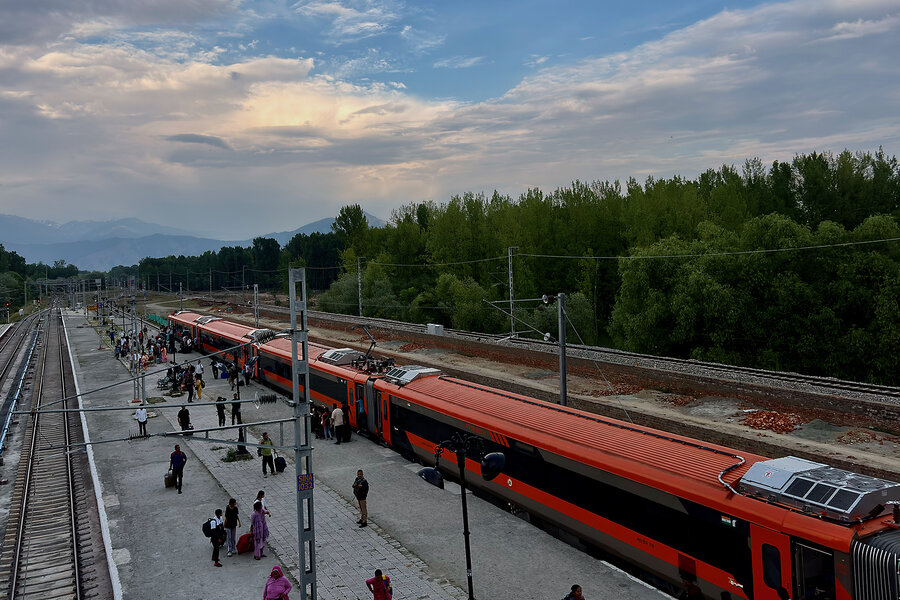
As morning rain gave way to a humid afternoon in Jammu, India, the city’s historic train station came to life with the familiar bustle of a South Asian transit hub. But its new concourse was more subdued.
Passengers bound north for Kashmir had to cross an overhead bridge and pass through a second round of security to reach the new platform, which opened in April and still smelled of fresh concrete and marble. Bags were re-screened. Identities verified again. A half-hour before the 1:20 train announced itself with a long baritone whistle, soldiers and police personnel armed with automatic rifles fanned across the platform.
“This train is very special and very sensitive,” a masked soldier told a passenger who appeared surprised – and perhaps a bit disgruntled – by the heightened security. “We make sure it is the safest one, too.”
Why We Wrote This
Many countries have used infrastructure to bind disputed frontier regions more tightly to the national core. In India, a Monitor writer’s awe-inspiring train ride through the Himalayas reveals a region at a political and social crossroads.
The station is part of a decades-long effort to carve a corridor through the Himalayas and connect the disputed region of Kashmir to India’s national rail network. Hailed as one of the world’s most ambitious railway projects, the Udhampur-Srinagar-Baramulla line threads through dozens of tunnels and across bridges spanning deep mountain gorges, overcoming terrain that left Kashmir largely isolated for centuries. Inaugurated last June, the 170-mile railway now provides Delhi year-round connectivity to a strategically important border region – and one with a well-documented demand for independence.
The train’s first year in operation has underscored the complicated feeling Kashmiris have toward the project. As more stations are added and upgraded, the train promises to bring greater prosperity to the region. But it also reflects Delhi’s broader push to bind Kashmir more closely to the Indian mainland – similar, some analysts have noted, to China’s railway expansion into Tibet.
Prime Minister Narendra Modi described the railway last year as “a huge celebration of India’s unity and India’s willpower.”

Access to Kashmir
At the station, passengers raised their phones to film the arrival of the orange-and-black Vande Bharat, Indian Railways’ premium train service. Black-clad soldiers boarded first, moving methodically through the emptied coaches with handheld scanners.
Kashmir’s disputed status has made it one of the most militarized places in the world. After the first India-Pakistan war, a U.N. ceasefire divided the majority-Muslim region between the rival nations, on the condition that the people of Kashmir would eventually be allowed to vote on which country – if any – they wanted to be part of. That vote never happened.
Today, India and Pakistan both claim the region in full, and periodic militant attacks and waves of anti-India protests continue to keep Kashmir in global headlines.
But it’s not the only thing the region is known for. Indeed, with its alpine landscape, unique culture, and relative isolation, Kashmir has loomed large in Indians’ imaginations. When this railway first opened, there was a clamor to obtain tickets.
Kamran Ashraf, an education entrepreneur from Delhi who remembers visiting Kashmir with his family as a teenager, hoped to be among the train’s first passengers. It took him a year to nab a spot.

“I eventually had to ask a member of Parliament to help me get a reservation,” he says. “That’s how much excitement there was.”
That excitement was visible throughout the train. Unlike conventional long-distance trains with sleeper berths, the Vande Bharat’s coaches are arranged with rows of reclining seats and large windows. Like Mr. Ashraf, many passengers were tourists from India’s plains. They remained glued to the windows as the train plunged through tunnel after tunnel – one stretching nearly 8 miles – before emerging onto bridges suspended above deep Himalayan gorges.
An announcement alerted passengers as the train approached the Chenab Bridge, an engineering landmark rising 1,178 feet above the river below – nearly 100 feet higher than the Eiffel Tower.
Rahul Gorka, a surgeon from neighboring Jammu, says the workers who spent years blasting through the region’s rugged Pir Panjal mountain range “are the unsung heroes of this project.”
Until last year, traveling from Jammu into Kashmir was dependent on a single mountain highway vulnerable to heavy precipitation and periodic security restrictions. During snowy winters, the road can remain closed for weeks, and on a rainy day like this one, landslides can block the highway without warning.
“I wouldn’t have dared make this journey by road,” says Dr. Gorka, pausing over a bowl of soup served at his seat.
“Skepticism and suspicion”
For Kashmiris, this lifeline has been accompanied by a profound political transformation. Some see the railway as part of a broader effort to forcefully integrate Kashmir into India, which began in 2019 when Delhi unilaterally revoked the state’s limited autonomy. This constitutional change was followed by a monthslong communication blackout, the detention of local political leaders and journalists, and several new laws that made it easier for outsiders to take up residence within the valley.
As the train pulls into Srinagar, Kashmir’s capital and a hotbed of the 2019 unrest, Abdul Rasheed Mir is waiting for a local train to his hometown of Qazigund. Thanks to the new rail project, a journey that once meant an uncertain day on mountain roads takes only a few hours.
“The train has brought relief,” Mr. Mir says. “But we cannot forget that there is conflict, and people have genuine skepticism and suspicion.”
To be sure, many Kashmiris acknowledge the railway’s benefits: The line is expected to speed the movement of freight, including apples, Kashmir’s most important horticultural crop, connecting growers more directly with markets across India and reducing transport costs and spoilage. This year, 20,000 metric tons of apples were moved via the train, and goods like cars and cement were ferried into the region.
Yet this infrastructure push has done little to address a deep sense of political disenfranchisement within the region, and tensions between India and Pakistan remain high. The nuclear-armed neighbors have fought several wars over Kashmir, and came close to yet another military confrontation just last year, after militants killed 26 tourists in Indian-administered Kashmir.
On board, reminders of the region’s troubles were never far away.
Railway officials have equipped locomotive pilots with protective gear, while armed security personnel patrol the train and guard stations along the line. As they moved through the coaches, soldiers occasionally paused to look out at the passing countryside, which poet Amir Khusrow once described as a paradise on earth.
Mr. Mir says these kinds of contradictions – between tranquility and conflict, hope and fear, beauty and violence – have long defined Kashmir.
“There is nothing wrong with the train itself,” he says, rolling past orchards and shimmering rice fields in the fading evening light. “But in a place like Kashmir, even a railway cannot be separated from politics.”