
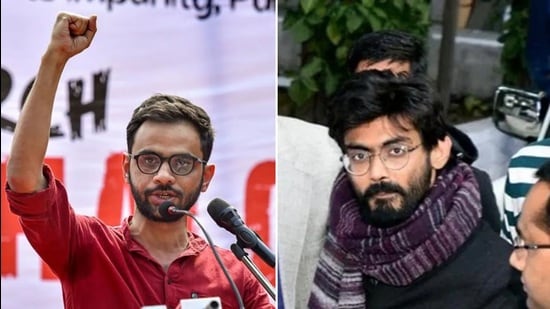
A Delhi court on Saturday dismissed the bail applications filed by student activists Umar Khalid and Sharjeel Imam in the larger conspiracy case linked to the February 2020 Delhi riots, holding that there were no grounds to “entertain” the fresh plea as it could not even examine whether circumstances had changed since the Supreme Court rejected their pleas in January.

The order was passed by additional sessions judge Sameer Bajpai of the Karkardooma Courts.
The court held that there were no grounds to entertain the applications in view of the Supreme Court’s January 5 order refusing bail to both accused and laying down specific conditions under which they could revive their pleas.
ASJ Bajpai observed that the divergence of opinion between the January 5 Supreme Court judgment in the Gulfisha Fatima case and the subsequent ruling in the case involving Syed Iftikhar Andrabi had already been referred to a larger bench of the apex court. Until that issue is settled, the trial court said, it could not consider the fresh applications on any ground.
Khalid and Imam, in their pleas moved in June, had argued that there had been a change in circumstances following a May 18 judgment by a Supreme Court bench of justices BV Nagarathna and Ujjal Bhuyan while granting bail to Andrabi in a narco-terror case investigated by the National Investigation Agency.
In that case, the Supreme Court had expressed “serious reservations” about the reasoning adopted in the January 5 ruling and observed that it may not have correctly applied the principles laid down in the 2021 judgment in Union of India vs KA Najeeb, which recognised that prolonged incarceration and delay in trial can override the statutory restrictions on bail contained in Section 43D(5) of the Unlawful Activities (Prevention) Act.
The apex court had also expressed reservations regarding the January 5 direction that Khalid and Imam could renew their pleas only after the examination of protected witnesses or after one year, whichever was earlier.
However, ASJ Bajpai held that the trial court was bound by the earlier Supreme Court order.
It noted that the apex court had specifically held that the two accused would be at liberty to renew their prayer for bail only after the completion of the examination of protected witnesses relied upon by the prosecution or upon the expiry of one year from the date of the order, whichever occurred earlier.
“Thus, following the said order of the Hon’ble Supreme Court, this court cannot entertain the applications and grant bail to the applicants. In fact, the applications are not maintainable and they are hereby dismissed,” the court noted.
The Delhi Police had opposed the pleas, arguing that there was no change in circumstances and that both Khalid and Imam occupied roles in the alleged conspiracy that were distinct from those of other co-accused who had secured bail.
Opposing Khalid’s application, the prosecution argued that the alleged change in circumstances relied upon by him did not amount to a substantial or material development warranting reconsideration of bail. “Successive bail applications are maintainable only upon demonstration of a substantial and material change in circumstances. No such change has occurred after dismissal of the applicant’s special leave petition and review petition,” the prosecutor submitted.
The prosecutor argued that Khalid’s reliance on certain subsequent judgements and observations made in other cases did not constitute a change in circumstance. It contended that the trial court could not effectively review or sit in appeal over the Supreme Court’s January 5 judgment.
Arguing on merits, the prosecution submitted that the allegations against Khalid were grave and related to an alleged larger conspiracy that culminated in large-scale communal violence in northeast Delhi.
It said multiple courts had already found the statutory restrictions under Section 43D(5) of the UAPA applicable to Khalid’s case. “The prosecution evidence is extensive and includes protected witnesses and electronic evidence. The possibility of influencing witnesses, directly or indirectly, cannot be ignored,” the prosecutor argued.
Opposing Imam’s plea, the prosecution said the Supreme Court had already held in January that he occupied a “distinct, senior and primary role of ideological and strategic centrality” in the alleged conspiracy. On that basis, it argued, Imam could not claim parity with co-accused persons who had been granted bail.
The prosecution further submitted that the Supreme Court had, after examining the chargesheet and electronic evidence, already concluded that the accusations against him were prima facie true.
“The statutory embargo under Section 43D(5) operates with absolute rigour and completely strips the court of any residual discretion to grant bail,” the prosecutor submitted.
The prosecutor also argued that Imam’s heavy reliance on an interim order passed by the Supreme Court on May 22 in the case of Tasleem Ahmed was misplaced because a reference to a larger bench does not amount to a declaration of law under Article 141 of the Constitution.
The prosecution further argued that Imam’s contention that he had been arrested in another case on January 28, 2020, and was therefore not physically present in Delhi during the riots in February that year had already been considered and rejected by the apex court.
“The applicant commands a vast network of student activists and radicalised cadres; his release at this vulnerable pre-charge stage will fatally compromise witness safety, induce systemic intimidation and completely derail the fairness of the impending trial,” the prosecution argued.