
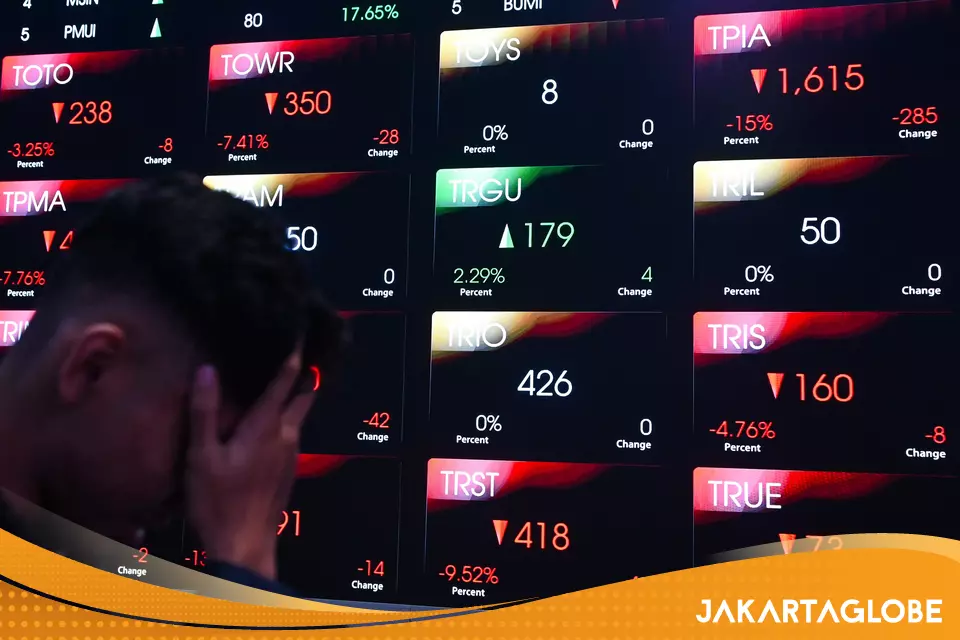
Jakarta. Indonesian stocks extended their decline this week, with the benchmark index and market value edging lower as persistent foreign selling and concerns over inflation outweighed improving global risk sentiment.
The Jakarta Composite Index (JCI) fell 0.35% to 5,875.78 in the week ended July 3, while the Indonesia Stock Exchange’s market capitalization slipped 0.14% to Rp 10.3 quadrillion ($572 billion), exchange data showed.
The latest losses add to a steep selloff this year. After reaching a record 9,134 in January, the JCI has plunged more than 30%, wiping out about Rp 6.5 quadrillion in market value and allowing Singapore to overtake Indonesia as Southeast Asia’s largest equity market.
Foreign investors were modest net buyers of Rp 6.08 billion on Friday, but remained net sellers by Rp 74.42 trillion so far this year, underscoring continued caution toward Indonesian assets despite signs of stabilization in global markets.
ADVERTISEMENT
Brokerage Pilarmas Investindo Sekuritas said investor sentiment improved after Qatar reported progress in US-Iran peace negotiations, easing concerns over disruptions to oil shipments through the Strait of Hormuz. Crude prices have retreated toward pre-conflict levels, reducing fears of renewed inflation and easing pressure on energy-importing economies such as Indonesia.
Markets also drew support from weaker-than-expected US labor market data, which strengthened expectations that the Federal Reserve will refrain from further tightening monetary policy in the near term. US nonfarm payrolls increased by just 57,000 jobs in June, well below economists’ forecasts of 110,000, while the unemployment rate unexpectedly declined to 4.2%.
Domestically, investors welcomed a preliminary agreement between the government and Parliament on the framework for the 2027 state budget. The government is targeting state revenue of 12.01% to 12.4% of gross domestic product, with spending set at 13.82% to 14.2% of GDP, implying a fiscal deficit of 1.8% to 2.2% of GDP.
Lower global oil prices could also ease pressure on Indonesia’s fiscal position by reducing fuel subsidy costs and creating room for lower prices of non-subsidized fuels.
Still, macroeconomic headwinds continue to cloud the market outlook.
Indonesia posted a $1.61 billion trade deficit in May, ending a six-year run of monthly trade surpluses as elevated oil prices pushed up import costs. The deficit followed a sharply narrower surplus of just $89.1 million in April.
Inflation also accelerated faster than expected. Consumer prices rose 3.34% in June from a year earlier, while monthly inflation reached 0.44%, driven by higher non-subsidized fuel prices and increased airfares during the school holiday season.
The pickup in inflation has fueled expectations that Bank Indonesia may tighten policy further after already raising its benchmark interest rate by a cumulative 100 basis points since May to 5.75% in an effort to stabilize the rupiah and stem capital outflows.
Bank Permata said rising import costs and production expenses are increasing the likelihood of another rate increase later this year if inflationary pressures persist.
Tags:
Keywords: