
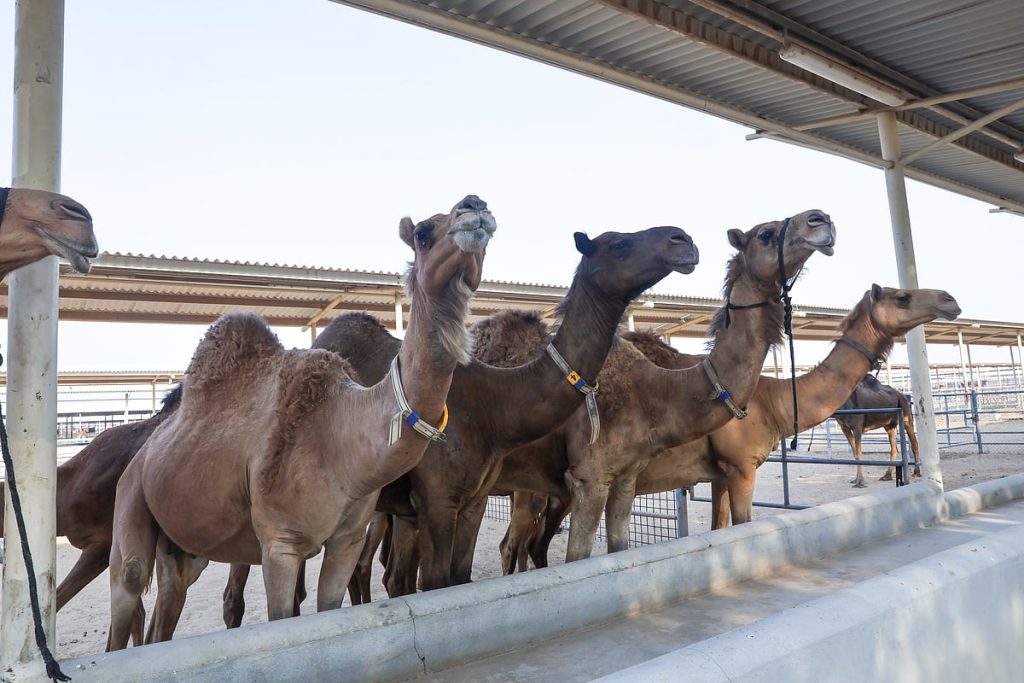
Watching those reunions unfold was unexpectedly moving. In an operation of this scale, I had anticipated efficiency. Instead, I found tenderness.
That same sense of care seemed to run through every part of the farm. Each paddock has a designated capacity to prevent overcrowding, every camel carries an identification tag containing its complete medical and production history, and welfare isn’t treated as a fashionable buzzword but as part of the daily routine.
“Animal welfare is a huge priority,” Hesham told me. “It comes from every perspective — feed, medicine, water, walking and showering.”
Another surprise awaited around the next corner.
Many of the people feeding the camels, caring for pregnant animals and looking after newborn calves were women.
“So this is women empowerment, baby?” I joked.
Looking around, I wasn’t entirely wrong. The female camels are the backbone of the farm, carefully cared for through every stage—from pregnancy and lactation to motherhood—while the males are few and far between.
It was one of those details that probably wouldn’t appear in a brochure but stayed with me long after I left.
Towards the end of the tour, Hesham insisted on introducing me to one final resident.
Standing proudly in his own paddock was the farm’s prized breeding male.
“This is our superhero,” Hesham said.
There was no arguing with that description. Towering over the fence with an air of complete confidence, he looked every bit the king of the herd. I offered him a carrot, convinced we’d end the morning on friendly terms.
He ignored me entirely.
Perhaps celebrities really are the same everywhere.
As we wrapped up the tour, I realised none of the questions I’d arrived with had prepared me for what I was actually taking home.
Yes, camels are bathed every month. No, they don’t spend their days spitting at visitors. Their eyelashes really are every bit as magnificent as they look.